African Martial Arts Belong in World History
African martial arts include systems of wrestling, boxing, stick and blade work, mounted combat, strategic movement, dance-combat, body conditioning, initiation, and community defense. They developed across many peoples and regions, so there is no single "African martial art." What unites them is not one uniform technique but a civilizational field in which physical training carried ethics, history, social responsibility, and often sacred meaning.
The site does not claim that every martial art in the world began in Africa. It does hold that African societies developed deep and wide martial sciences long before many later societies entered the connected routes of trade, migration, warfare, and diaspora. People carry weapons, drills, skills, and warrior organization when they move. African peoples forged weapons and maintained sword, spear, knife, staff, wrestling, striking, and boxing traditions across vast stretches of time; they also formed warrior associations and organized military institutions long before the later European traditions usually centered in popular martial-arts history.
Nile Valley states, including Kemet and Nubia, recorded military offices, armies, strategic defense, and professionalized martial service. In the Ancestral Egbé reading, the Myriniad—a ten-thousand-person military unit associated with Queen Myrina, the Libyan Amazon warrior—preserves an additional memory of African large-scale military organization. Read Black Amazons: Queen Myrina, Libya, Troy, and African Warrior Women for the full Myrina evidence and doctrine context.
The phrase stolen legacy names the historical pattern in which African martial contribution is minimized, separated from its cultural roots, or remembered only after it has been repackaged under another nation’s name. Restoring the legacy means giving African practitioners, teachers, lineages, and historical memory their proper place in the record.
Combat, Culture, and Formation
In many African and African-diaspora systems, training is more than a contest of force. It can develop timing, deception, balance, courage, musical intelligence, emotional regulation, communal discipline, and the responsibility to protect others. That is why fighting, drumming, dance, healing, religious life, and education can appear together without becoming the same thing.
This larger model remains visible in African-centered martial teaching. The Mfundishi is not merely a coach of blows and defenses. The title names the teacher whose responsibility includes skill, character, memory, and service.
Capoeira, Engolo, and the Atlantic Continuity
Capoeira is a major Afro-Brazilian martial practice: a fight and dance performed in a circle with music, song, clapping, and disciplined movement. UNESCO identifies it as an Afro-Brazilian cultural practice, while its Valongo Wharf material records strong Congo-Angola influence in both movement and instruments. This is not a vague similarity. It is a documented African diasporic continuity shaped further in Brazil under enslavement, resistance, and community survival.
Scholars of Central African combat history, including T. J. Desch-Obi, have examined connections among capoeira, Angolan engolo, inversion, ancestral-world symbolism, and Atlantic martial development. The Kongo language of Kalunga, Mfumbi, nganga, and capoeira gives this movement a cosmological dimension: the body can carry memory of the living-dead boundary as well as practical fighting intelligence.
Kemet, Nubia, and Warrior Memory
Kemet and Nubia belong inside African martial history, not outside it. Ancient Nile Valley states maintained armies, border defenses, military offices, weapons traditions, and cultures of valor. The military evidence does not turn all later martial arts into Egyptian copies; it establishes that Africa’s historical record includes organized combat, strategic training, and honored warrior service on its own terms.
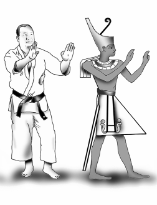
Within Ancestral Egbé doctrine, this Nile Valley field also opens a deeper inquiry into disciplined breath, attention, solar cultivation, animal forms, and warrior ethics. The Kemetic Ashram develops the inward practice side: body, breath, concentration, self-command, and the gradual refinement of force. Its comparative links to later Asian practice are a lineage inquiry, not a license to erase either African or Asian traditions.
Pankration, Black Sparta, and the Mediterranean Question
Pankration was an ancient Greek combat sport combining boxing and wrestling. The British Museum describes it as a mixture of the two in which almost any tactic was allowed, with limited prohibitions. It belongs to the historical martial world of Greece and should be understood precisely as such.
Its relevance here is Mediterranean context. Africa, Kemet, Nubia, the Levant, Greece, and the wider sea world were connected through exchange, warfare, travel, trade, sacred practice, and artistic contact. The Black Sparta and African Greece article examines that African-connected Mediterranean field and challenges the later fantasy that Greece existed in a sealed, purely white European world. African presence in Greek art and the Hellenistic world is also materially documented by the Metropolitan Museum of Art.
African Roots and Asian Martial Traditions
The Ancestral Egbé research tradition holds that African sacred, martial, linguistic, and cultural currents moved along the Indian Ocean, Mediterranean, Atlantic, and diaspora routes and carried substantive martial knowledge into many later traditions. This includes southern and Southeast Asian cultural history, Indonesia, the Caribbean, South America, and the old American South. African inheritance and influence were vast, not marginal.
Within this doctrine, early southern Chinese cultures include African dark peoples, and some ancestralized or deified figures from those cultures preserve that inheritance. This article records the Black Chinese position as part of the larger martial-history frame; the full evidence argument belongs in its own dedicated study.
African martial traditions are a central source for this connected history: their weapon traditions, body disciplines, warrior organization, sacred practice, and cultural survival traveled with people and remained active in the places where African peoples settled. For the site’s Kemetic-to-Buddhist lineage reading, continue to Buddhism in the Kemetic Ashram and Kemetic Fa and Divine Mathematics.
Ansar the Great and Ethiopian Knightly Chivalry
The Ethiopian knightly-chivalry current belongs in this martial map. In public historical catalogs, the figure is commonly named ʿAntarah ibn Shaddād, also rendered Antar or Antara; in Ancestral Egbé teaching this draft preserves the name Ansar the Great. He was born into enslaved status through his Ethiopian mother, Zabībah, then became a military man and rose through warrior ranks by demonstrated courage, horsemanship, weapon skill, leadership, and poetry.
His history makes the African dimension impossible to treat as background. Ansar’s life stands at the meeting point of Ethiopia, Arabia, racialized bondage, martial service, freedom, and honor. The later Arab chivalric epic carried his warrior image forward, but the foundational memory is already clear: an Ethiopian-born enslaved man became a major military and poetic figure rather than remaining in the social position imposed upon him.
This history also belongs beside the longer Arab and East African slave-trade record. It does not reduce Ansar to that later history; it shows that African captivity, resistance, mobility, and distinction in the Red Sea and Arabian worlds form an older and continuing historical field. Read the developing study, Ansar the Great: Ethiopian Knightly Chivalry and the African Warrior Tradition, for the draft source map and the material still being added from owner-held research.
Why Recovery Matters Now
Recovering African martial arts is not about claiming every fighting method in the world. It is about ending the habit of treating African people as the raw material of history while crediting disciplined knowledge, strategy, spiritual practice, and civilization only after those things are renamed elsewhere.
A living martial legacy asks more of us than pride. It asks for disciplined bodies, clear minds, ethical teachers, historical study, community protection, and respect for the specific people who carried their arts forward.
Sources and Further Study
- UNESCO: Capoeira Circle
- UNESCO World Heritage Centre: Valongo Wharf and capoeira’s Congo-Angola influence
- T. J. Desch-Obi, Fighting for Honor: The History of African Martial Arts in the Atlantic World
- British Museum: Ancient Greek combat sports and pankration
- Metropolitan Museum of Art: Africans in Ancient Greek Art
- Metropolitan Museum of Art: In Honor of Pharaoh’s Fighters
- African Union Library: Race in Pre-Islamic Poetry—Antara Ibn Shaddad
- HM NebShakara, Chapter One (unpublished manuscript and research bibliography), consulted as an author-held source for the article’s African martial-culture and Black Chinese comparative framework.