Start Here
This is not a manual. It is a Pan-African spiritual and religious thesis statement. It argues that names such as Amun, Amen, Amma, Olokun, and Aum/Om should not be treated as isolated coincidences or as simple etymological curiosities. They belong to a wider Pan-African current of Black creator theology: hidden divinity, deep water, primordial vibration, sacred utterance, and the dark foundational source behind humanity and creation.
The article is written as a doctrine position. Citations will continue to be strengthened, especially around Amun, Black creator theology, sacred sound, and Kemetic priestly language. The deeper issue is that cultural-priestly knowledge, tonal language, and living African religious interpretation do not always fit neatly into European academic categories.
How This Thesis Connects the Web
This article is a flagship position statement because it gathers several lines of the Ancestral Egbe teaching system into one argument. The Pan-African model is not one isolated culture pretending to be the whole. It is a web of interconnection: Yoruba language and Ori discipline, Kemetic hidden divinity, Olokun and deep-water memory, Kongo cosmology, Sahelian sacred architecture, Buddhist/Aum resonance, and the diaspora's need to recover a language of sacred Black humanity.
Language Is Sacred Technology
Across African and African-adjacent sacred systems, sound is not merely decoration. Sound carries force. Names are not only labels. Names can be doors, keys, masks, invocations, and veils. A divine name may have a mundane form used in ordinary speech and a sacred form used in ritualized or elevated utterance.
This is central to the argument around Amun. In a mundane frame, the name can be read as a name of a deity. In a priestly or divine frame, the same consonantal body can be sounded differently, elevated differently, and carried as a sacred utterance. The issue is not only spelling. It is tone, breath, context, power, and determinative meaning.
Another way to say it is this: a sacred name can function as a label, and it can also function as invocation. The label identifies the deity or principle. The invocation activates, calls, praises, or enters relationship with that principle. This pattern is standard in the study of Kemetic deities because deities are not only personalities. They are abstractions of principles, forces, processes, and natural-spiritual realities.
Once that is understood, related divine names do not have to be treated as either identical or unrelated. They can carry a core unity while producing different shades of meaning through consonant shifts, vowel changes, tone, breath, and ritual context. This can be seen in Yoruba. It can be seen in Kemetic language. This article is arguing that a similar process may be operating around Amun, Amen, Amma, Aum/Om, Okun, and Olokun: related sound-forms circling meanings of depth, vibration, hiddenness, waterness, and under-water mystery.
That principle is not foreign to African languages. Yoruba already teaches that tone changes meaning. Kemetic writing also uses determinatives to clarify class, force, divinity, action, personhood, and spiritual category. When later scholars remove the tonal and cultural logic, they often mistake one sacred pattern for separate unrelated words, or they flatten living African language structure into a dead museum object.
Why Yoruba Language Study Matters Here
Yoruba language learning is part of this path because it trains the ear to understand what many outside scholars miss. In a tonal African language, a word is not only a sequence of consonants and vowels. Tone, length, breath, and context can shift meaning. When those elements are ignored, the interpretation can become clumsy even when the spelling looks correct.
This is similar to examples often given from classical Chinese, where the same romanized syllable can represent multiple meanings depending on tone. The point is not that Yoruba and Chinese are the same. The point is that tonal language requires tonal intelligence. If a scholar lacks that intelligence, sacred African language can be misread, over-separated, or forced into a foreign model.
For this reason, the argument around Amun, Amen, Amma, Olokun, and Om should not be separated from language recovery. A person who studies Yoruba begins to understand why sacred utterance, praise name, sound shift, and ritual pronunciation are not secondary details. They are part of the structure of meaning itself.
Study why Yoruba language matters and continue into Reclaim Yoruba as an Ancestral Language of Power.
Oko: A Small Word with Big Consequences
A useful teaching example is the Yoruba word pattern often flattened in English writing as oko. Depending on tone, vowel quality, dialect, and context, related written forms can point toward very different meanings. The printed letters alone do not carry the whole meaning. The sound-body of the word must be heard correctly.
| Yoruba form | Teaching meaning | Why it matters |
|---|---|---|
| oko | farm / farmland | Shows how a plain written form can point toward land and cultivation. |
| okó | sexual organ / phallus | A tonal shift can move the meaning into adult or fertility language. |
| ọkọ | husband | The underdotted vowel changes the sound-body and the social meaning. |
| ọkọ́ | hoe / farming implement | This is the “work the land” meaning, not a spouse or deity. |
| ọ̀kọ̀ | spear / lance; phallic force by association | Low tones on the underdotted vowels shift the meaning into weapon language, which can also carry a phallic/fertility association. |
| Ọkọ̀ | vehicle / conveyance | Another tone changes the word again into a transport idea. |
| Òrìṣà Oko | the deity of farming, fertility, and agriculture | In ritual speech, the deity must not be reduced to a flat English spelling. |
This table is a teaching model. Yoruba tone marking can vary by dialect, source, and orthographic convention, so a living teacher or fluent speaker should be consulted for ceremonial use.
This is not a minor academic issue. A person who does not hear the tones can say the wrong thing in a family setting and appear to be talking about a wife's husband while actually sounding like they are referring to her sexual organ. In ritual language, the mistake can become even worse: one could intend to name a deity and instead sound as if they are talking about farming, raking the earth, or some other completely misplaced action.
The humor is real, but the lesson is serious. Tonal language is not optional decoration. Tone protects meaning. Tone protects respect. Tone protects theology. Without tonal understanding, African sacred language gets misread from the inside out.
This is the doorway into the Amun, Amen, Amma, Aum, and Okun argument. If a small everyday Yoruba word can shift so dramatically through tone, vowel quality, and context, then sacred African names cannot be responsibly interpreted by spelling alone. The same discipline required for oko becomes even more necessary when the subject is divine names, hidden names, water signs, and priestly utterance.
Amun, Amen, and the Hidden Name
Once the reader understands the Oko lesson, the sacred-name argument becomes easier to see. The question is not whether every similar sound is automatically the same word. The question is whether related sacred systems may preserve a shared structure of meaning through hiddenness, depth, breath, water, vibration, and protected pronunciation.
Amun is commonly explained as the hidden one. That reading matters. The hidden name is not only a theological idea. It belongs to a larger sacred technology: the name as a concealed force, the name as vibration, and the name as a controlled point of access to divine presence.
From this perspective, later traditions of the unpronounceable or secret divine name in Hebrew religion can be read as part of a wider Afro-Asiatic and African priestly inheritance, not as an isolated invention. The consonants remain stable, while the sacred vocalization is guarded, altered, or restricted. What later becomes framed as a secret name tradition may also preserve older African-language logic: consonantal structure, sacred breath, tonal distinction, and ritualized utterance.
This does not mean every later use is identical to the Kemetic source. Time, geography, conquest, translation, priesthood, and politics all change language. But the pattern is important enough to be studied seriously.
In the devotional language of this tradition, Amun is also approached as a force that brings contrition, silence, and inward surrender. The hidden one is not merely hidden because scholars cannot see him. The hidden one is hidden because deep divinity is approached through breath, reverence, vibration, and inner quiet.
Amma, Olokun, and Deep Primordial Force
Amma, in Dogon cosmology, points toward the hidden creative principle. The supporting Dogon material describes Amma as the creator who holds the world firm, a force that carries both male and female principles and is therefore better understood as dual-gender or beyond ordinary gender. Amma is also associated with hidden smallness, potentiality, the cosmic egg, spiral movement, and the release of creation into form.
Olokun, in Yoruba and related Atlantic traditions, holds the deep: oceanic mystery, wealth, depth, memory, the unseen, the unmeasured, and the forces below ordinary sight. The name itself can be opened as Oló plus Okun: the owner or possessor of Okun, the ocean, the deep, the great water. Once the Yoruba personifying prefix is set aside for analysis, the core concept is Okun: depth, ocean, under-water mystery.
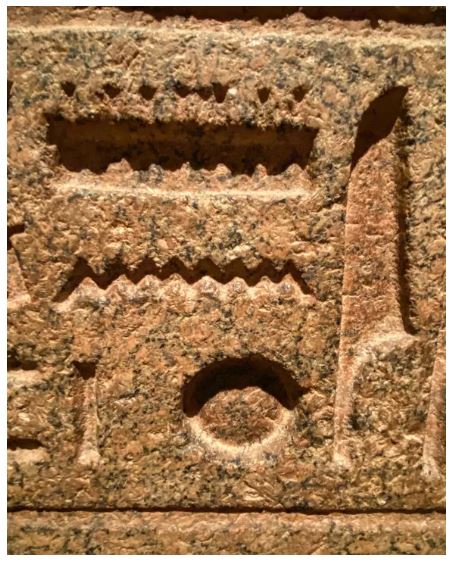
This makes Olokun more important to the Amun/Amu thesis than a surface comparison would suggest. Amun is the hidden one. Amu can be read in the direction of hiddenness, underness, depth, and the concealed foundation. In Kemetic sign logic, the wave/water imagery associated with this sign cluster points toward what is below, hidden, and difficult to see directly. In Yoruba, Okun carries the same spiritual weight of depth and oceanic concealment. The thesis here is not that Yoruba simply copied Kemet in a flat way. The thesis is that related African sacred-language patterns may preserve the same deep concept through different local forms: Amun/Amu as hidden depth and Okun/Olokun as the owner or force of the deep.
This argument is also supported by cultural structure, not language alone. The article Pyramids in West Africa & the Sahelian Tradition shows that West Africa, the Sahel, and the Nile Valley share more than scattered words. They preserve related architectural, ancestral, royal, and sacred concepts. The pyramid, tumulus, mound, shrine, and deep-water symbol all point toward a larger civilizational conversation where form, ritual, burial, ancestor power, and divine ascent belong to the same African logic.
There are also African-centered linguistic arguments comparing Kemetic and Yoruba language patterns, including work associated with Yoruba scholarly circles and Obafemi Awolowo University. Those arguments need careful citation review, but they help explain why this article treats Amun, Okun, and Olokun as part of a larger African sacred-language conversation rather than as isolated names.
| Form / name | Language or tradition frame | Core concept | How it supports the thesis |
|---|---|---|---|
| Amun / Amon | Kemetic / Nile Valley divine name | Hidden one; concealed divinity; breath and deep inward presence | Provides the central hidden-depth current that the article is tracking. |
| Amen | Later religious and liturgical form | Seal, affirmation, and sacred-name remnant | Shows how a divine-name current can survive as a ritual closing word or sacred title. |
| Amma / Amen | Dogon and wider West African creator-language frame | Hidden creator; cosmic egg; dual-gender creative principle | Extends the hidden creative principle into West African cosmology. |
| Aum / Om | Sacred sound / mantra frame | Primordial vibration; breath-sound; meditative resonance | Aum is a closer sound bridge to Amun/Amon than the shortened English spelling Om. |
| Oló + Okun | Yoruba name structure | Owner or possessor of Okun: ocean, depth, deep water | When the personifying prefix is set aside, Okun becomes the depth/ocean concept that can be compared to hidden-under-water Amun/Amu imagery. |
| Medu Neter water signs (aka "hieroglyphs," a Greek word) | Kemetic writing and determinative logic | Wave/water imagery; what is below, hidden, deep, or concealed | Shows that the hidden/deep concept is not only sound-based; it is also carried visually through Kemetic sign logic. |
Om, in South Asian sacred sound traditions, is treated as primordial vibration and sacred utterance.
The thesis does not require pretending these traditions are the same religion. They are not. The stronger argument is that African creator theology, sacred language, Nile Valley priestly systems, West African deep-water metaphysics, and wider ancient-world sound traditions all preserve a serious idea: creation, depth, divinity, and sound are related.
For Pan-African spiritual study, this matters because the African world is often treated as fragmented and local, while Indo-European or Semitic traditions are treated as universal. That is a political habit, not a neutral scholarly truth.
Hesi, Hekau, and Mantra
The supporting devotional material gives an important distinction. In ancient Kemetic language, hesi can be understood as devotional song: praise, adoration, and sacred singing to a divine principle. Hekau, often reduced in English to "magic," is better understood here as words of power, ritual utterance, and creative speech-force.
This distinction helps explain the larger thesis. A sacred name may be sung as praise, but it may also be intoned as power. The deity's public name and the deity's sacred vibrational form do not function in the same way. The repeated, elevated, tonal, or breath-carried name becomes a key that opens the force of the principle.
That is why the Om/Amun question matters. Om is often written and sounded as Aum, and that form gives a much closer sound bridge to Amun/Amon than the shortened English spelling "Om" suggests. In this tradition, Om/Aum is taught as a reclaimed sacred sound related to Amun. This is a cultural-theological position that will continue to receive citation support, but it is not an empty speculation. It is a living interpretive practice built around breath, vibration, trance induction, cranial resonance, and the African sacred-name principle.
Yoruba practice offers a related but different example. Oriki are praise names, songs, and story-keys that invoke the identity and power of Orisha, ancestors, lineages, and spiritual forces. They are not usually treated as "mantras" in the same way, but they show the same African principle: name, tone, sound, praise, memory, and power are linked.
The Problem with European Models of African Language
Much of the academic treatment of Kemetic and African sacred language still carries the weight of white supremacist assumptions. African civilizations are often forced into models that minimize African continuity, detach Kemet from the rest of Africa, or interpret African priestly systems through Indo-European expectations.
This is especially dangerous with sacred language. A scholar who does not understand tonal African language, priestly utterance, ritual context, or living traditional practice may still be treated as more authoritative than the cultural experts who actually understand how names, tones, praise forms, and sacred speech operate.
The point is not to reject scholarship. The point is to read scholarship with discipline. Citation matters. Evidence matters. But the citation model itself can carry bias when it privileges European categories over African language logic and living priestly knowledge.
Citation Development Note
This article should be read as a position statement in development. The citation base will continue to grow around Amun, Kemetic divine names, sacred utterance, determinatives, Afro-Asiatic language debates, Dogon Amma, Yoruba Olokun, and comparative sacred sound traditions.
Some of the strongest evidence lives in cultural-priestly practice: how divine names are spoken, when they are not spoken, how tonal variation changes meaning, how praise names operate, and how ritual language marks sacred status. Those forms of knowledge do not always enter European academic citation systems cleanly. They still matter.
Initial Source Pathways
- Kemetic language and divinity: James P. Allen, Jan Assmann, Erik Hornung, Richard H. Wilkinson, Theophile Obenga, and Cheikh Anta Diop provide entry points into Egyptian language, religion, African continuity, and the politics of classification.
- Amun and hidden divinity: studies of Amun-Re, Theban theology, hiddenness, divine names, and priestly power provide the historical frame for the Amun/Amen layer.
- Dogon Amma: Marcel Griaule and Germaine Dieterlen remain unavoidable for Dogon cosmology, though their work must be read critically and alongside African-centered interpretation.
- Yoruba Olokun: William Bascom, Wande Abimbola, Henry Drewal, and Babatunde Lawal provide pathways into Yoruba religion, divination, deep-water symbolism, and sacred aesthetics.
- Sacred speech and practice: the internal devotional song and mantra material used in this teaching line distinguishes hesi, hekau, sacred name, praise name, and vibrational utterance as different but related modes of spiritual sound.
- Om and sacred sound: the Mandukya Upanishad and related Indian philosophical traditions provide a comparative sacred-sound reference, without collapsing it into African religion.
Why This Matters
The deeper issue is restoration. If African creator theology and sacred sound are misread, African divinity is misread. If African divinity is misread, African philosophy is misread. If African philosophy is misread, African people are taught to inherit someone else's explanation of their own spiritual ancestors.
This thesis is part of the larger Ancestral Egbe project: restoring African spiritual categories, correcting historical distortion, and giving the diaspora language strong enough to think with.
A Pan-African Black God/Goddess of Humanity
This is the final point of the thesis. The argument is not merely that Amun, Amen, Amma, Olokun, and Aum/Om are sacred sounds. The argument is that this constellation of sounds, images, and principles may preserve a Pan-African understanding of the Black God/Goddess of humanity: hidden, deep, womb-like, dark, echoing, vibrational, oceanic, affirming, and present before the later divisions of religion hardened into separate civilizational claims.
In this reading, Amun is not only a Kemetic deity. Amma is not only a Dogon creator principle. Olokun is not only a Yoruba deep-water force. Aum/Om is not only an Asian sacred sound. Amen is not only a closing word in church. They are related witnesses to an ancient spiritual grammar: the dark hidden source, the womb of creation, the sound that calls divinity into consciousness, the deep water beneath form, and the affirmation that seals sacred speech.
This is why the thesis can reach from dark-skinned melanated peoples across Southeast Asia and the Buddhist world, through sacred sound traditions, back across the Nile Valley, into ancient Kemet, through Yoruba deep-water spirituality, and across the Atlantic into the diaspora. The forms are not identical. The religions are not collapsed into one flat system. But beneath them is a recognizable Black spiritual memory: divinity as depth, vibration, darkness, water, womb, echo, and shepherding presence.
Stated plainly, this article posits a unified Pan-African Black God/Goddess in many forms: the hidden one, the deep one, the dark one, the womb of humanity, the sound before speech, the breath inside the name, the shepherding presence, and the sacred affirmation that returns the human being to source.