Who Is Ajé in Yoruba Spirituality?
In Yoruba spirituality, Ajé, or Àjẹ́, is the spiritual power associated with wealth, prosperity, commerce, economic increase, and the ability of material resources to circulate and remain productive. Ajé should not be confused with Ajá, a separate Yoruba spiritual being associated in various traditions with the forest, herbs, and medicinal knowledge.
Ajé is much more than a simple goddess of money. Money is only one expression of wealth. True Ajé includes the spiritual and practical forces that allow productive abundance to move through a person, household, business, family, and lineage.
- opportunity to appear
- resources to circulate
- business to prosper
- property to be maintained
- wealth to multiply
- skills to become livelihood
- relationships to create opportunity
- one generation to transmit prosperity to the next
Within an African-centered ancestral framework, this matters because wealth is rarely an isolated individual phenomenon. Wealth moves through families, communities, and generations. A person inherits more than money: knowledge, habits, reputation, property, relationships, spiritual traditions, skills, debts, opportunities, wounds, and unfinished responsibilities.
Ajé and Olókun Are Related, Not Identical
One of the most important relationships in Yoruba wealth spirituality is the relationship between Ajé and Olókun. Olókun is the Òrìṣà of the profound depths of the ocean and is widely associated with extraordinary wealth, abundance, mystery, and resources hidden beneath the visible surface.
The ocean conceals enormous riches. Fish move beneath its surface. Pearls and shells emerge from its depths. Trade historically crossed its waters. Entire worlds remain invisible beneath it. For this reason, Olókun represents more than literal water: Olókun represents depth, hidden potential, inaccessible resources, and abundance that exists before it becomes visible.
This distinction is essential. Wealth does not begin when money appears in the hand. Before visible money comes knowledge, opportunity, relationships, resources, timing, ability, ideas, land, labor, technology, access, and favorable circumstances. These exist first as potential. Only afterward do they become visible prosperity.
Olókun and the Black Womb
Within our broader ancestral doctrine, Olókun may also be contemplated through the symbolism of the Black Womb. This should be understood as a theological interpretation, not as a universal Yoruba title for Olókun.
The Black Womb concerns the primordial darkness from which manifestation emerges. Darkness in this context does not mean evil. Darkness means unmanifest potential: the child developing within the womb, the seed germinating beneath dark soil, minerals hidden beneath the earth, marine wealth beneath dark waters, ancestors beyond ordinary sight, ideas before action, and destiny before lived experience.
The darkness is not emptiness. It is pregnant potential. From this perspective, Olókun can be contemplated as the deep womb of possibility, abundance, ancestral memory, and unmanifest resources. Ajé then becomes one of the powers by which those resources enter visible circulation.
Ajé Is Not Simply an Ancestor
When Ajé is introduced into ancestral veneration, an important theological distinction must be maintained. Ajé is not simply another ancestor. The ancestors are deceased members of the human lineage. Ajé is a spiritual power governing wealth, prosperity, and economic circulation. These are different categories of being.
However, they interact. The ancestors represent the human channels through which prosperity has historically moved. Ajé represents the spiritual principle by which prosperity successfully circulates. Olókun represents the deeper reservoir from which hidden resources and potential may emerge.
This creates the Ancestral Wealth Axis.
The Ancestral Wealth Axis
The ancestral wealth axis explains prosperity as a generational process rather than merely an individual event. It lets each spiritual and human category remain distinct while showing how they cooperate inside a lineage restoration model.
The Deep Reservoir
Olókun represents depth, hidden potential, oceanic abundance, ancestral memory, and resources that exist before they become visible.
The Power of Circulation
Ajé governs productive prosperity: whether opportunity, skill, knowledge, property, business, and resources can move and multiply.
The Human Bridge
The ancestors are the human channels through which land, trade, education, healing, relationships, reputation, and useful knowledge historically moved.
The Stewards
The living recover what was lost, repair what was damaged, organize what remains, and make wealth useful to the family and community.
The Continuation
Descendants reveal whether prosperity became a true inheritance or whether each generation was forced to begin again from nothing.
Ancestral Poverty and Interrupted Ajé
Not every family experiencing economic hardship lacks the spiritual potential for prosperity. Sometimes the lineage possesses enormous productive potential but has suffered repeated interruption. For African and African-descended peoples, these interruptions include historical, spiritual, family, and economic forces.
- slavery and colonial extraction
- land theft and discriminatory banking
- destruction of Black businesses and traditional institutions
- forced migration and cultural displacement
- poor financial planning and unmanaged debt
- family conflict, addiction, and destructive relationships
- lack of wills, inheritance planning, and economic education
- abandonment of useful ancestral knowledge
Wealth that might otherwise have accumulated across generations was repeatedly removed, destroyed, prevented from reproducing, or mismanaged after trauma. From an ancestral perspective, these are breaks in the circulation of lineage prosperity. The purpose of ancestral wealth work is therefore not simply to attract money. It is to restore circulation.
Ancestral Wealth Healing
A mature ancestral prosperity system can be summarized in six movements. These movements keep wealth spiritual without making it vague, and they keep economics practical without stripping away lineage memory.
Recover
Identify what the lineage once possessed: land, business knowledge, spiritual practices, family history, professions, networks, skills, and unfinished opportunities.
Cleanse
Address the spiritual, psychological, relational, and economic patterns that repeatedly destroy prosperity.
Reconnect
Reconnect living descendants with useful ancestral knowledge, relationships, cultural memory, and practical skills.
Circulate
Move knowledge into action, opportunity into productivity, and productivity into assets.
Preserve
Protect what has been acquired so prosperity does not disappear with the generation that created it.
Transmit
Leave descendants with resources, knowledge, protection, opportunity, and a stronger foundation.
From Prosperity Magic to Ancestral Economic Restoration
This framework changes the question. Instead of merely asking, "How do I attract money?" the living descendant begins asking:
- What interrupted prosperity in this family?
- What resources have been forgotten?
- What skills have not been transmitted?
- What ancestral opportunities remain unfinished?
- Where is wealth leaking from the lineage?
- What must be rebuilt so descendants inherit more than struggle?
This is no longer simple prosperity magic. It becomes ancestral economic restoration. The goal is not merely to enrich an individual. The goal is to repair the economic body of the lineage.
Ajé Within an Ancestral Shrine Framework
Ajé may be honored within an ancestral spiritual system without confusing an ancestral shrine with an Òrìṣà shrine. The distinction should remain clear: the ancestral shrine asks who we are; Ajé asks how prosperity moves through us; Olókun asks from what hidden reservoir possibility emerges.
A traditional ancestral shrine may continue to include its ordinary ancestral elements: water, ancestral glasses, photographs, names, candles, food offerings, libation, prayer, and remembrance. A separate or adjacent prosperity space may represent the wealth current of the lineage.
Cowries are especially appropriate symbolic objects because of their historical relationship to currency, exchange, and African systems of value. But symbolic ancestral wealth work should not be confused with formally consecrated Òrìṣà shrines. Specialized priestly constructions should not be imitated without proper training.
The Ajé Station
Within our ancestral framework, an Ajé station may serve as a symbolic location dedicated to the prosperity and economic continuity of the lineage. It does not replace the ancestral shrine. It complements it.
This preserves theological clarity. The ancestors remain ancestors. Ajé remains Ajé. Olókun remains Olókun. Their relationship becomes visible without collapsing them into one category.
Offerings to Ajé
Offerings to Ajé should be handled as prosperity offerings within their own category, not as ordinary ancestor food and not as an imitation of a formally consecrated Òrìṣà shrine. The point is to honor the wealth current while preserving the distinction between Ajé, Olókun, the ancestors, and the living lineage.
A key point in making offerings to Ajé is that nature is often the preferred route. Whether the offering begins at an ancestral altar, an ancestral shrine, or a separate Ajé station, the river or ocean is often the best final destination for the offering items because Ajé works through lineage, movement, exchange, and flow.
In a home setting, the higher ascended ancestors, lineage heads, and ascended masters may be approached as liaisons or intermediaries. They do not become Ajé, and Ajé does not become an ancestor. Rather, the elevated ancestral current helps the living relate properly to a principle like Ajé, which emerges from the same dark womb of creation, potentiality, and the well of souls while taking a different spiritual form.
For this reason, an offering may be placed respectfully at the ancestral altar or shrine with clear speech and then later taken to a river or ocean as the final destination of the offering items, where safe, legal, and environmentally responsible. When direct nature offering is possible, it is usually the cleaner and preferred path.
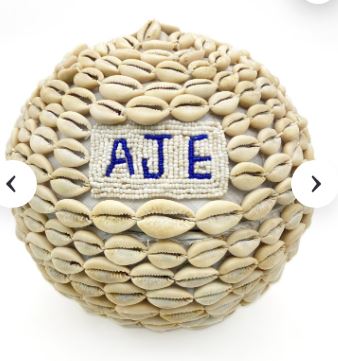
Cowrie shells
Cowries represent historical currency, exchange, value, and the African memory of wealth moving through systems of trade.
Honey and sweet foods
Sweet offerings symbolize ease, sweetness, pleasant movement, and the desire for resources to circulate without bitterness or unnecessary obstruction.
Grains and beans
Black-eyed peas or other common beans can represent stable growth, nourishment, household continuity, and prosperity that feeds more than one person.
Fresh fruit
Bananas and seasonal fruits may be used where they are clean, fresh, and appropriate to the household or lineage context.
Monetary tokens
Coins, paper currency, or jewelry may be placed respectfully near an Ajé station as symbols of exchange, stewardship, and accountable increase.
Ojo Ajé, Monday, is traditionally understood as a day connected to Ajé. Within a simple home framework, Monday morning can become a time for gratitude, money discipline, prayer over work, and review of how resources are moving through the household.
The intention should not be a demand for sudden windfalls. Prayers to Ajé should center good business opportunities, steady work, prepared hands, wise money management, clean exchange, and the ability to preserve what is received. If a religious house, priest, elder, or lineage gives more specific instruction, that instruction should govern the practice.
For a simple weekly rite that joins Ori, ancestors, Ajé, offerings, action, and a prosperity ledger, continue with Best Money Ritual: Ori, Ancestors, and Ajé for Prosperity.
Ancestral Wealth Prayer
Ancestors, reveal the resources of our lineage. Let the gifts, knowledge, and opportunities carried within our bloodline be remembered and restored. Ajé, allow beneficial resources to circulate through this family. May our work become productive. May opportunity find prepared hands. May what we receive be preserved. May what we preserve multiply. May what multiplies remain useful to the lineage.
Olókun, open the depths of hidden possibility. Bring forward what has been buried, forgotten, suppressed, or unrealized. May what was interrupted be restored. May what was lost be replaced by greater wisdom. May what one generation builds become the foundation of the next. May our descendants inherit resources, knowledge, protection, and opportunity rather than beginning again from nothing.
Ajé and Ancestral Elevation
Ajé also belongs within a larger doctrine of ancestral elevation. Ancestral elevation should not be understood as purely ceremonial. If a lineage is genuinely being healed and elevated, some consequences should eventually become visible among the living: greater stability, clearer identity, healthier relationships, stronger families, better judgment, more effective spiritual practice, productive work, and improved economic capacity.
This does not mean that spiritual work automatically produces wealth. It means that true ancestral restoration should increasingly remove the conditions that repeatedly prevent descendants from developing. Ancestral healing removes inherited obstruction. Ancestral elevation improves the condition of the lineage. Ajé allows productive prosperity to circulate. Olókun represents the deep reservoir of unrealized potential.
The Olókun-Ajé-Ancestor Wealth Doctrine
Olókun is the depth. Ajé is the circulation. The ancestors are the transmission. The living are the stewards. The descendants are the continuation.
The purpose of ancestral wealth work is to restore the entire chain. We recover what was lost, repair what was damaged, develop what remained dormant, circulate what has become stagnant, preserve what has been acquired, and transmit something stronger to those who follow.
This is not merely a prayer for money. It is the restoration of ancestral prosperity, economic sovereignty, and generational continuity.