Start Here
If you are asking why you cannot hear your ancestors, why ancestor work feels blocked, or why your family never taught you how to speak to the dead, begin with this: most people were not simply forgetful. They were trained away from ancestral relationship.
The blockage is usually layered. There is fear of the dead. There is shame around African spiritual systems. There is inherited Abrahamic teaching that calls ancestral work forbidden. There is Western materialism, which denies spirit altogether. There is also modern anti-spiritual culture, which teaches people to trust only what can be measured, purchased, or certified by an institution.
A Mature Political Reading of Religion
This article is not written to attack the sincere spiritual life of ordinary believers. Many people love God, pray with devotion, and use the religion they inherited to survive pain, grief, poverty, racism, and family struggle. That should be respected.
The analysis here is different. It is about how empires, ruling classes, priesthoods, states, and power-seeking people use religious images, doctrines, myths, councils, symbols, fear, and salvation language to organize populations. In that sense, religion can become a constructed social reality: a world-picture people are trained to live inside before they realize who built it and who benefits from it.
This is the uncomfortable adult conversation. Powerful people often care less about the spiritual development of the individual than about order, taxation, obedience, labor, land, and control. If this touches a deeply held religious identity, the purpose is not insult. The purpose is to separate personal devotion from the political machinery that has often used devotion for imperial ends.
The Simple Answer: People Were Taught Not To
In many African and African-descended families, the ancestors are present in dreams, family patterns, names, food, funeral customs, warnings, blessings, and repeated life lessons. The problem is not always absence. Often the problem is that people no longer have a clean language for what they are already experiencing.
A person may dream of a grandmother and call it "just a dream." A family may repeat the same collapse for three generations and call it bad luck. A child may feel watched over, corrected, or warned, but be told not to "play with spirits." In this way, the ancestral world keeps speaking, while the living are trained to misname the conversation.
That is why the first stage of ancestor work is not dramatic ritual. The first stage is recognition. You must be able to admit that the dead are not gone in the way modern culture pretends. They remain part of the world of family, memory, protection, unfinished business, and destiny.
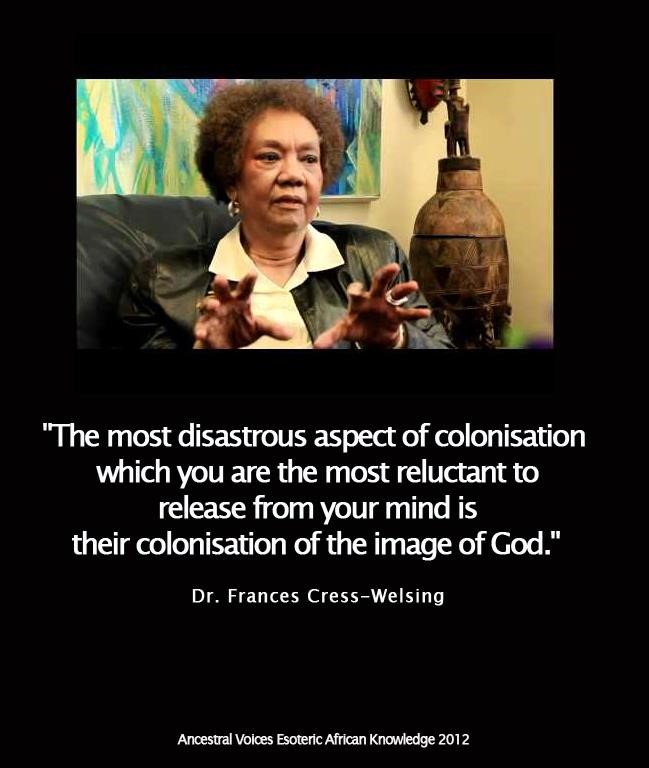
Cress-Welsing and the Colonized Image of God
Dr. Frances Cress-Welsing's point is central here. If a people are taught that the highest image of God is outside themselves, outside their ancestry, outside their color, outside their dead, and outside their own sacred memory, then ancestral relationship becomes psychologically difficult.
The question becomes: how can a person honor Black ancestors while carrying a colonized image of God that quietly ranks those ancestors beneath someone else's sacred image? That is one reason people do not speak to their ancestors. They have been taught, often without realizing it, that spiritual authority comes from elsewhere.
This is not only theology. It is image control. It shapes prayer, imagination, fear, self-respect, and the feeling of who has the right to stand close to the divine. Once the divine image is moved away from the people, the ancestors are also moved away from authority. They become memory, not power. They become family stories, not living spiritual force.
The Isis Papers and the Psychology of Sacred Images
Cress-Welsing's work in The Isis Papers is useful here because she does not treat racism as only personal prejudice. She reads it as a global behavior system that organizes symbols, images, institutions, fear, sex, power, and control. In that framework, the image of God is not decoration. It is psychological government.
If a people are trained to see whiteness as sacred, beautiful, universal, rational, and divine, while Blackness is treated as cursed, physical, primitive, dangerous, or demonic, then ancestor work becomes psychologically obstructed before it even begins. The person may say they believe in ancestry, but the deeper image system inside them still ranks their own dead beneath the conqueror's sacred image.
This is why ancestral practice must repair imagination. It is not enough to say "honor your ancestors" if the sacred imagination has already been colonized. The person must learn to see African people, African memory, African ritual, African beauty, and African divine order as legitimate again. Otherwise the altar is present, but the inner image is still enslaved.
White Male Deification and the Displacement of the Ancestors
The colonized image of God did not happen by accident. European Christianity increasingly placed sacred authority inside a white masculine image: white Christ, white God, white angels, white saints, white kings, and white church authority. Once that image becomes normal, African sacred images are treated as lower, primitive, demonic, or merely cultural.
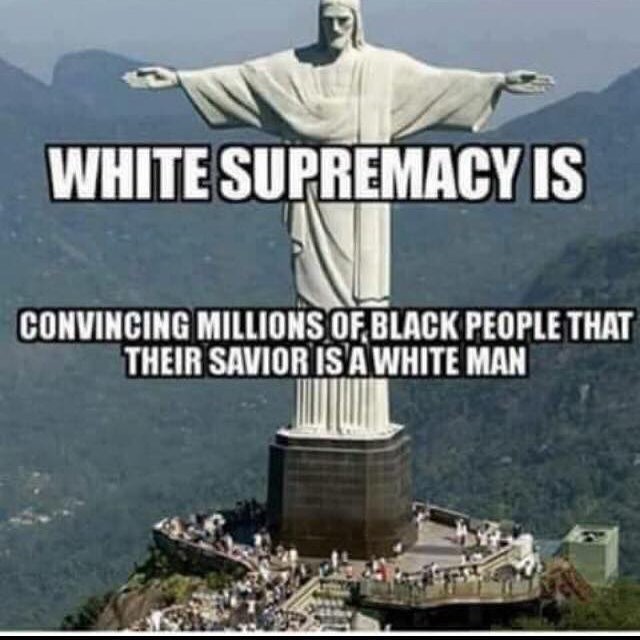
This is how religious imagination becomes political. If the highest image in the mind is white, then the Black ancestor is pushed downward in the spiritual hierarchy. The ancestor is no longer seen as a carrier of authority, memory, and protection. The ancestor becomes someone to be pitied, saved, corrected, or forgotten.
That is why ancestral repair must include image repair. A person cannot fully restore ancestral relationship while secretly believing that holiness has only one face, one color, one civilization, and one authorized religious genealogy. The image of God and the image of the ancestor are tied together inside the psyche.
Western Materialism and Anti-Spiritual Culture
Another reason people do not speak to ancestors is that Western society trains people to distrust spirit. It is materialist, meaning it treats the physical world as the only serious reality. It is anti-spiritual in practice, even when it allows religion as a private belief. It wants spirit managed, contained, institutionalized, or dismissed.
Modern people are often allowed to believe in God abstractly, but not to treat the dead as present. They are allowed to speak of mental health, but not ancestral pressure. They are allowed to honor history, but not to feed lineage. They are allowed to mourn, but not to maintain relationship.
This creates a strange contradiction. The modern world says family matters, inheritance matters, trauma matters, history matters, and identity matters. But when African people say ancestors matter, the same world calls it superstition. That contradiction is not accidental. It protects a worldview where spiritual authority is removed from the family line and relocated into institutions.
Yahweh, Jealousy, and the First Exclusion
The deeper Abrahamic argument begins with Yahweh. In the Hebrew Bible, Yahweh is famously described as a "jealous God," a deity who will not share devotion with other gods. Once that principle is extended into the metaphysical life of a people, it does not only exclude rival deities. It also begins to exclude ancestors, household spirits, land powers, diviners, local shrines, and the older spiritual relationships that existed before the rise of exclusive monotheism.
That is the first major break in the Abrahamic logic. In many non-Abrahamic and pagan traditions, reverence is distributed. People honor the high divine, local powers, nature forces, household guardians, and ancestors without treating those relationships as betrayal. This includes many African and Asian systems, and also European pagan traditions such as Norse and related ancestral customs that continued alongside, before, and after the rise of Yahweh-centered religion in the historical timeline.
Exclusive Yahweh religion introduces a different spiritual psychology: one God, one covenant, one authorized center, one jealous claim over devotion. This gives the religion tremendous organizing force, but it also narrows the sacred world. The ancestor is no longer a natural part of spiritual life. The ancestor becomes a competing object of reverence, or is pushed into memory without metaphysical authority.
This is why the article is mainly speaking to people in the West and the African diaspora who have been shaped by Abrahamic assumptions. Ancestor veneration remains large across much of Asia and in many non-Abrahamic traditions because those cultures did not organize spiritual life around the same jealous exclusion of other sacred relationships.
Abrahamic Religion and the Break from the Ancestors
The predominance of Abrahamic religion is another major reason people do not speak to their ancestors. Christianity, Islam, and Judaism are not identical, but historically they share a strong movement toward exclusive divine authority. They often reject ancestral mediation, local deities, family spirits, and ritual systems that do not fit their theology.
For African people, this was not a neutral shift. Conversion often meant more than accepting a new God. It meant abandoning shrines, stopping offerings, renaming ancestral forces as demons, and treating inherited spiritual systems as error. The living were separated from the dead by doctrine.
This becomes a form of self-hate personified. It is the opposite of how African communities traditionally bonded. People gathered, talked through common connections, remembered the dead, compared family lines, found out which cousin was related to whom, and used shared ancestry to build social unity across households and communities. Abrahamic anti-ancestral doctrine weakens that process. It gives reverence to distant Abrahamic patriarchs who may or may not have lived as described, while discouraging respect for the actual ancestors who built the local family, town, lineage, and communal world. The result is greater fragmentation: families lose shared memory, communities lose common ancestor language, and people become spiritually unified around foreign patriarchs while socially divided from the ancestors closest to them.
One of the saddest examples is when Christian or Muslim practitioners attack collective communal ancestral processions, festivals, libations, or veneration rites inside their own community. Religious change is then treated as permission to dishonor other people's ancestors and one's own ancestors, particularly in events such as ancestral masquerades, where the ancestor collective includes communal heroes, leaders, founders, and notable figures.
That is why many people feel blocked. They may love their family. They may respect their elders. They may feel ancestral pull. But religious fear stands at the gate. They were taught that speaking to ancestors is dangerous, sinful, demonic, or unnecessary. The result is not spiritual freedom. It is often spiritual disinheritance.
Sacred Kingship Is Not Always Anti-Ancestor
This is where the comparison with Kemet and Japan matters. Not every imperial or royal system treats ancestor veneration as a threat. In ancient Kemet, the royal head functioned inside a sacred cultural order. The pharaoh was not merely a foreign ruler imposed from outside the people. He was imagined as a divine and ancestral intermediary within the civilization's own sacred family structure, a kind of hyper-extended clan head standing between the gods, the ancestors, the land, and the people.
Ancient Japan gives a similar structural example. The emperor was bound to the ancestral and divine origin story of the people through the imperial line. Whether one accepts the theology literally is not the point. Politically, the emperor functioned as a symbolic relative, a sacred head within the cultural body. Ancestor veneration did not automatically threaten the imperial system because the emperor's authority was presented as part of the same extended ancestral order.
The Roman model is different. Rome conquered peoples who did not all share one bloodline, one ancestor story, one land spirit, or one clan identity with the emperor. For conquered people, the emperor could be experienced as foreign power, not extended kin. In that situation, local ancestors, local gods, and lineage loyalties become dangerous because they give people another court of appeal. They remind the conquered that their deepest obligations may be older than Rome.
This is why the Roman-Abrahamic model becomes so hostile to ancestral authority. Yahweh's jealous logic says no rival devotion. Rome's imperial logic says no rival sovereignty. Together, they produce a Western pattern where the king, emperor, church, or state stands above the ancestral line. The ancestor is no longer a sacred foundation of social order. The ancestor becomes competition.
The Political Function of Monotheism
Monotheism does not only function as belief. Historically, it can also function as political technology. A state, empire, or ruling priesthood can use one God, one doctrine, one official ritual order, and one authorized priestly system to unify people under a central authority.
This can be seen in the movement from Canaanite religious plurality toward Yahweh-centered monotheism in ancient Israelite religion. It can also be discussed in relation to the Roman Empire's later movement toward Christian consolidation, where religious unity supported imperial order. These are complex histories, and scholars debate the details, but the political function is clear enough: many gods and many ancestral powers create many centers of authority. One official God can create one official center.
From the standpoint of empire, local spirits are difficult to manage. Family ancestors can motivate resistance. Land-based deities can defend territory. Magical systems can give people spiritual weaponry outside the state. Multiple gods, local priesthoods, diviners, healers, and ancestral cults create many channels of power. Centralized monotheism can reduce that plurality.
This is one reason monotheism can disarm spiritual radicalism. It does not merely say, "Worship this God." It often says, "Stop feeding those ancestors. Stop calling those forces. Stop consulting those diviners. Stop using those medicines. Stop trusting those dreams. Stop listening to the dead."
The Caesar's Messiah Model
One modern theory that illustrates this political reading is Joseph Atwill's Caesar's Messiah. The theory argues that the Flavian Roman ruling family helped shape, or even engineer, the Gospel story as a literary and political response to Jewish resistance after the Roman-Jewish War. This is not the mainstream scholarly position, and it should be named as a theory. But as a model of imperial logic, it is useful.
The argument says, in effect, that Rome did not only defeat rebellion militarily. It also created or shaped a religious image that taught a conquered population to spiritualize submission. In that reading, a Messiah who says to render Caesar what belongs to Caesar becomes politically useful: pay the tax, accept the empire's claim, and treat imperial order as part of sacred order.
Whether one accepts Atwill's full thesis or not, the broader political pattern is clear. Empires regularly absorb, redirect, and reframe spiritual symbols. They turn dangerous prophecy into obedient doctrine, local spiritual power into authorized religion, and revolutionary hope into managed worship. That is the point for this article: religious identity can be manufactured, standardized, and deployed as social control.
This also explains why ancestor veneration becomes threatening. Ancestors give people another authority. They give the living a memory older than the empire, a duty deeper than the state, and a spiritual court outside official doctrine. Imperial religion often seeks to close that court.
The Councils and the Construction of the Official Christ
There is a popular image that says Jesus "never existed" and lists the early church councils as the place where he was made. That statement is too simple for serious historical work. The stronger argument is not that no teacher, prophet, or historical figure could have existed. The stronger argument is that the official Christ of empire was constructed through councils, doctrine, political selection, and institutional control.
The councils of Nicaea, Constantinople, Ephesus, Chalcedon, and later gatherings did not simply preserve memory. They defined orthodoxy. They decided which interpretations were legitimate, which were heresy, which writings and ideas would be centered, and which communities would be pushed outside the official church. In other words, they helped turn a complex spiritual movement into an imperial religious structure.
For ancestral people, that matters because the official Christ was not only a spiritual image. He became a governing image. The imperial Christ could be used to override local spirits, silence ancestral systems, condemn indigenous ritual, and organize obedience around one authorized religious center. That is how doctrine becomes administration. That is how theology becomes power.
The question is not whether every Christian was evil or whether every believer intended harm. The question is what happened when the image of God was politically standardized, whitened through later European art, and carried into colonized worlds as the only legitimate face of the sacred. That process weakened ancestral speech because it taught people to distrust every spiritual authority that did not pass through the approved imperial image.
Goetia, Demonization, and Captured Spiritual Technology
The same pattern appears in Western occult history. Older spirits, land forces, gods, daemons, and local powers were often not simply forgotten. They were renamed, ranked, demonized, and placed inside European ritual systems as forces to be commanded, bound, or controlled. The Goetic tradition is one example of this larger pattern.
This does not mean every Goetic name has a simple African origin or that all Western magic is one thing. The point is structural. When a conquering religious system cannot erase spiritual power completely, it often reclassifies it. What was once deity, ancestor, local spirit, or sacred intelligence can become demon, devil, familiar, or dangerous force. The power remains, but its meaning is changed.
That matters for African-descended people because many were taught to fear their own ancestral technologies while European systems continued to study magic, grimoires, astrology, alchemy, Masonry, ceremonial magic, and spirit contact under different names. The public message to Africans was "your spirits are evil." The hidden message inside Western esoteric practice was "spiritual power is real, but we will classify and control it."
This is another way people were spiritually disarmed. They lost confidence in their own ancestral systems while the conquering world preserved its own magical options. Ancestral repair therefore requires discernment: not reckless spirit work, but the recovery of legitimate spiritual authority, proper boundaries, clean lineage relationship, and trained diagnosis.
Christian Imagery and Enslavement
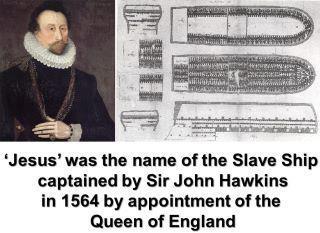
The historical record gives painful examples of how Christian symbolism and enslavement traveled together. John Hawkins' second slave-trading expedition in 1564-65 used the Jesus of Lubeck, and Queen Elizabeth I was among the powerful backers of that expedition. The point is not that one ship explains the whole history. The point is that the symbol reveals the contradiction.
That contradiction had already been prepared in church law and imperial theology. The papal bull Dum Diversas in 1452 authorized the Portuguese crown to attack and reduce non-Christian peoples to perpetual servitude. Romanus Pontifex in 1455 expanded the religious-legal framework for Portuguese claims in Africa, trade, conquest, and enslavement under Christian authority. These decrees show how Christian imagery and imperial economics could be joined into a single machinery.
A ship carrying kidnapped African people could bear the name Jesus while participating in a system that shattered African families, broke ancestral lines, and helped build European wealth. That is why ancestral people must read religious history with clear eyes. The question is not only what the religion preached. The question is what political work the religion performed when joined to empire.
When the sacred image is used to bless domination, the conquered people inherit a spiritual trap. They are asked to pray through the same image that accompanied their disinheritance. This is one reason ancestral speech becomes difficult. The old line is calling, but the imposed image stands between the living and the dead.
Islam, Africa, and Ancestral Displacement
This pattern is not limited to Christianity. Islam also entered many African regions as a universal Abrahamic system that placed ultimate authority in one God, one revelation, one book-centered frame, and a religious law that often stood above local lineage systems. In some places Islam blended with African practice. In other places it came through trade, scholarship, state formation, conquest, jihad, enslavement, and political consolidation.
The result was complex. African Muslims have created deep civilizations, scholarship, poetry, and forms of discipline. That should be acknowledged. But it is also true that Islam, like Christianity, often treated older African spiritual systems as ignorance, shirk, magic, or forbidden practice. Ancestors, shrines, local deities, possession systems, divination, and lineage ritual were frequently pressured, reclassified, or driven underground.
For the ancestral question, the issue is not whether Islam produced learning or order. The issue is what happens when African people are taught that inherited ancestral systems are spiritually illegitimate. Once that teaching is accepted, a person can still honor elders culturally while being forbidden from engaging the ancestors spiritually. That creates another form of disconnection.
In both Christian and Islamic forms, the Abrahamic pattern can centralize spiritual authority away from the family line, away from local land, away from diviners, away from ritual specialists, and away from the dead. That is why the critique must include both. The problem is not one denomination. The problem is the larger imperial function of religious systems that break ancestral continuity while calling the break salvation, civilization, or reform.
Arab Enslavement and the Islamic Slave Routes
The Islamic world also carried its own history of African enslavement. This history includes the trans-Saharan routes, the Red Sea routes, and the Indian Ocean slave trade. It involved Arab, Berber, Persian, Swahili, African, and other Islamicate trading networks across many centuries. It should not be collapsed into a single slogan, but it also should not be erased.
For African people, these slave systems were not only economic. They were spiritual and ancestral ruptures. People were taken from land, lineage, language, ritual, clan protection, and ancestral obligations. Some were absorbed into households, armies, courts, plantations, harems, and military systems. Others were transported into North Africa, Arabia, Persia, the Ottoman world, India, and Indian Ocean societies. The routes differed from the Atlantic trade, but the ancestral consequence remained severe: dislocation, captivity, conversion pressure, and the breaking of inherited spiritual continuity.
This matters because many people discuss Christianity and slavery while treating Islam as outside the same critique. That is incomplete. If the subject is why African people stopped speaking to their ancestors, then both Christian and Islamic imperial histories must be examined. Both could replace local sacred order with Abrahamic authority. Both could classify African spiritual systems as backward or forbidden. Both could participate in systems that separated Africans from the land, the dead, and the ritual frameworks that held community together.
Again, the issue is not to say every Muslim or every Islamic society acted the same way. The issue is to name the structure. When religious expansion travels with conquest, slave trading, state formation, and the downgrading of African spiritual systems, ancestral speech is weakened. The living are taught to fear the ancestral line, while the historical systems that damaged that line are presented as civilization.
The Western Imperial Inheritance
The later Catholic, French, Portuguese, Spanish, British, Belgian, and other European imperial models inherit much of this Roman centralizing logic. Power becomes political, religious, legal, economic, and psychological at the same time. The church blesses the crown. The crown protects the church. The empire controls land, labor, images, doctrine, and the categories of legitimate spirituality.
In that model, ancestor veneration is not merely an alternative religion. It is a rival sovereignty. It says the family line has authority. It says the dead have claims. It says the land remembers. It says the village, shrine, lineage, and ritual specialist may know something the empire does not authorize. For enslaved and colonized people, that is especially dangerous because ancestors can motivate revolt, refusal, escape, memory, and cultural survival.
This helps explain why modern Western society is still uneasy with ancestor work. The West only recently shifted from explicit imperial religious order into the language of freedom of religion and democracy. Even now, for many non-European traditions, "religious freedom" often means tolerated practice under a worldview that still gives deep cultural respect to Abrahamic religion and, more cautiously, to certain Asian traditions. African ancestral systems are still often treated as superstition, fear, entertainment, or danger.
So the modern silence around ancestors is not random. It is the afterlife of empire. People are not speaking to their ancestors because the Western imperial model trained them to see ancestral speech as backward, forbidden, dangerous, or unnecessary. The work now is to restore the older truth: the ancestor is not competition with life. The ancestor is part of the architecture of life.
Removing Spiritual Weaponry
When ancestral practice is removed, people lose more than ritual. They lose spiritual intelligence. They lose warning systems. They lose inherited protection. They lose the ability to ask the lineage what is happening. They lose the ability to distinguish unresolved dead, noble ancestors, and hostile forces. They lose the structure that tells them when a dream is random and when it is instruction.
That is why this question matters. "Why don't people speak to their ancestors?" is not only a cultural question. It is a power question. A people separated from their dead are easier to govern, easier to confuse, easier to shame, and easier to redirect.
Ancestor work restores a different kind of sovereignty. It says the family line has memory. It says the dead have a voice. It says the living are not alone. It says the spiritual world did not begin with empire, church, mosque, synagogue, university, or state.
When Ancestors Became Engines of Resistance
The proof is in the history of resistance. In Haiti, African religion and ancestral practice were not side issues. Vodou ceremony, African memory, oath, song, possession, and collective spiritual commitment helped form the moral engine of revolt against French imperial slavery. The Haitian Revolution was not only military. It was spiritual, ancestral, cultural, and political at the same time.
In Jamaica, the Maroon struggle against British power also carried African spiritual force. Queen Nanny and the Windward Maroons are remembered not only as military resisters but as cultural and spiritual defenders. Obeah, herbal knowledge, African ritual memory, oath, and communal discipline helped sustain people who were fighting a larger imperial machine from the mountains.
This pattern repeated across Africa and the diaspora. Traditional leaders, spirit mediums, shrine keepers, prophets, priestly figures, medicine people, and ancestral authorities often became centers of anti-imperial resistance. They gave people courage, legitimacy, protection, and a reason to fight beyond material survival.
That is why ancestral systems were so often attacked. They did not merely comfort people. They organized people. They gave the oppressed a sacred reason to resist. They linked the living to the dead, the land, the gods, the lineage, and the unfinished duty of freedom. Once that is understood, the attack on ancestor veneration is no longer confusing. Empire was not only trying to change beliefs. It was trying to remove the spiritual engines of rebellion.
The Belgian Congo and the Lie of Civilization
The Congo Free State under King Leopold II gives one of the most horrific examples of this pattern. Leopold's project was presented to Europe in the language of civilization, humanitarian uplift, Christianity, commerce, and anti-slavery. In practice, it became a machinery of forced labor, rubber extraction, kidnapping, mutilation, terror, and mass death.
This matters to the ancestral argument because imperial violence does not only kill bodies. It breaks social order. It attacks village authority, priestly authority, land relationship, family continuity, initiation systems, and ancestral confidence. When people are forced into extractive labor under terror, the shrine, the lineage, the funeral order, the elder system, and the normal rhythm of ancestral obligation are all damaged.
A text often circulated as "Leopold's letter to colonial missionaries" claims to expose the missionary strategy in blunt language. Its literal authenticity is disputed, so it should not be treated as a proven archival speech. But the reason the text circulates so powerfully is that it describes a real historical pattern: missionary language could be used to soften conquest, redirect African imagination, weaken traditional authority, and train the colonized to accept the moral vocabulary of the colonizer.
Belgian Congo shows the brutality hidden under the word "civilization." The colonizer arrives claiming moral authority, Christian order, and modern progress, while severing the structures that made African people whole. This is why ancestral repair cannot be separated from historical truth. The ancestor line was not lost by accident. It was attacked through slavery, missionization, forced labor, land seizure, and the destruction of local authority.
So when a modern African-descended person says, "I do not know how to speak to my ancestors," the answer is not shame. The answer is history. Someone interrupted the line. The work now is to restore it with intelligence, reverence, and structure.
So How Do You Begin Speaking to the Ancestors?
Begin cleanly. Do not rush into advanced ritual. Start by learning the difference between memory, prayer, altar, shrine, and priest-guided work. Start with known and benevolent ancestors. Use water, light, names, prayer, and respect. Do not open every door at once.
If your family history is heavy, if dreams are disturbing, if the dead feel unresolved, or if the spiritual condition feels noisy, begin with diagnosis. Not every ancestral presence should be fed the same way. Not every dead person is a true ancestor. Some conditions require cleansing, elevation, correction, or priestly intervention.
The goal is not to perform ancestor work because it sounds interesting. The goal is to restore relationship, order, protection, memory, and responsibility.
Practical Next Steps
Historical Note
This article treats religious history as power history. For the Hawkins example, see standard historical summaries of John Hawkins' 1564-65 slave-trading expedition and the Jesus of Lubeck. Britannica notes that Queen Elizabeth I was among those who supported Hawkins' second expedition, and historical accounts identify the Jesus of Lubeck as the major ship used in that voyage.
For the Arab and Islamicate slave routes, see historical summaries of the trans-Saharan, Red Sea, and Indian Ocean slave trades. Britannica's slavery overview gives an estimate of millions of Africans delivered into Islamic trans-Saharan and Indian Ocean slave trades between the seventh and early twentieth centuries, while UNESCO's Deim Zubeir material preserves the memory of North African, Arab, and Asian-led slave routes connected to Sudan, East Africa, and Zanzibar. The exact numbers remain debated, but the ancestral rupture is not in doubt.
The Cress-Welsing section is supported by the image-control and symbolic power arguments associated with The Isis Papers. The Goetia section uses Western ceremonial magic as an example of how older spiritual powers can be preserved, renamed, subordinated, and controlled inside a conquering religious-esoteric framework.
For the liberation examples, standard histories of the Haitian Revolution note the role of Vodou ceremony and African religious nationalism in the uprising against French slavery. Jamaican Maroon histories likewise preserve Queen Nanny as a religious, military, and cultural leader whose resistance to British power drew from African spiritual knowledge and communal discipline.
For the Congo example, Britannica's Congo Free State and Leopold II entries describe the forced labor, rubber extraction, atrocities, and international scandal that marked Leopold's private rule. The commonly circulated "Leopold letter to missionaries" is disputed by fact-checkers and historians, so this article treats it as a symbolic Pan-African teaching text rather than a confirmed archival document. The point here is not dependent on that letter: the documented Congo record is already sufficient evidence of terror imposed under the language of civilization.
Selected Sources and Further Study
The argument above is synthetic. It combines African ancestral theology, political history, religious studies, colonial history, and Black psychological analysis. These sources support different parts of the thesis.
Yahweh, Monotheism, and Exclusive Devotion
- Hebrew Bible: Exodus 20:5, Exodus 34:14, and Deuteronomy 6:15 for the "jealous God" language and the exclusionary covenant logic.
- Mark S. Smith, The Early History of God and The Origins of Biblical Monotheism, for the development of Yahweh-centered religion out of older West Semitic religious worlds.
- Jan Assmann, Moses the Egyptian and The Price of Monotheism, for the argument that monotheism can create sharp boundaries between true and false religion.
Rome, Constantine, Councils, and Imperial Christianity
- Britannica, "Christianity - The alliance between church and empire", for Constantine, imperial favor, and the church-state relationship.
- Britannica, "First Council of Nicaea", for the first ecumenical council and the doctrinal conflict around Christ's nature.
- Britannica, "Ancient Rome - The reign of Constantine", for the political setting of Constantine's relationship to Christianity.
- Joseph Atwill, Caesar's Messiah, for the Flavian/Roman-creation thesis. This article treats that model as a contested theory useful for discussing imperial logic, not as settled consensus.
Image Control, White Deification, and Psychological Domination
- Dr. Frances Cress-Welsing, The Isis Papers, for the symbolic and psychological analysis of white supremacy, image control, and the colonized image of God.
- Dr. Na'im Akbar, Chains and Images of Psychological Slavery, for the broader Black psychological analysis of enslavement, identity injury, and internalized domination.
- Wade Nobles, Seeking the Sakhu, for African-centered psychology and the need to restore African spiritual and cultural frames.
Sacred Kingship: Kemet, Japan, and Kinship-Based Authority
- Britannica, "Sacred kingship - The divine or semidivine king", for divine kingship in Egypt, Japan, and other societies.
- Britannica, "Ancient Egyptian religion", for the integration of king, gods, dead, ritual, and public religion in Kemet.
- Britannica, "Shinto", and Britannica, "Tenno", for Japan's imperial myth, Amaterasu, and the emperor as symbolic descendant of divine ancestry.
Christianity, Slavery, and the Ship Jesus of Lubeck
- Dum Diversas (1452) and Romanus Pontifex (1455), for the papal authorization framework used by Portugal in conquest, enslavement, and claims over African trade and territory.
- Richard Hakluyt, The Principal Navigations, and standard accounts of John Hawkins' 1564-65 voyage, for the English slave-trading expedition using the Jesus of Lubeck.
- Britannica, "John Hawkins", for Hawkins, English maritime expansion, and his role in the early English slave trade.
Islamicate Slave Routes and African Displacement
- Britannica, "Slavery - Historical survey", for broad discussion of slavery, including trans-Saharan and Indian Ocean dimensions.
- John Ralph Willis, ed., Slaves and Slavery in Muslim Africa, for historical scholarship on slavery in Muslim Africa.
- Ehud R. Toledano, Slavery and Abolition in the Ottoman Middle East, for the Ottoman and Islamicate slave systems.
- Gwyn Campbell, ed., The Structure of Slavery in Indian Ocean Africa and Asia, for the Indian Ocean slave trade context.
Ancestor Practice, Resistance, and Liberation
- Britannica, "Haitian Revolution", for the role of Vodou ceremonies, racist colonial society, slave brutality, and revolutionary conflict in Saint-Domingue.
- Britannica, "Vodou", for Vodou as an Afro-Haitian religious world rooted in West African systems, ancestors, and spirits.
- Elizabeth McAlister, "From Slave Revolt to a Blood Pact with Satan," for the political-religious meaning of Bois Caiman in Haitian memory and evangelical reinterpretation.
- BlackPast, "Queen Nanny of the Maroons", and Karla Gottlieb, The Mother of Us All, for Queen Nanny, Maroon resistance, and Obeah/spiritual leadership in Jamaica.
Congo Free State, Missionary Control, and Colonial Violence
- Britannica, "Congo Free State", and Britannica, "Leopold II", for the forced labor, rubber extraction, atrocities, and international scandal under Leopold's rule.
- Adam Hochschild, King Leopold's Ghost, for a modern historical account of Leopold's Congo and the reform movement.
- George Washington Williams, "Open Letter to King Leopold II," for an early Black critique of Leopold's Congo regime.
- Congo Check on the disputed Leopold missionary speech, for caution around treating the viral missionary letter as a confirmed archival document.
Western Occult Capture and Demonization
- Joseph H. Peterson, ed., The Lesser Key of Solomon, for the Goetic tradition and its spirit catalogues.
- Owen Davies, Grimoires: A History of Magic Books, for the history of European magical texts, ritual books, and spirit-command traditions.