Book Plug
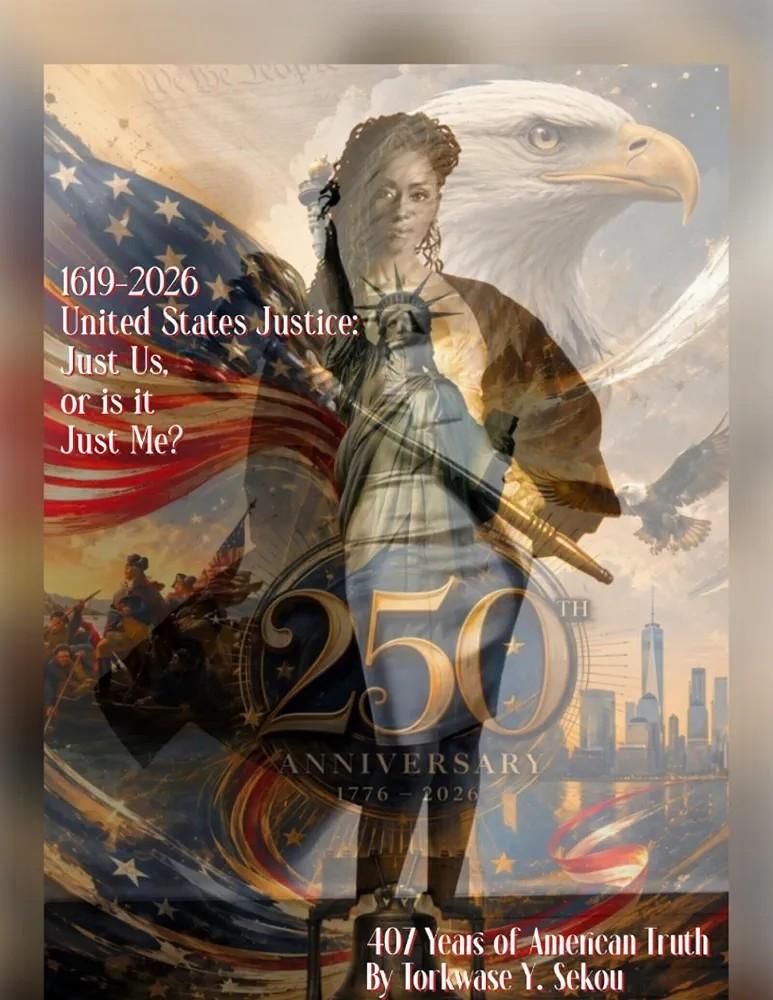
1619-2026 United States Justice: Just Us, or is it Just Me? is presented here as companion reading for the site's work on U.S. historical erasure, Black land loss, public memory, policing, punishment, reparations, and the moral meaning of justice.
Written by former New Jersey Superior Court Judge Torkwase Sekou, the book appears to confront the gap between America's stated ideals of justice and the lived reality of African-descended people from slavery through the present day.
The title asks whether American justice has ever truly meant equal justice, or whether it has too often meant "just us" - a system protecting some while policing, punishing, and marginalizing others.
Book Synopsis
1619-2026: Justice: Just Us or Is It Just Me?
As the United States commemorates 250 years since the signing of the Declaration of Independence, former Superior Court Judge, public defender, educator, and legal analyst Torkwase Sekou asks a provocative and necessary question: Can America celebrate 250 years of freedom without confronting the 407-year history of African Americans who helped build the nation while fighting to fully share in its promises?
1619-2026: Justice: Just Us or Is It Just Me? is a compelling examination of American history, law, wealth, race, and democracy through the perspective of a Black woman who has spent more than four decades inside the institutions that educate, defend, judge, and govern American society.
Beginning with the arrival of Africans in English North America in 1619, Judge Sekou traces the extraordinary labor, sacrifice, innovation, and resilience of African Americans across four centuries. She examines slavery and the creation of American wealth; the Constitution and the denial of citizenship; the Dred Scott v. Sandford decision; Reconstruction and its betrayal; Jim Crow; segregation; the Civil Rights Movement; the continuing racial wealth gap; and modern efforts to restrict, rewrite, or erase uncomfortable chapters of American history.
But this book is more than a history lesson.
Drawing upon her own journey from special education teacher to public defender, Superior Court Judge, municipal court judge, and legal analyst, Judge Sekou challenges readers to consider the difference between justice as an American ideal and justice as an American experience.
The book also turns the lens inward, asking difficult questions about responsibility, leadership, political power, economic independence, and the choices African Americans must make in determining the future of their communities.
At its heart, 1619-2026: Justice: Just Us or Is It Just Me? is not an indictment of America. It is a conversation with America.
It challenges readers of every generation and background to understand that confronting history is not about remaining trapped in the past. It is about recognizing that a nation cannot honestly understand its present, or responsibly build its future, while erasing the people, labor, laws, struggles, and sacrifices that made that future possible.
As America enters its next 250 years, Judge Sekou offers a timely reminder:
History does not disappear because we refuse to teach it. Justice does not exist simply because we proclaim it. And democracy cannot survive if truth becomes negotiable.
1619-2026: Justice: Just Us or Is It Just Me? invites America to remember, to reckon, and ultimately, to decide what justice will mean for the generations yet to come.
Why It Belongs Near the U.S. Erasure Article
The Ancestral Egbe article U.S. Erasure of Black History as a Control System argues that erasure is not only about missing facts. It is about power: who gets remembered, who gets framed as dangerous, whose labor is extracted, whose land is taken, whose institutions are destroyed, and whose suffering is made invisible.
This book belongs beside that conversation because legal memory and historical memory cannot be separated. A justice system that forgets 1619, enslavement, Black Codes, convict leasing, racial terror, land theft, redlining, mass incarceration, and police violence cannot honestly explain the conditions it claims to judge.
Not Merely History
This is not merely a history book. It is likely a witness text: part legal critique, part racial truth-telling, and part moral challenge to the American conscience.
The value of a work like this is not only in the record it gathers. It is in the question it forces readers to carry: if justice has been promised for centuries, who has received it, who has been denied it, and what repair is required now?
Continue the Thread
External Book Link
Read the Book
Use this page as a bridge from the site's justice-memory work into Judge Sekou's legal and historical reflection.