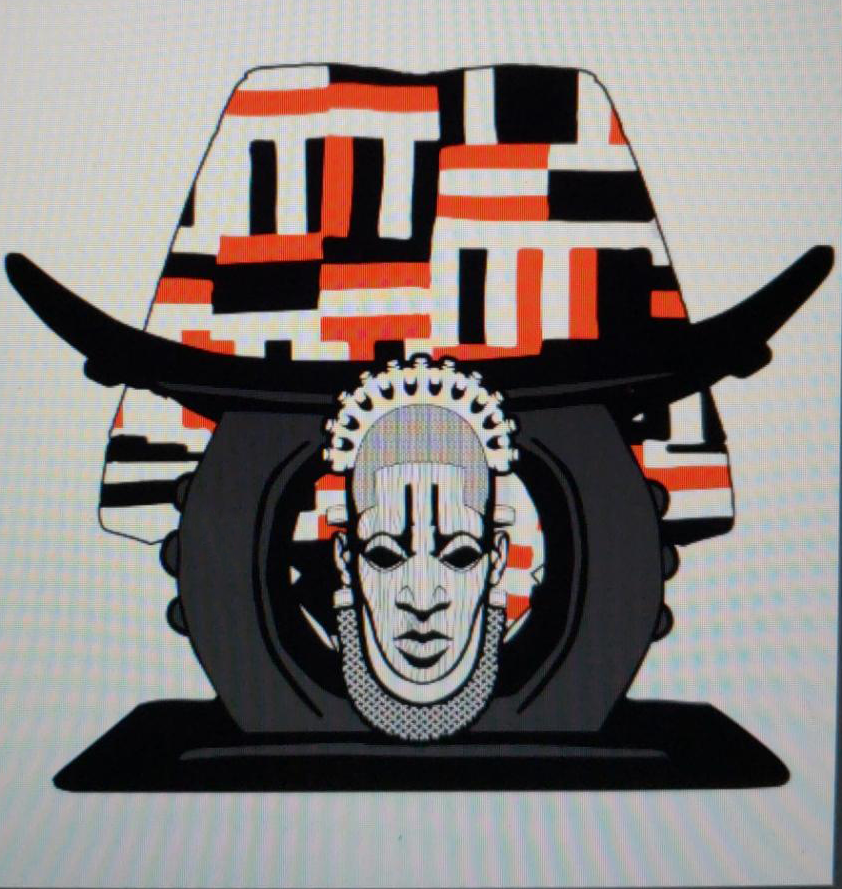
Leopard Societies and the Panther King
From African authority to colonial villain and Black sovereign
Who has the right to protect an African community? Who names its guardians, recognizes its authority, and tells its story?
The leopard brings these questions into focus. In African sacred and political imagery, it can express authority, vigilance, disciplined force, and the responsibility to defend a community. In colonial adventure fiction, the leopard-clad African often becomes a threatening figure whose defeat makes the outsider a hero. In Marvel’s Black Panther, an African king occupies the center again: the defender of an African country, rather than an obstacle to someone else’s adventure.
We read these images as a trans-African constellation of leadership, royalty, and community sovereignty. West African Leopard societies and kingship traditions belong in a wider African discussion that includes leopard symbolism in ancient Kemet and its later diasporic reinterpretation. The Black Panther Party brings that discussion into modern political organization, community service, and the struggle for self-determination. The question is larger than a costume or an animal symbol. It concerns the institutions through which a people governs, protects, remembers, and represents itself.
How we distinguish the layers
The historical layer concerns particular societies, objects, places, and records. The interpretive layer explains the relationships our house draws between them. The contemporary layer asks what those relationships mean for cultural recovery and responsible organization today. A meaningful correspondence does not, by itself, establish an uninterrupted institutional lineage.
A documented Leopard Society emblem
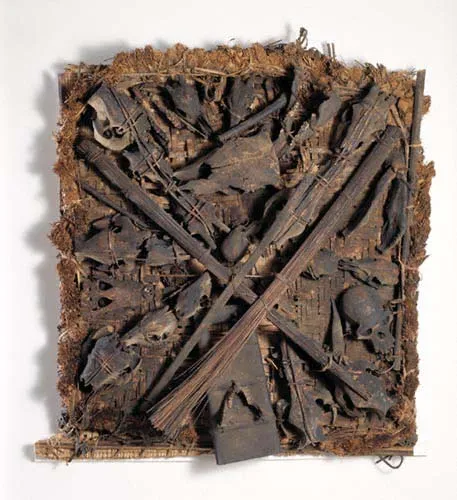
Ejagham artist, Emblem (nkpa) of the Leopard Society (ngbe), late nineteenth–early twentieth century. Cross River region, Nigeria/Cameroon. Animal bones, human mandible, wood, cane, raffia, plant fibers, and organic material; 121.9 × 111.8 × 27.9 cm. Gift of H. Kelley Rollings, Class of 1948, and Mrs. Rollings, 1995-408. Princeton University Art Museum. Museum record.
This object gives the discussion a material anchor. It is an emblem of an identified institution, not an illustration invented for a European adventure story. Its correct regional identification matters: this is an Ejagham work from the Cross River region, not a Congolese object. Similar animal imagery across Africa should lead us to investigate relationships without erasing the distinct communities that created it.
Leopard societies as institutions of order
The Leopard Society cannot be understood solely as a frightening mask or a collection of secret rites. In the Cross River region, the institutions known through such names as Ekpe, Egbo, and Ngbe exercised social and political authority.
P. Amaury Talbot’s In the Shadow of the Bush (1912), chapter IV, “Egbo,” describes an institution involved in town authority, ranked membership, adjudication, obligations, and enforcement. Talbot connects the names Egbo, Efik Ekkpe, and Ekoi Ngbe with the leopard. His account also describes the society’s lodge as a central institution of communal life. Talbot, chapter IV, pp. 37–46; bibliographic record.
Talbot wrote as a member of the Nigerian Political Service. His language and judgments belong to a colonial encounter with institutions that possessed authority before colonial government and continued to exercise influence alongside it. We therefore read him critically: his observations can document institutional functions, while his explanations of origins and his judgments about African religion require separate scrutiny.
This distinction prevents two distortions. The first reduces African institutions to superstition and terror. The second treats every exercise of traditional authority as automatically benevolent. Governance includes the power to protect, adjudicate, exclude, punish, and compel. The historical question is how those powers operated in a particular society, under whose authority, and with what consequences.
An additional museum comparison supports the governmental dimension. Queensborough Community College’s Art Gallery describes an Ejagham Nkpe emblem from Cameroon and identifies the society as an institution of social regulation whose leaders could hold authority comparable to village chiefs. QCC Art Gallery, “Nkpe Emblem”.
The Panther King and the body of the community
The leopard also belongs to African kingship. The Metropolitan Museum’s discussion of Benin identifies the Oba with the leopard: authority in the human community is expressed through the commanding animal of the forest. The Met, The African Origin of Civilization, “Supreme Beasts”.
Within our house’s interpretation, the Panther King and the Leopard Society express related responsibilities at different scales. The king represents the concentrated obligation of guardianship; the society represents organized people carrying duties of discipline, defense, judgment, and continuity. The image of the sovereign and the institution of social defense belong in the same conversation, even where their exact historical relationship differs.
“Panther King” is our comparative name for this sovereign-protector model. The historical titles and animal associations vary; the connection lies in the political and spiritual work of the symbol.
A trans-African constellation of leadership
The leopard house, Panther King, and Leopard Society are related concepts in this reading of African authority. They bring the royal person, the organized body, and the obligations of leadership into the same field of meaning. Their West African expressions are part of a wider African constellation, rather than the entire geographical extent of leopard symbolism.
The leopard-skin stool makes the Kemetic connection concrete. Tutankhamun’s stool, catalogued as JE 62035, uses ebony and ivory to imitate a leopard skin, including its hanging paws and tail. It is a representation of a skin in royal furniture, not an actual hide covering that surviving stool. The statue of Anen, second priest of Amun, also preserves the leopard skin as a sign of priestly office. These objects document the leopard’s presence in Kemetic royal and sacred settings. Global Egyptian Museum, JE 62035; Museo Egizio, Statue of Anen, Cat. 1377.
The association of leopard skin with a seat of leadership also appears elsewhere in Africa. The University of Michigan Museum of Art describes a Hemba chief’s ceremonial stool placed upon a leopard skin during royal occasions, including investiture. These distinct examples support the breadth of the comparison. We understand them through a Pan-African leadership and royalty framework, while keeping the histories of the objects and institutions distinct. UMMA, Chief’s Stool, 2005/1.224.
Ògbóni and the House of the Leopard
Within diasporic Ògbóni houses such as Ilé Ẹkùn—House of the Leopard, Ògbóni is understood as an expression of the wider Leopard Society principle: sacred authority organized to preserve communal order, hold leadership accountable, and protect the relationship among the living, the ancestors, and the land. These houses exist as related, independently organized institutions. Ogboni Orientation Manual, “House of the Leopard as Diasporic Example”.
The leopard’s royal symbolism connects the house to the Panther King concept. Within the framework described here, the Panther King would be a member of the Ògbóni Leopard house, carrying obligations within an institution rather than standing above it. Kingship joins the organized body of leadership. Ògbóni’s Earth-centered teaching places character, ancestral responsibility, and communal justice before personal power: Ilẹ̀, the Earth, remains witness to human behavior, including the conduct of a king. Ògbóni in the West: Sacred Governance in the Diaspora.
Yorùbá Ògbóni and Cross River Ekpe/Ngbe have distinct institutional histories and rites. The comparison concerns how they organize leadership, restrain power, and protect a community; the Leopard-house framing described here belongs to particular diasporic houses.
For modern Panther formations, recovering this older tradition means returning to community protection, discipline, and accountable leadership. Diasporic Ògbóni houses such as the House of the Leopard offer a point of reference for that work: defending a community also means serving it, cultivating character, and accepting limits on leadership. This is a model for contemporary organization, not a claim of Ògbóni affiliation or inherited initiatory authority.
Marronage, Palo Mayombe, and the lineage house
Marronage belongs to the wider history of African diasporic independence. Across Cuba, Puerto Rico, the Caribbean, South America, and the Southern United States, people escaped enslavement and sought to establish lives beyond the plantation order. Forests, mountains, swamps, and other refuges became places of survival, resistance, and community formation. The regional names include cimarrones, palenques, quilombos, and Maroon communities; the forms of escape and settlement differed from place to place. UNESCO, “Quilombos, hotbeds of Afro-Brazilian resistance”.
Research on Puerto Rican cimarronaje examines people seeking freedom beyond colonial control, while the Great Dismal Swamp supplies a Southern United States example of refuge and independent community life. Escape could lead to rebuilding households, obtaining food, organizing protection, and sustaining relationships with the land and the ancestors. Melissa Reyes Segarra, “Esclavitud y resistencia,” University of Puerto Rico–University of Michigan collaboration; National Park Service, “Tom Copper’s Rebellion and Great Dismal Marronage”.
We understand Palo Mayombe and other Palo traditions within this broader current of African cultural independence. The Palo Mayombe: Before the Gate guide describes Kongo roots, Caribbean transformation, Indigenous contact, Catholic pressure, and house-specific developments; its discussion of diaspora formation explicitly includes forests, mountains, and Maroon spaces. Palo carries African spiritual knowledge through initiatory houses and relationships with the dead. Todd Ramón Ochoa’s research documents a Cuban-Kongo Palo house as a distinct sacred and social formation. Palo Mayombe orientation and further study; Ochoa, “The Dead and the Living in a Cuban-Kongo Sacred Society”.
Ngó Nfinda—“leopard of the forest” enters this discussion as a Palo Mayombe lineage/house example. In the lineage understanding presented here, the name evokes practitioners associated with the forest leopard’s power: spiritual authority, potency, and the capacity to act. Justice may be associated with that authority, but it is not guaranteed by possessing power. A practitioner’s spiritual capacity does not, by itself, establish moral righteousness or ensure a just outcome.
In this reading, the practitioners are themselves the “leopards of the forest”: bearers of a continuing African spiritual force, sustaining power and authority beyond the institutions that marginalized them. That self-understanding brings the lineage into comparison with Leopard societies in Africa through a shared symbolism of potency and independent authority.
A lineage house gives cultural continuity an organized form: teachers transmit knowledge, initiatory relationships carry responsibilities, and spiritual authority remains rooted in the tradition rather than depending on outside religious approval. Ngó Nfinda enters this account through that living lineage understanding, rather than a documented genealogy from a particular Maroon settlement.
Cross River–Abakuá transmission is a distinct connection
The Cross River Leopard tradition has its own documented diasporic transmission. Ivor Miller’s research traces Cuban Abakuá to Ekpe/Ngbe Leopard societies of the Cross River region. This is an institutional connection that can be studied through historical and linguistic evidence. Palo’s Kongo roots, Abakuá’s Cross River inheritance, and the wider practice of marronage belong in conversation without becoming interchangeable names for one tradition. Miller, “Cuban Abakuá Chants: Examining New Linguistic and Historical Evidence for the African Diaspora”.
Palo and the struggle over religious respectability
The Before the Gate guide directly challenges the fear of Palo inherited through colonial and Christian judgments about African spiritual life. Its sections on Kongo historical memory and colonial distortion ask why African traditions are labeled primitive, demonic, or dangerous. Ochoa likewise describes Palo’s public vilification as sorcery and examines its distinct cosmological sovereignty in a Cuban setting shaped by Kongo, West African, and Spanish Catholic influences. Ochoa, dissertation abstract; Ochoa, Society of the Dead.
The practitioner perspective developed here challenges a hierarchy that treats Christian-coded respectability as spiritual advancement while casting Palo as darker, rougher, more dangerous, or excessively African. Such judgments can reproduce colorism and colonial ideas about civilization within the diaspora itself. We treat these as stigmatizing classifications to examine, not as descriptions of practitioners’ worth. This critique does not speak for every Santería house or make Christian affiliation a measure of anyone’s African authenticity. The point is to recognize how cultural independence can be recast as evidence of danger.
The colonial gaze reverses the meaning of this image. Where a lineage recognizes spiritual power and independent authority, colonial officers and local collaborators—including those invoking Christian legitimacy—can portray a monster: dark, evil, and outside the supposedly civilizing order. In the worldview criticized here, legitimacy is measured by submission to a racialized image of God and civilization. African spiritual autonomy becomes a reason to fear and villainize its bearers.
Resistance and the colonial power to name
African institutions did not cease to be political when colonial administrations labeled them secret, criminal, or primitive. A body that regulated conduct within a community could also obstruct an outside government’s claim to exclusive authority. The encounter could involve resistance, accommodation, rivalry, or the redirection of an older institution toward new conflicts.
Central African leopard-men histories belong beside the Cross River material as a comparison, not as a substitute for it. The AfricaMuseum’s account of resistance includes leopard-men and crocodile-men among localized forms of opposition to colonial rule. This supports examining resistance as part of their history, without assuming that every group, attack, or victim had the same political meaning. AfricaMuseum, “Resistance”.
Our house’s concern is the power to determine who counts as a defender and who is represented as a menace. Colonial accounts must be questioned when they deny Africans political motives or treat resistance on African land as evidence of inherent savagery. That scrutiny does not require us to excuse every act of violence. It requires us to investigate the actors, targets, testimony, and struggle over authority rather than inherit a colonial verdict as our starting point.
Leopold II’s Congo Free State supplies a necessary counterpoint. The 1904 Casement report documents coercion in rubber collection, killings, mutilation, and other abuses under colonial administration. Claims to civilize African people cannot themselves establish the moral legitimacy of a regime that destroyed their freedom and political authority. Religious institutions must also be examined in their actual roles: missionary involvement in colonial society coexisted with missionaries who helped expose its violence. The relevant contrast is between proclaimed civilization and documented conduct, not an assumption that European power was humane while African power was inherently barbaric. Casement, 1904 report, reproduced by Vancouver Island University; University of Exeter, Alice Seeley Harris and Congo Reform Association lantern-slide record.
Leopard skin and spiritual responsibility
The Kemetic priestly leopard skin also raises a question of spiritual responsibility. Our house reads it through a principle of disciplined power: the person who bears a sign of authority must cultivate the capacity to govern the self. Anen’s statue gives this reflection a documented priestly setting. Museo Egizio, Statue of Anen, Cat. 1377.
In this doctrinal reading, victory over destructive impulses makes authority a responsibility rather than a license. The leopard’s power becomes a demand for vigilance, restraint, and service.
Tarzan and the colonial imagination
Edgar Rice Burroughs’s Tarzan and the Leopard Men, published as a book in 1935, places leopard-men within the adventure world organized around Tarzan. The 1946 film Tarzan and the Leopard Woman provides another leopard-associated fictional antagonist. These are distinct works; neither should be treated as a documentary record of an African institution. Edgar Rice Burroughs, Inc., novel record; film record.
Our reading concerns the structure of the encounter. The audience is invited into an Africa where the exceptional white hero occupies the position of legitimate action and judgment. African collective power can then be staged as the danger that makes his intervention necessary. A people’s capacity to defend, govern, or refuse the outsider is displaced by the adventure’s need for a threatening opponent.
The Charlie Chan cover bearing the title The Land of the Leopard Men! provides a related example. Its language compares the leopard-clad figures to jungle creatures that behave like beasts while walking like men. The contrast with the visiting investigators turns African presence into a spectacle of danger. This dehumanizing visual rhetoric gives fictional form to the same struggle over whose presence is legitimate.
This is what our comparison means by the colonial imagination: the outsider is granted individuality and rightful agency, while the organized African presence is rendered a mystery, an animalized threat, or a problem awaiting outside resolution.
Black Panther and the return of the African sovereign
Marvel’s T’Challa changes the position from which the story is told. Black Panther is an African king and the protector of Wakanda. First introduced in Fantastic Four no. 52 in 1966, he belongs to a fictional African country whose authority and future are central to the narrative. Smithsonian National Museum of African American History and Culture, “Who Is the Black Panther?”.
Our house sees an important reversal. The African protector no longer needs to be defeated so that an outsider’s adventure can be completed. His country has institutions, political conflicts, obligations, and a future of its own. African sovereignty becomes something the audience is asked to understand from within.
We read this reversal as a recovery of the Panther King’s positive imaginative position. Fiction can restore a possibility to the imagination without establishing a direct historical source for its imagery.
The warrior god-king, Bast, and the obligation of Ma’at
T’Challa is more than a fighter who happens to wear an animal emblem. Our house reads him as a modern fictional expression of the warrior god-king: a sovereign whose office joins physical protection, ancestral responsibility, and sacred obligation. Marvel explicitly identifies Bast as the Panther goddess connected with the Black Panther tradition. Its fictional mythology supplies a religious dimension to the office, not merely a technological costume. Marvel, “A Guide to the Myths, Legends, and Gods of Wakanda”.
In our house’s comparative theology, the Panther goddess can be read as a feline expression of the responsibility to uphold Ma’at: truth, righteousness, justice, and right relationship. Museum records identify Ma’at with cosmic harmony, truth, justice, and moral integrity, while describing Bastet as a protective goddess. The comparison joins these responsibilities while preserving the deities’ distinct identities. British Museum, Ma’at; The Met, Bastet.
The film’s animal-associated social imagery expands the comparison beyond the king. We read its gorilla-associated Jabari and the Border Tribe’s use of rhinoceroses alongside the panther-centered royal office as an imaginative echo of differentiated animal-totem affiliations within a wider society. These fictional affiliations suggest how animal symbolism can express collective identities and responsibilities.
This opens a connection to our ancestral animal-totem work: the relationship among ancestral orientation, affiliation, initiation, discipline, and service. Forthcoming article: Ancestral Animal Totems, Initiation and Social Responsibility.
American Panthers and diasporic reconstruction
The history of American Panther organizing has its own documentary record. The SNCC Digital Gateway’s account of Lowndes County connects the black-panther symbol with local political organization, education, and the effort to secure effective Black political power. This history grounds the American formation in the practical work of building political authority. SNCC Digital Gateway, “Political Education”.
Our house’s argument concerns reconstruction. Across displacement, enslavement, segregation, and cultural disruption, African-descended communities have continued to organize around protection, mutual responsibility, political education, and the right to determine their future. We interpret modern Panther formations as possible diasporic expressions of that older responsibility for collective sovereignty. Different organizations must still be evaluated through their own histories and actions; the shared animal name does not make them one institution.
The Black Panther Party was a political organization whose work joined community defense to concrete services. Its food and breakfast programs, health clinics, and schools made leadership a matter of meeting community needs as well as challenging oppressive power. We read that combination of service, political organization, and self-determination as a modern expression of the sovereignty principle discussed here. This is where the trans-African comparison reaches beyond royal imagery into the work of a modern community institution. Smithsonian NMAAHC, “The Black Panther Party: Challenging Police and Promoting Social Change”.
A documented organizational lineage and a deliberate cultural recovery are different kinds of connection. Neither should be confused with a merely decorative resemblance. The work of reconstruction becomes substantial when a symbol is given institutional form: education, accountable leadership, care for the vulnerable, protection of community life, and the transmission of knowledge.
Repression, scattered formations, and the recovery of a tradition
The sovereignty argument does not stop with the original American Black Panther Party. It reaches the modern Panther formations that continue to organize, sometimes separately and with different accounts of what the Panther tradition means.
The repression that damaged the earlier movement is documented. The United States Senate’s history of the Church Committee identifies COINTELPRO as a covert program used to disrupt and discredit targeted organizations. The National Archives documents the December 4, 1969 police raid that killed Fred Hampton and Mark Clark and the subsequent investigations and litigation. Leadership killings, surveillance, and deliberate disruption belong in the history of what communities were trying to build and what interrupted that work. U.S. Senate, Church Committee; National Archives, “Fred Hampton: Vanguard Revolutionary”.
The struggle over Black self-defense also concerns who is permitted to appear as a legitimate protector. In 1967, armed Panthers protested California’s proposed Mulford restrictions on carrying loaded firearms in public. We place that episode beside the movement’s experience of surveillance and police violence as part of a racialized struggle over authority and public safety. In this article’s interpretation, the threatening Leopard Man, the supposedly dangerous Palo practitioner, and the criminalized Black community defender belong to a recurring politics of representation. They are different histories; the connection is the power of stigma to make African autonomy appear illegitimate and repression appear protective. California State University, East Bay, Black Panther Party anniversary exhibition.
Our house understands today’s scattered Panther formations against this history of rupture. Their origins, leadership, and institutional histories vary. The shared question is how a damaged inheritance can be studied, recovered, and given responsible form again.
This article is therefore addressed to those formations as well as to general readers. For groups that know the American Panther name but have not studied the African leopard institutions and royal traditions discussed here, these sources offer a wider field of historical reference. They place the modern symbol beside older questions of social defense, spiritual discipline, communal authority, and sovereignty. Recovering that knowledge can give contemporary organization a deeper foundation in service and responsibility.
In our house’s language, this is the lineage of the Panther tradition: an inheritance of questions, symbols, responsibilities, and possibilities that can be reclaimed across historical breaks. Its African institutional histories, its American political history, and its modern formations each deserve study in their own right. Recovering that lineage should deepen what Panther organization asks of its members. It should make the name carry knowledge and obligation, not simply a recognizable image.
What we carry forward
The Leopard Society material belongs in a political reader’s journey because it joins questions often separated: spiritual authority, social organization, cultural representation, and political power.
The Princeton emblem anchors us in an actual African institution. Talbot’s account requires us to read colonial testimony critically. The Panther King asks what legitimate guardianship demands. Tarzan and the Charlie Chan cover expose the struggle over who is allowed to appear as human, authoritative, and heroic. Black Panther helps us imagine an African sovereign whose country is not somebody else’s stage.
Our task is not to recreate every historical institution unchanged or to romanticize its power. It is to recover the questions those institutions addressed and organize responsibly in the present. Who protects the community? Who teaches its history? Who restrains its leaders? Who preserves its obligations to those who came before and those who will follow?
For our house, the leopard becomes a reminder that sovereignty requires organized responsibility. The emblem must point beyond the wearer toward the life of the people.
Check your understanding
Two private student assessments accompany this reading: Historical and Cultural Foundations and Political Sovereignty and Community Responsibility. Each has twelve questions and a separate saved score. Complete the reading while signed in before taking either assessment. These assess comprehension, not initiation readiness.
Continue the political reading
Continue the political reader’s journey with Black Consciousness: From Spiritual Through Cultural to Sovereignty, Pan-Africanism and the War for Identity, Black August, and Reparations as Ancestral Responsibility.
The African martial-arts connection belongs here as well. In our framework, physical training develops a capacity; sovereignty asks to whom that capacity is accountable and what it protects. Continue with African Martial Arts and Ancestral Warrior Traditions and African Martial Arts: A Stolen Legacy. The Leopard Society comparison brings organized social responsibility into that discussion: the capacity to defend becomes meaningful through service to the community.