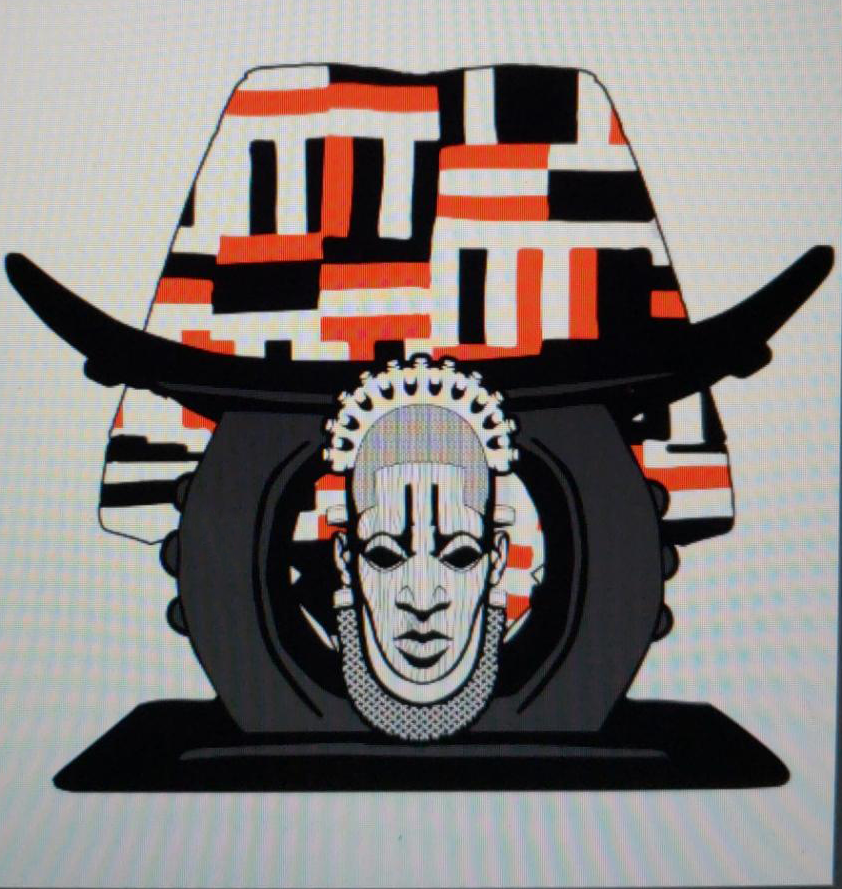
Why the Blue Crown belongs at the center of this work
The divine spark within one being enters into relationship with the divine spark within another. This is the organizing principle of Blue Crown work in Ancestral Egbe. We call this inter-spiritual relationship: care for ancestors, responsibility toward spiritual companions, and the discernment needed to stand among conscious spiritual beings. A crowned head becomes answerable for the welfare of that community.
We draw this teaching from Kemetic royal imagery, African ancestral institutions and living house practice. Read it in three connected layers: historical evidence establishes the objects and cultural record; our doctrinal interpretation explains their relationship within the Crown map; and cultural and living practice gives that interpretation an organized field of application.
The historical Khepresh
The Khepresh is the royal headdress commonly called the Blue Crown. Surviving images show a rounded, sometimes high-backed crown with a frontal uraeus and a patterned surface. The Brooklyn Museum statuette of Amunhotep III, accession 48.28, provides a material example of its representation: the king wears a gilded Blue Crown on a wooden figure with glass inlays. The object dates to approximately 1390–1352 BCE.
The older label “War Crown” does not exhaust its meaning. Crown research examines its development from earlier cap-like forms and its use within royal iconography, including ritual contexts. Its changing shape and decoration belong to that wider history.
The representation of a crown is not a surviving wearable crown. A statue's gold, stone or faience does not by itself establish what the ruler's actual headdress was made from. In particular, the evidence used here does not establish that the Khepresh was a solid lapis-lazuli crown.
The divine child and the responsibility of inheritance
Divine parentage could authorize royal office. Hatshepsut's birth cycle at Deir el-Bahri presents Amun as her father; the Met explains this relationship in its record of Howard Carter's 1899 facsimile of Queen Ahmose. The facsimile is modern, while the scene it records belongs to the ancient temple.
There is also a direct surviving connection between a child deity and the crown. The Met's Head of a Harpokrates with a Blue Crown and Sidelock, object 2021.41.95, is a limestone work dated 332–30 BCE. It gives the divine-child discussion a specific historical anchor, rather than relying on resemblance alone.
These examples are different: Hatshepsut's divine-birth narrative concerns Amun, while Harpokrates belongs to the imagery of Horus the Child. They do not make every Blue Crown wearer a child of Amun. Within our teaching, they help articulate a shared question: what obligations follow when life and authority are understood as received from sacred source?
Our answer is that divine kinship must mature into service. The divine child is not a warrant for spiritual entitlement. Inheritance brings the duty to learn, develop judgment and sustain what has been entrusted to the next generation.
Lapis and the celestial language of blue
Lapis lazuli gives blue a physical depth that can evoke the sky. The Met's Face of the goddess Bat, object 2012.178, is lapis, gold and travertine, dated approximately 1100–664 BCE. Its catalogue specifically relates white inclusions in the stone to clouds and Bat's celestial realm.
Blue divine imagery also appears in other materials. The Met's Head of Amun with inlaid eyes, object 2021.41.93, is made of Egyptian blue, not lapis. Distinguishing the natural stone from the manufactured material strengthens the comparison: sacred blue was expressed through more than one medium.
In our house, lapis becomes an image of divine mind and a consciousness larger than the personal self. The Blue Crown placed upon the head signifies an intention to bring judgment into relationship with that larger order. We understand this as contact with divine presence, not as a claim that wearing a blue object automatically produces spiritual attainment.
Our Divine Blue Body teaching places this symbolism alongside other blue divine forms. The Amun, Amma and Olokun teaching develops the wider relationship of sacred source, name and divine presence.
The crowned head and the welfare of the community
We express the responsibility of the office through the maxim “the ka of the king is the ka of the people.” Here it is our doctrinal formulation, not a verified quotation from an ancient inscription. It asks the leader to understand personal conduct as consequential for the life entrusted to that office.
There is historical support for linking kingship with obligations beyond the ruler's individual life. UCL's account of Egyptian royal duties presents judgment, right order and offerings for gods and blessed dead together. These duties give sacred leadership a responsibility across generations.
Other African institutions illuminate the comparison in their own terms. The Met describes the Yoruba adénlá crown as connecting the oba with preceding rulers. Its record of an Edo head of an oba explains royal ancestral commemoration and the relation between the king's head and the kingdom's welfare. Yoruba and Edo traditions remain distinct; neither is simply an Egyptian institution under another name.
These relationships help explain our ancestral shepherd principle. Authority carries duties of remembrance, discernment, protection, repair and continuity. A spiritual title is meaningful when the person can carry those duties responsibly.
In our comparative theology, Amun names hidden sacred source while Olokun expresses primordial depth and the mystery of origin. Their relationship supports the Blue House's understanding of spiritual continuity without making their historical traditions interchangeable. The creator-source article develops that teaching.
From the divine spark within to relationship between beings
Our blueprint distinguishes intra-spiritual development from inter-spiritual relationship. Intra-spiritual work emphasizes the divine spark within oneself. The Orí lane within the Nemes Crown makes that inward relationship explicit: Orí is understood as one's personal deity, with its own practices of alignment, care and responsibility. The Nemes Crown also includes meditation, energetic cultivation and distinct ascension systems; it is broader than the Orí lane alone.
Blue Crown work emphasizes the relationship of one's divine spark to other conscious spiritual beings. The distinction is between the principal objects of practice: attending to one's own Orí is not the same work as tending an ancestral relationship or learning responsibility toward Egbe companions. Inner clarity supports those relationships, but does not replace them. Here “inter-spiritual” describes this house's relational model, not simply dialogue between religions.
The Blue jurisdiction addresses that relational field: the living, the ancestral dead and conscious spiritual companions. In our cosmology this is an aspect of the universe's organization, not merely a list of cultural customs. Different peoples have recognized and organized practices within this field through their own languages and institutions.
This does not collapse all unseen beings into one category. Our jurisdiction blueprint distinguishes this conscious-spirit work from the elemental and nature-power emphasis of the Red Crown and the Orisha/deity emphasis of the White Crown. Real practices can intersect several layers; the distinction helps identify the relationship and responsibility at work.
Cultural and living practice
The practical question is who the relationship concerns and what work is appropriate. These are related doors, not one interchangeable ritual system.
Ancestral and Egungun work
Work with the dead begins with lineage, remembrance and discernment. What Is Egungun? already explains ancestral priesthood, communal responsibility and funeral work. The Ancestral Hierarchy distinguishes conditions of the dead; Elevation and Lineage Elevation explains the repair and completion layer. The Ancestral Manual extends public study into organized household practice.
Egbe companionship
In our house, Egbe concerns spiritual companions and destiny peers; it is not merely another word for deceased relatives. Use the Egbe model, Egbe Manual and appeasement orientation for that relationship. Where guidance supports it, the Egbe shrine service describes an existing support option, not an automatic next purchase for every reader.
Espiritismo and guiding spirits
Espiritismo provides a related comparison in the realm of relationships with the dead and guiding spirits. It is not presented here as historically founded by the Khepresh, Egungun or our house. Diana Espírito Santo's Developing the Dead studies mediumship and selfhood in Cuban Espiritismo; this is a specific living context, not a definition of every form of spirit work.
Our existing White Table article is the practical bridge to mesa blanca, spiritual tables and ancestral elevation. A table's color does not make its jurisdiction the White Crown. The beings addressed, the purpose of the work and the authority of its practitioners matter. Espiritismo, Egungun, Egbe and Orisha practice should not be treated as synonyms, nor should shared interests erase different training and obligations.
The Blue Crown and the Blue Lodge
In our house's Masonic teaching, the Blue Crown is the crown of the Blue Lodge. Lapis and sacred blue belong to our symbolic reading of this work: the head becomes accountable to divine order, while fellowship gives that accountability a social form. Intellectual formation must grow into sound judgment, disciplined conduct and care for others.
Continue that study through Amon, Mas-Amon Masonry, and Divine Mathematics, Sacred Geometry, Solomon and Siamun and Egregores and Deified Ancestors. The Masonic Ancestral Restoration Manual organizes the fuller lodge study.
Choose the work by relationship and responsibility
The Blue Crown is the organizing principle; the developmental overview maps the arc; the ancestral hub supplies the reading; manuals organize local practice; and existing services support particular needs. Those functions should work together without making every reader an initiate or every difficulty a reason for ritual escalation.
Begin by clarifying whether the concern is remembrance, an unresolved dead relationship, Egbe companionship, or another jurisdiction entirely. Where the matter requires guidance, the existing Standard Reading and Ancestral Healing Journey explain assessment and service routes. Experiences alone do not establish a spirit's identity or a person's authority to serve others.
The Blue Crown joins origin to obligation. Divine-child symbolism speaks of sacred inheritance. Lapis speaks to our understanding of divine mind. The ancestral and companion practices give those meanings a field of application. The measure of the work is the quality of relationship the practitioner learns to sustain.
Source and study boundaries
Museum and university links above support the specific historical objects and practices described. W. V. Davies's The Origin of the Blue Crown (1982) is a research reference for the crown's development; its full argument has not been independently checked here. The supplied support draft's proposals about lapis or faience ring-beads on actual crowns remain proposals, not verified construction facts.
The Amun–Olokun relationship, Divine Blue Body reading, Blue Lodge correspondence and inter/intra-spiritual categorization belong to Ancestral Egbe's comparative theology. The historical sources establish particular objects and cultural contexts, not the full doctrinal synthesis. Color or symbolic resemblance alone does not establish shared deities, institutional descent or an uninterrupted lineage. The Blue Lodge correspondence is not a claim that every Masonic jurisdiction teaches this interpretation or that a Masonic office confers Egungun or Egbe priesthood.
This public article organizes learning and existing support; it discloses no private initiation procedure and creates no student assignment, priestly status or guaranteed outcome.
How This Site Organizes Evidence
These public articles are written for general readers. African spiritual and historical questions often require archaeological, linguistic, textual, material, scientific, ritual, and oral-tradition evidence; placing every layer of that record inside one introductory article would bury the teaching under apparatus.
Ancestral Egbe therefore works in layers: citations support particular factual claims; linked articles carry adjacent evidence; and longer studies or manuals hold the fuller multidisciplinary record. Where an interpretation is Ancestral Egbe doctrine, the article names it as doctrine rather than presenting it as settled academic consensus.