Start Here
In the African diaspora, one of the great challenges is rebuilding spiritual identity after history, language, and culture have been stripped, distorted, or replaced. A person begins to study African systems and quickly finds many doors: Yoruba, Kemet, Kongo, Egungun, Ifa, Orisha, Palo, Ogboni, meditation, elemental work, and ancestral practice.
The confusion comes when all of these systems are treated as if they are interchangeable. They are not. Each system tends to operate within a spiritual jurisdiction. A jurisdiction is a sphere of authority, function, responsibility, and spiritual law. It answers a simple question: what layer of the person, lineage, world, or cosmos is this practice designed to develop?
Why Jurisdiction Matters
In Orisha, Ifa, Palo Mayombe, Egungun, and other African traditional systems, initiation is often described as a crowning. That language is not accidental. A crown is not decoration. A crown represents responsibility, authority, and a defined range of spiritual work. To be crowned is to be placed under a force and given a relationship to a sphere of service.
Crowns, houses, and jurisdictions are interrelated but not interchangeable. A jurisdiction is the particular field of divine operation, spiritual practice, and doctrine. A house is the group of people practicing within that jurisdiction. A crown is the initiatory leadership authority through which the house and jurisdiction are directed. At the highest level, crowns represent the leaders of their jurisdictions: social, political, and implicitly spiritual leadership, not merely administration of people.
In the older African frame, office and initiatory crowning belong together. The crown establishes spiritual authority over the jurisdiction itself, not only authority over the people in a house. Modern systems may preserve titles and offices after the traditional African priesthood initiation and crowning process has been separated from them. The title can still indicate the leadership function while the original crowning process is absent.
The problem in the modern world is that people often seek power before foundation. They seek initiation before alignment. They seek title before character. In African spiritual logic, that is backward. A crown should sit on a prepared head, and the head should be grounded in the right layer of development.
This article presents the Ancestral Egbe public model: a five-layer Pan-African map that relates major African spiritual jurisdictions to the symbolic crowns of Kemet. The model is not meant to replace living elders or lineage authority. It is a teaching map for understanding why different systems train different parts of the human being.
The Five-Layer Jurisdiction Model
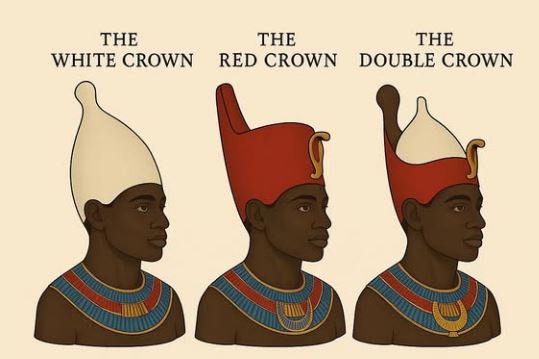
Kemet preserved a royal and spiritual symbolism in which crowns, names, colors, and divine functions were layered. In this interpretation, the crowns can be read as symbols of spiritual jurisdiction. They are also relative levels in an ordered hierarchy: from material, mundane, and earthly work, through elemental, structural, mental, and ideological work, to subtle energetic work. Modern ATR systems preserve related functions, even when the old Kemetic language is no longer used.
| Layer | Jurisdiction | Crown principle | Related practice area | Function |
|---|---|---|---|---|
| 1 | Inner force and self-realization | Nemes headdress / solar lion principle | Meditation, energy work, martial discipline, life-force awakening | The person learns to know the self, regulate the body-mind, and open perception without losing character. |
| 2 | Conscious spirit, ancestral beings, and sentient companion currents | Blue crown / Spiritism, conscious-spirit, and ancestral shepherd principle | Egungun, Egbe, ancestral veneration, house and clan responsibility | The person learns relationship, compassion, lineage responsibility, and how to stand responsibly among ancestors, Egbe, and other sentient spiritual beings. |
| 3 | Earth, land, elementals, earth magic, and terrestrial power | Red crown / Palo, Geb, land, and earth-power principle | Kongo/Palo, elementals and earth magic, Ogboni, Onile, and earth-centered ritual systems | The person learns how power moves through land, matter, boundary, danger, protection, oath, and embodied sovereignty. |
| 4 | Ideation, ideology, concepts, and conceptual deity order | White crown / ideation, ideology, and conceptual-deity principle | Orisha, Lwa, Abosom, Neter, and concepts such as life, death, war, and marriage | The person learns to enter culturally specific systems of divine concepts, relationship, and collective identity without confusing those concepts with the elemental and earth layer. |
| 5 | Wisdom, witness, destiny, and causal law | Atef crown / Fa structural principle | Fa / Ifa, the Odù linguistic structure, Maat, Djehuty, hidden wisdom, and the higher law of sequence | The person approaches the hidden law behind visible life: destiny, consequence, divination, initiation, and the subtle architecture of existence. |
How This Site Organizes Evidence
These public articles are written for general readers. African spiritual and historical questions often require archaeological, linguistic, textual, material, scientific, ritual, and oral-tradition evidence; placing every layer of that record inside one introductory article would bury the teaching under apparatus.
Ancestral Egbe therefore works in layers: citations support particular factual claims; linked articles carry adjacent evidence; and longer studies or manuals hold the fuller multidisciplinary record. Where an interpretation is Ancestral Egbe doctrine, the article names it as doctrine rather than presenting it as settled academic consensus.
The First Crown: Nemes and the Solar Lion Tradition
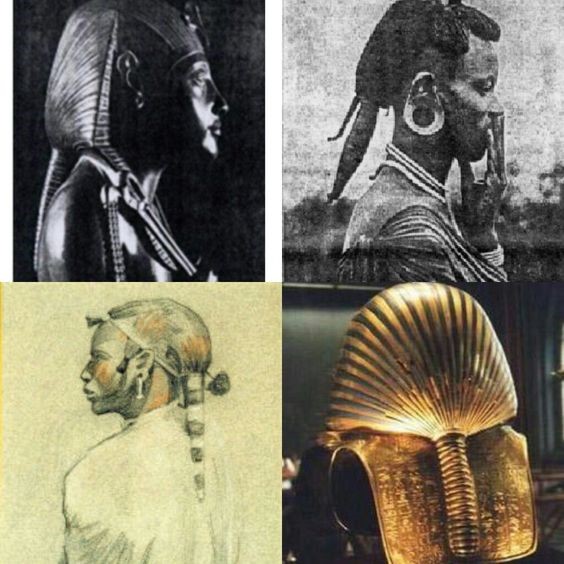
The first crown in this five-crown reading is the Nemes: the striped cloth headdress worn by Kemetic pharaohs as a visible sign of royal and divine status. It covers the top and back of the head, with two broad lappets descending behind the ears and over the shoulders. A braided tail falls at the back. Its alternating blue-and-gold or yellow stripes make the crown immediately recognizable.
The sacred cobra, called the uraeus, sits at the front of the brow as a protective sign of the ruler. In Ancestral Egbe doctrine, the uraeus is understood as rising or risen Kundalini within an Eastern comparison: awakened force ascending into clear royal consciousness. The Nemes represents the solar lion tradition. Its form is based on the Egyptian lion's mane, expressing the pharaoh's status as king of all humans. Its gold stripes are read as flowing ascended light, radiating around the head in the way a lion's mane radiates around the lion. The headdress also preserves the principle of a traditional hair-lock fashion and style that remains visible in African-descended communities today.
This doctrinal reading leads directly into Body of Light practice: the work of stabilizing attention, character, vitality, and subtle capacity before attempting higher ritual responsibility.

Solar African Prince: Natural Nemes Crown
This traditional comparison shows why Ancestral Egbe reads the Nemes as a hair-form principle as well as a royal cloth form. The radiating locks, gathered tail, and head-framing silhouette make the solar African prince visible beneath the later ceremonial construction. This reading counters whitewashed screen portrayals that cast white actors as Egyptian kings and turn Kemetic royalty into an abstraction without African people, African hair, or African masculine radiance. Read the wider media correction on the whitewashing of African antiquity.
Nemes Prayer for Solar Self-Mastery
Modern Ancestral Egbe reinterpretation: this is not a translated ancient Kemetic text. It is a contemporary orientation prayer built from the Nemes, solar-lion, Uraeus, Body of Light, and self-mastery teachings in this article. Use it before meditation, breath practice, or other first-layer Body of Light work; it is not a substitute for lineage-specific rites.
Radiant source, place order upon my head. Let my mind become clear, my breath become steady, and my character become strong. Let the light that surrounds me be disciplined, protective, and useful. May I carry my ancestors with honor, stand in my own authority without pride, and grow into the responsibility that belongs to my path. May my inner force serve truth, balance, and right action.
The First Layer: Inner Force Before Outer Power
The first layer is the development of inner force, attention, health, perception, and self-mastery. The document connects this to Num, Kia, kundalini-like activation, meditative discipline, martial energy practice, and related life-force systems. This is not merely about feeling energy. It is about the person becoming stable enough to perceive without being destabilized by what is perceived.
Without this layer, a person may gain access to spiritual power but still lack peace of mind, good character, or emotional balance. That is dangerous. Power without self-mastery can amplify confusion.
This is why meditation, grounding, breath, movement, and basic energy work remain foundation practices in the Ancestral Egbe path. They prepare the head, body, and nervous system before heavier ancestral, elemental, or initiatory work is placed on the person.
Further reading: Dr. Muata Ashby's Egyptian Yoga: The Philosophy of Enlightenment presents Smai Tawi as a contemporary Kemetic spiritual discipline concerned with uniting the higher and lower self. It is offered here as a complementary modern interpretive path, not as a source for the distinct Ancestral Egbe five-crown model.
The Second Layer: Blue Crown, Conscious Spirit, and the Shepherding Self
The second layer is the jurisdiction of conscious spirit: ancestral beings, Egbe, and other sentient spiritual companions. It develops the self across lineage, memory, reincarnation, obligation, and spiritual inheritance. In Kemetic language, this relates to the Ba and Ka. In Yoruba and West African practice, it includes Egungun, ancestral veneration, Egbe relationship, and the organized relationship between the living and the elevated dead.
In modern Western language, work with many spirits is often called spiritism. Ancestral Egbe places that broad practice within the Blue Crown jurisdiction: a disciplined relationship to conscious beings, not a generalized search for spiritual phenomena. This is the realm where the person learns that the self is not isolated. The person belongs to a line, a family, a people, and a spiritual condition.
The Blue Crown is linked in this doctrine to Egungun initiation and the Egbe path. These are distinct relationships, but both train responsibility toward living spirit, ancestral memory, and companionship beyond the isolated individual. The Masonic Ancestral Restoration Manual is offered as a pre-initiatory practice in this Blue Crown lane: a study and brotherhood discipline that prepares character, ancestral responsibility, and fellowship before deeper ritual office.
The public Blue Crown pathway is the Ancestral Healing and Spiritual Journey. When a person needs supported work, the Ancestral Priest Service Path places diagnosis, healing, shrine foundation, Tile of Egun, Opa Iku, and ancestral priesthood initiation in order. These services are not a status ladder; they are different responses to different conditions and confirmed responsibilities.
For Ancestral Egbe, this is one reason ancestral work is not optional decoration. It is foundational. Before people reach toward high-status priesthood, they must know who stands beneath them, who carried them here, and what unresolved lineage matters are asking for attention.
The Third Layer: Earth Power, Kongo, Ogboni, and Onile
The third layer is the jurisdiction of Earth, land, matter, oath, danger, protection, and terrestrial force. In Ancestral Egbe doctrine, the Red Crown is the crown of Geb, the Earth deity: an elemental crown of land, matter, and terrestrial authority. It links the old earth powers to Kongo and Palo systems, Ogboni, Onile, and related earth-centered practices.
This layer is not gentle sentiment. It deals with boundary, pact, land, grave, oath, force, and the hidden powers of the phenomenal world. That is why it must be approached with respect. Earth systems can heal deeply, but they can also become chaotic when handled without grounding, ethics, and proper guidance.
The Kongo/Palo path on this site belongs in this middle zone. In this doctrine, the initiatory crowning of a Kongo priest is heralding back to that Red Crown's Geb/Earth jurisdiction: a disciplined relationship to land, elemental force, boundary, oath, and responsibility. It should not be confused with general ancestor work or with Yoruba Orisha worship. It carries its own house logic, registration, spirits, elemental relationships, and responsibilities. Enter the Kongo/Palo Student Path.
The Red House is a related Masonic-alchemical house framework. It supports Red Crown literacy through material transformation, chemistry or KEM-istry, alchemy, color, and the Dikenga, but it is not identical to the Red Crown jurisdiction or a substitute for Kongo/Palo house formation.
The Fourth Layer: Celestial and Cultural Deity Systems
The fourth layer is the realm of Orisha, Neter, Lwa, and other culturally specific deity systems. These systems organize divine principles into community, song, color, story, shrine, ceremony, and priesthood. They are powerful, but they are also culturally dense. They require language, etiquette, lineage, offerings, songs, taboos, and discipline.
This is one reason the Ancestral Egbe model does not rush people into Orisha or Ifa as the first step. The fourth layer can be beautiful, but without the prior layers it may become costume, status, or spiritual overwhelm. A person needs self-regulation, ancestral grounding, and earthly stability before higher deity work can sit cleanly.
The Fifth Layer: Ifa, Odu, Maat, and the Hidden Law
The fifth layer is the layer of wisdom, witness, hidden law, destiny, and sequence. The document relates this to Ifa, Odu, Maat, Djhuti, Shu, Amun, the double-plumed crown, and the higher law behind visible life. This is the realm of divination not as fortune-telling, but as access to the architecture of consequence.
Ifa and Odu are sometimes compared to a chart of existence: a way of reading the permutations of life, cause, destiny, imbalance, and correction. This is an advanced layer because it speaks across seen and unseen worlds. It should seal and clarify the path, not substitute for the path.
For public orientation, this site names Hand of Ifa and Full Ifa Initiation as the offered thresholds into this realm. Further continuations may include initiatory works, shrines, and ritual objects within an Ifa lineage—such as receiving the Opan Osun / Osun staff or the shrine of Odù. They are named here only to clarify the scope of Crown Five; they are not offered as online instructions, public rituals, or casual services.
This is also why the order matters. The fifth crown should not be treated as a shortcut. It is not healthy to place destiny-level tools on top of an unstable foundation.
Why Ancestral Egbe Emphasizes the First Three Layers
The public Ancestral Egbe path emphasizes the first three layers: inner force and meditation, ancestral healing and Egungun, and earth-based Kongo/Palo or related elemental work. This is not because the higher layers are rejected. It is because oppressed and displaced African people need foundation first.
The first layer stabilizes the person. The second layer repairs the lineage. The third layer reconnects the person to Earth, land, protection, and indigenous sovereignty. Together they address the deepest wounds created by enslavement, colonization, religious replacement, racial alienation, and loss of cultural memory.
Only after these layers are being handled with discipline does it make sense to ask whether Orisha, Ifa, or other higher initiatory systems should be received. The goal is not to collect crowns. The goal is to become whole enough to carry responsibility.
The Core Warning
Spiritual practice without foundation is problematic and can become dangerous. A person may gain power without ethics, perception without grounding, title without maturity, or initiation without character. The old systems understood this. They used preparation, taboo, elderhood, observation, ritual sequence, and social responsibility to keep spiritual power tied to human development.
The modern seeker often wants the visible crown. The tradition asks whether the head is ready to wear it.
Continue the Path
Read this article beside the larger spiritual journey model, the ancestral hierarchy, and the priest services pathway. Together they explain why diagnosis, foundation, cleansing, shrine work, and initiation are not random products. They are stages in a coherent spiritual development sequence.
Next study
Kemetic Fa and Divine Mathematics
This doctrine article connects the Five Jurisdictions, the Earth jurisdiction, Fa / F-A, the Aft directional principle whose core crown is Atef, Ifá and Afa as regional forms of the Fa cognate, astronomy, astrology, astrotheology, and the paired vulture-and-cobra symbolism. It develops the fifth Atef crown as the fundamental, transcendent structural-memorial layer that sits over Fa/F-A, rather than as simply heaven or earth.
Read the articlePublic Edition, Research Edition, and Doctrine Reading
This page is the public teaching edition of the Five Crowns framework. It gives the general reader the sequence, key objects, and essential visual evidence, including the Nemes comparison because that image is central to the teaching. The Full Scholarly Five Crowns Research Edition, available separately, carries the fuller citation apparatus, comparative material, images, and extended discussion of the I Ching, Tai Chi, and the Great Calabash.
The physical forms and historical names of Kemetic crowns can be studied through museum and collection records. The five-layer jurisdiction sequence, solar-lion Nemes reading, Earth/heaven correspondences, and modern practice comparisons are Ancestral Egbe doctrine: a contemporary teaching map, not a claim that every connection is an ancient Kemetic text or a conventional scholarly consensus. Where this public edition makes a doctrinal comparison without a citation immediately beside it, its detailed research support is retained in the Full Scholarly Five Crowns Research Edition.
- Metropolitan Museum of Art: Double Feather Crown of Amun, for the physical Amun crown object, its materials, date, and Theban provenance.
- British Museum: Amun-Ra Figure, for an object-based reference to Amun's double-feathered form.
- Dr. Muata Ashby, Egyptian Yoga: The Philosophy of Enlightenment, for a modern Smai Tawi interpretation of higher/lower-self integration.
The Full Scholarly Five Crowns Research Edition is the supporting layer for readers who need the fuller scholarly record before relying on a particular comparative claim.