Egungun in Plain Language
Egungun is often introduced as Yoruba ancestral masquerade. That is true, but incomplete. The masquerade is the visible public face of a deeper ancestral institution.
Egungun belongs to the order of Egun: the positive, settled ancestors, lineage powers, and elevated ancestral forces that remain connected to the living. In practice, Egungun can refer to ancestral masquerade, annual festival, lineage ritual, ancestral society, and the priesthood that serves the ancestors through communication, remembrance, elevation, and moral responsibility.
In the Ancestral Egbé comparative hierarchy, Egúngún are treated as a Yoruba group category of Transcendent Dead: individual or collective minor deities whose functional operation exceeds ordinary dead. Some may act as specific Ascended Masters, but the Egúngún category is broader than that office. The many distinct Egúngún names and their full cultural relations belong to later specialized Yoruba study.
At Ancestral Egbe, we understand Egungun as a priesthood of the ancestors: a discipline devoted to helping individuals, families, clans, and communities remain in right relationship with their dead.
In short, this priesthood exists for the elevation of the individual, the family, the clan, and the community, along with the rites, teachings, tools, offerings, prayers, divination, memory work, and public responsibilities used to accomplish that elevation.
Egungun Is Not Only a Costume
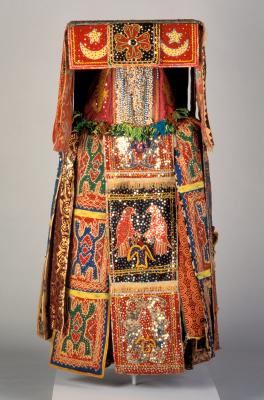
Outside observers often focus on the cloth, movement, mask, and public spectacle. Those are important. Egungun masquerades are known for layered cloth, concealed bodies, drumming, movement, public appearance, and the sense that ancestral power is present but hidden.
But if we stop at the costume, we miss the point. Egungun is not performance alone. It is ancestral technology. The visible garment points to invisible authority: the ancestors who guard family continuity, social order, moral memory, and the community's relationship with the dead.
Egun, Egungun, Elder, and Priest
Clear vocabulary matters because ancestor work can easily become confused.
What Does Egungun Priesthood Do?
Ancestral priesthood focuses on the well-being and upliftment of personal, family, and community spirit. It is not only about ritual power. It is also about learning, courtesy, respect, truth, history, and the proper relationship between generations.
Ancestor Communion
Egungun priesthood works with the dead as active members of family and community memory, not only as historical names.
Funeral and Elevation Rites
The priesthood protects transition, supports proper funerary rites, and assists Egun in rising to or remaining in the light.
Rites of Passage
Birth, naming, maturity, marriage, elderhood, and death are handled as moments where destiny, family, and lineage order must be supported.
Historical Memory
Egungun practice preserves the deeds of ancestors, elders, heroes, forgotten exemplars, and community founders.
Moral Guidance
Public ancestral presence can bless, warn, correct, discipline, satirize, or remind the community of its obligations.
Ancestral Healing
The work addresses personal, family, clan, community, and racial trauma through remembrance, truth, ritual, and repair.
A Priesthood of Memory, Truth, and Ascension
Egungun priesthood remembers the deeds of ancestors and heroes so the population does not forget who made the present possible. It investigates old mysteries, protects the memory of community exemplars, and separates truth from rumor where history has become confused.
It is also concerned with ascension. Whether working with the living or the dead, the ancestral priest assists human souls in elevation: helping the living become better descendants and helping the dead move toward light, order, and completion.
Egungun, Funeral Rites, and Ancestral Elevation
Funeral rites are not an afterthought. In an ancestral worldview, death is a transition that must be handled properly. The dead may need recognition, rites, prayer, offerings, correction, elevation, and protection from spiritual bondage or unresolved conditions.
This is why Egungun priesthood places high value on traditional funerary responsibility. Proper rites support the individual who has died, the family line, the community, and future descendants. Poor transition can become lineage heaviness. Proper transition can become ancestral blessing.
For diaspora communities marked by enslavement, colonialism, forced conversion, and broken burial customs, this concern becomes even more important. The question is not only how to remember the dead. The question is how to repair interrupted ancestral order.
Egungun and Community Protection
Egungun is also social and civic. The ancestors are not treated as private emotion only. They are guardians of family order, children, marriage, elderhood, moral conduct, and community cohesion.
In public ritual, ancestral presence may bless, warn, correct, discipline, entertain, or remind the community of what it owes to the dead and to the unborn. This is why some Egungun roles carry a moral and protective force. They do not merely symbolize ancestors. They help the community remember that the living are accountable before the lineage.
Egungun as Ancestral Governance
Egungun can also be understood as a form of ancestral government. In this frame, the dead are not passive memories. They remain part of lineage law, inheritance, moral order, historical memory, blessing, correction, fertility, and communal protection.
Because that force is powerful, Egungun is not supposed to operate casually. It requires hierarchy, training, ritual control, music, guards, elders, and rules. The public may see movement and cloth, but the working system underneath is organized.
Agba and Iyaagba
Elders of the ancestral system who preserve history, guard the shrine, authorize appearances, and discipline the priestly structure.
Alagba Egungun
Ritual commander who opens and closes the ancestral gate, regulates which ancestral forces may appear, and enforces ritual law.
Alare / Atokun
Spirit controller and ancestral retriever who stabilizes dangerous force, pulls back unstable manifestation, and restores what has become displaced.
Elegun Egungun
The masked ancestral vessel who carries the Egungun in public ritual. This role embodies rather than commands the ancestral force.
Drummers and Chanters
Musicians and praise specialists who tune the ritual setting through rhythm, chant, praise, and signal.
Esentaye
Ritual guards and ancestral enforcers who protect boundaries, stabilize the crowd, and keep the ceremony from becoming dangerous.
Alare, Atokun, and Retrieval Work
Within the governance frame, Alare and Atokun point toward a dangerous ancestral specialty: stabilizing, retrieving, and pulling back spiritual force when the dead, the living, or the ritual setting become unstable.
This is especially important in diaspora conditions. Enslavement, forced migration, unritualized death, broken burial, and lost names created a wounded ancestral current. In that environment, ancestral work is not only celebration. It becomes repair: finding, cooling, cleansing, retrieving, and reseating what history violently displaced.
Men, Women, and the Visibility of Masquerade
Egungun is often mistaken as male-only because the most visible masquerading roles are commonly performed by men. That visibility can hide a more complex reality.
Practice varies by region, lineage, and house. In many contexts, men and women may participate in ancestral practice, lineage work, initiation, support roles, shrine responsibility, offerings, songs, teaching, and community memory, while particular public roles may be restricted by gender. The public face of a tradition is not always the whole priesthood.
What Is an Ancestral Priest?
The phrase ancestral priest can mean two things. In one broad sense, it may refer to any priest of the old family ways: a traditional priest serving the practices of the ancestors. In the more specific sense used here, an ancestral priest works directly with ancestors, ancestral memory, funerary rites, ancestral elevation, and the spiritual components of family and community life.
In a Kemetic frame, this may be compared with work around the Ka and Ba. In a Yoruba frame, this becomes Egungun priesthood: priesthood focused on Egun, lineage, transition, memory, and ancestral responsibility.
Responsibilities of an Egungun Priest
- Teach ancestor veneration, prayer, libation, altar structure, and basic divination where appropriate.
- Support families through births, marriages, funerals, rites of passage, and lineage obligations.
- Help identify ancestral blessings, inherited wounds, taboos, and incarnation objectives.
- Bring ancestral messages into the community through public ritual, white-table work, teaching, and divination.
- Preserve ancestral memory by remembering heroes, elders, founders, and forgotten exemplars.
- Assist Egun and ancestral lines through elevation, repair, annual feedings, and continuing evaluation.
The core responsibility is service. A priest is not simply a person with title, costume, or secret knowledge. A priest is a servant of the good of the people, the lineage, and the sacred order that makes community possible.
Egungun in the Diaspora
Diaspora communities often inherit fragmented ancestral systems. Some traditions preserved ancestral tables, boveda practice, funeral customs, spirit communication, or memorial forms, but not always the full ancestral priesthood structure that once held family, community, and rites of passage together.
For African-descended people recovering ancestral practice, Egungun offers more than a festival image. It points toward a missing social function: the restoration of elders, rites of passage, proper burial, ancestral memory, community truth, family repair, and public responsibility to the dead.
The Diasporic Egungun Movement
In diaspora Egungun practice, many practitioners believe African-descended people have a special need for ancestral healing because of slavery, forced conversion, broken burial customs, lost names, language loss, family separation, and the psychic fracture caused by being cut away from history and lineage.
For this reason, Egungun has been promoted in some Pan-African Yoruba spaces as a corrective priesthood for the diaspora. In the Oyotunji religious community, for example, some elders taught that people should enter Egungun first and spend real time healing the family lineage before moving into Orisha or Ifa priesthood.
Ancestral Egbe carries the same philosophy: ancestral foundation before higher priesthood. Before Palo, before Orisha, before Ifa, and before more forceful ritual authority, the family line should be addressed. The person should be stabilized. The ancestral current should be cooled, clarified, and repaired.
From this view, Egungun is one of the priesthoods best equipped to address the damaged mind state, fractured identity, and wounded psyche of African-descended people in the West. It works directly with memory, dead family, unresolved grief, communal rupture, lineage repair, and the restoration of responsibility before power.
This section is dedicated to Baba Ifakunle, born Baba Oluwole Ifakunle Adetutu Alagbede Manyansa. Known as the Babalawo of Harlem, he is a New York City-based Ifa high priest, author, interfaith minister, and director of Ile Omo Ope shrine in Harlem. He was my Egungun elder and initiator, and he brought me into this movement as a Pan-Africanist. He initiated our Egungun cohort for this mission of community repair, trained us freely, came to our events, functions, and masquerades, and supported the work in practice as well as in teaching.
A key teaching is: weed before you feed. If you water the soil before removing the weeds, you nourish the weeds along with the crop. In spiritual terms, empowerment before healing can strengthen distortion as well as destiny. If a person rushes into initiation, title, tools, and power before stability, unresolved wounds may become amplified instead of corrected.
This is why Ancestral Egbe emphasizes healing before empowerment. The goal is not to produce unstable practitioners with more force than character. The goal is to restore the person, the family line, and the ancestral foundation so that future priesthood develops from order rather than damage.
Research Notes
External museum and academic descriptions commonly identify Egungun with Yoruba ancestral masquerade, Oyo regional traditions, annual or periodic festivals, layered cloth, concealed ancestral power, and public performance for lineage and community. Ancestral Egbe adds the priesthood frame: the masquerade is one expression of a larger ancestral office.
Egungun FAQ
What is Egungun in Yoruba tradition?
Egungun is a Yoruba ancestral institution connected to Egun, the ancestral dead. It includes masquerade, festival, lineage memory, priesthood, ancestor veneration, funeral rites, moral guidance, and community protection.
Is Egungun the same as Egun?
No. Egun refers to ancestral spirits or the dead. Egungun refers to the ancestral power, masquerade, society, and priestly structure through which ancestral presence may be represented, honored, and served.
Is Egungun only a masquerade?
No. The masquerade is the most visible public face. The deeper work includes ancestral priesthood, elevation of the dead, rites of passage, family memory, moral correction, and community cohesion.
Can women be involved in Egungun?
Practice varies by lineage and region. The public masquerading role is often male, but men and women may have roles in ancestral practice, initiation, support, lineage work, and priestly responsibilities depending on the house and tradition.
Suggested next step
Continue Into Ancestor Practice
Study Egungun beside ancestor veneration, ancestral hierarchy, funeral rites, and ancestral elevation. The point is not to imitate a public masquerade. The point is to restore right relationship with Egun, family memory, and ancestral responsibility.