Death Is Transition, Not Deletion
Birth, initiation, marriage, elderhood, and death are great rites of human passage. Of these, death may be the rite most damaged by cultural displacement, colonial religion, and modern funeral industries that often reduce the process to viewing, burial, and paperwork.
Within many African and African-descended traditions, death is not the extinction of the person. The embodied stage of the journey has ended, but that does not by itself establish a person as a Completed One or mean the entire journey is finished. The funeral helps the deceased move from embodied life into the next condition of existence.
This is why African funeral practices cannot be separated from ancestor veneration, reincarnation, destiny, lineage continuity, and spiritual elevation. What a people believe about the person determines what they do with the dead.
What an African-Centered Funeral Does
Separate the deceased properly from the immediate world of the living.
Guide the spirit through the confusion that can follow death.
Introduce or restore the deceased to the ancestral community.
Protect the household from spiritual disorder after a major loss.
Preserve relationship between the lineage and its dead.
Evaluate and honor the incarnation that has just ended.
Prepare the deceased for elevation, further service, or future return.
Reorganize the family around memory, responsibility, and continuity.
The Funeral Is a Launching Platform
In the African-centered model presented here, life and death belong to a continuing spiral. A person lives in the body, enters ancestral or spiritual conditions after death, participates in the life of the lineage, undergoes further development, and may eventually return through reincarnation or progress into higher spiritual function.
A proper funeral begins that transition. It does not always complete it. A person may die carrying fear, addiction, anger, confusion, resentment, trauma, spiritual debt, broken promises, or attachment to the earthly world. Physical death does not automatically create wisdom, purity, or ancestral authority.
Ancestral elevation is the corrective work that helps the dead move toward peace, clarity, proper placement, and constructive relationship with the family line.
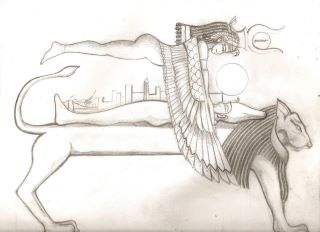
Each tradition names its own process and outcome. In the Kemetic tradition, Per-em-Heru—Coming Forth by Day, also known as the Book of the Dead—guides a cultural process of elevation and transfiguration through which the deceased may become an Akh, a being of light. That is a specifically Kemetic process, not a replacement name for every African funeral or ancestral practice.
The Dead, Family Spirits, and Ancestors Are Not the Same
A clear funeral doctrine requires discernment. Family spirits are deceased members of a household or bloodline. Troubled dead may remain confused, attached, angry, or spiritually disordered. Ancestors are deceased members of the lineage who have enough stability to participate constructively in family life. Elevated ancestors are Transcendent Dead whose primary operation is beyond ordinary ancestral placement and who may serve as stronger forces of protection, instruction, healing, mediation, and oversight.
Not every deceased relative automatically becomes a wise ancestor. This distinction protects the living from sentimental fantasy and protects the dead from being ignored, misused, or forced into roles they are not yet prepared to carry.
This is why ancestral hierarchy, diagnosis, funeral rites, home-bringing, and elevation work matter.
Signs a Burial May Not Have Completed the Transition
Improper burial does not always mean someone did something malicious. It can mean the deceased was buried outside their tradition, without necessary rites, under family conflict, through rushed institutional procedure, or with obligations left unresolved.
- Dreams where the deceased asks for rites, prayers, water, light, food, or a ritual to be redone.
- Dreams or impressions where the dead appear stuck, buried, cold, trapped, confused, or unable to leave the graveyard.
- A strong deceased relative seeking out help from a descendant, priest, elder, or sensitive family member.
- Repeated disturbances around the death date, burial site, funeral objects, house, or surviving family line.
- A sense that the funeral was rushed, forbidden, spiritually wrong, or cut off from the person's true ancestral tradition.
- Family conflict, illness-like heaviness, or recurring grief patterns that intensify after an improper burial or unresolved death.
These signs do not prove a single cause. They indicate that the family should avoid ritual guessing and begin with diagnosis, especially when the dreams, disturbances, or ancestral pressure repeat.
From Burial to Ancestralization
Many African burial traditions treat death as an extended process: biological death, preparation, vigil, funeral, burial, mourning, cleansing, home-bringing, ancestral installation, memorial observance, and later elevation may each carry a distinct function.
The deceased must leave the household as a physically living member without being erased from the family. The living must release the person from everyday physical presence without cutting the soul from its place in the lineage.
Traditional home-bringing rites express this principle clearly. The family may go to the grave, call the deceased, and ritually bring them home so they can rest with the lineage instead of remaining unsettled at the burial place.
African Examples: Kemet, Yoruba, Kongo, and Gede
Kemetic funerary science gives one of the best-known African examples. The Opening of the Mouth ceremony ritually restored the deceased's capacity to breathe, speak, receive offerings, and function in the afterlife. The point was not only memory. It was spiritual animation and continuity.
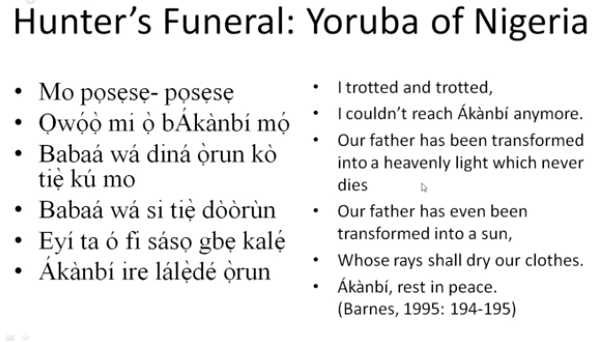
Yoruba funeral material can speak of a father transformed into heavenly light or sun-like presence, showing death as transformation rather than erasure. Kongo and Kongo-American grave practices often treat the grave as a charged threshold where objects, shells, vessels, trees, and symbolic medicines help guide and stabilize the spirit. Haitian Gede and New Orleans jazz funeral traditions preserve African-descended ideas that death and life, mourning and vitality, fertility and cemetery power, belong to one larger spiritual condition.
These examples are not identical systems. They show a shared African-centered concern: the dead must be guided, the living must be protected, and the family must know how to continue relationship without confusion.
Editorial Note: African Metaphysics and Western Afterlife Claims
This article speaks from an African-centered metaphysical position. It does not begin by assuming that European Christian categories are the universal standard by which African spiritual science must be judged.
Historical-critical and African-centered readings often note that early Hebrew death language includes Sheol, dust, pit, silence, grave, and ancestral sleep before later resurrection and heavenly doctrines become dominant. Biblical passages such as Genesis 3:19, Psalm 88, Ecclesiastes 1, and later Second Temple debates show that the afterlife tradition itself developed over time.
From this standpoint, it is reasonable to question whether later Christian claims about death, heaven, hell, and salvation should automatically override African funeral metaphysics. We assert the right to critique European and Western metaphysical claims, just as those traditions have long critiqued African traditions. This is not a claim that metaphysics can be proven like laboratory science. It is a claim that African systems have their own coherence, history, ritual evidence, and practitioner experience.
Funeral Sovereignty Must Be Established While Alive
One of the most practical lessons is simple: do not wait until death to explain your funeral religion. Families often default to the loudest relative, the most available institution, or the most socially acceptable religious form. If a person wants African-centered rites, ancestor veneration, elevation, memorial observance, or restrictions against certain rites, those instructions should be written and discussed while alive.
Name the spiritual tradition, house, priest, elder, or family authority that should guide the rites.
State what rites should happen before burial, cremation, memorial, or final disposition.
Clarify whether Christian, Islamic, secular, or foreign rites are permitted, optional, or prohibited.
Identify shrine objects, ritual tools, journals, photographs, medicines, or sacred items that require special handling.
Name preferred prayers, songs, colors, clothing, offerings, libations, readings, or memorial protocols.
Request home-bringing, elevation, anniversary remembrance, ancestral installation, or later memorial observances when appropriate.
Make space for African funeral service and memorial service support when the family needs trained ritual guidance.
African Funeral Service and Memorial Support
Ancestral Egbe offers African funeral service, memorial service, and ancestral elevation support for families who need help honoring the dead within an African-centered spiritual framework. This may include preparing the family, clarifying ritual needs, supporting memorial language, addressing unresolved transition, and completing funeral rites that were omitted or improperly observed.
When the situation is spiritually unclear, diagnosis comes before ritual selection. Some families need a memorial and prayer structure. Some need cleansing after death. Some need ancestral elevation. Some need support creating a funeral directive before the crisis comes.