Blue Crown · Ancestors, conscious spirits and Egbe
Blue Crown: Ancestral and Egbe Development
From understanding your relationships to sustaining them responsibly: an arc of cultural memory, ancestral care, spiritual companionship, discernment and guided formation.
This public pathway brings study, ancestral and Egbe practice, and guided formation into one map. Individual prerequisites and private ritual instruction belong with your teacher and lineage.
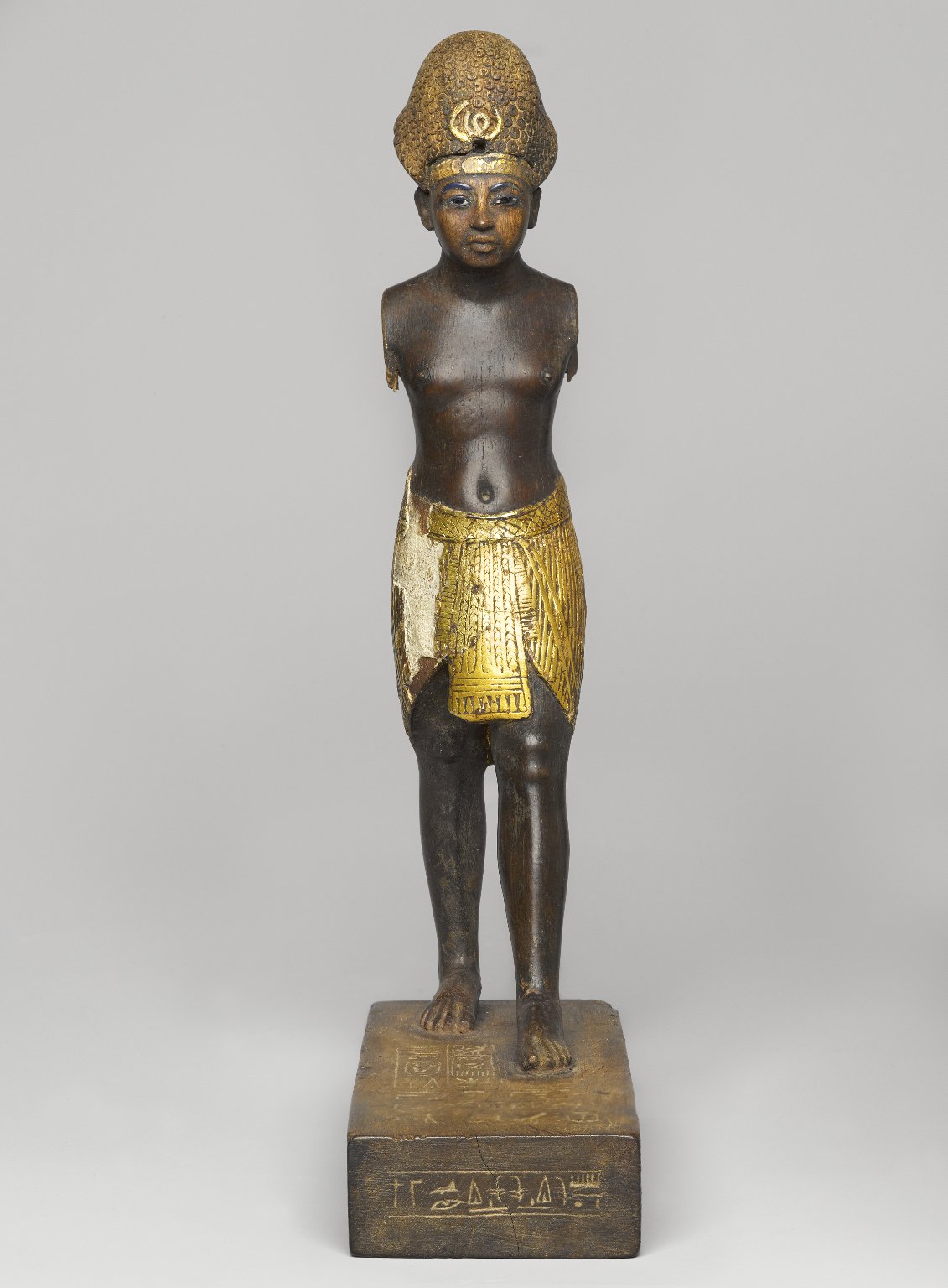
Amunhotep III (Amenhotep III), ca. 1390–1352 BCE, New Kingdom, Dynasty 18. Wood, gold leaf, glass and pigment. Brooklyn Museum, Charles Edwin Wilbour Fund, accession 48.28. Photograph credited to IGallic / Wikimedia Commons, CC BY-SA 4.0. Cropped detail of the head and crown; cropping by Ancestral Egbe. View the preserved full photograph (the statuette's arms are missing). The museum lists Thebes, Egypt, as a possible place collected, not a confirmed excavation location. This historical crown image illustrates our contemporary house framework; it does not establish an ancient ancestral/Egbe curriculum.
What this Crown develops
Core study: The Khepresh Blue Crown explains divine-child imagery, lapis, the Blue Lodge connection and how this house organizes ancestral, Egbe and related conscious-spirit practice.
In our house's Five Crown framework, Blue concerns relationship with conscious spiritual beings: ancestors, lineage and Egbe. Its development is relational, not simply the collection of power, titles or objects. Cultural knowledge, reverence, reciprocity and responsible conduct provide the ground for deeper work.
You may enter through cultural restoration, household ancestral practice, a question about recurring difficulties, or a wish to understand your spiritual relationships. Not everyone seeks priesthood. The fuller arc makes room for personal relationship and repair as well as more committed formation where appropriate.
This page brings the map together; the Ancestor Veneration hub supplies fuller public study and the Ancestral Healing Journey explains the problem-solving service layer. Healing is one part of the arc, not the whole meaning of ancestor relationship.
Two related relationships, not one interchangeable category
Ancestral lineage
Ancestral work concerns those who came before, family memory, inherited gifts, responsibilities and unresolved relationships. Learning to distinguish settled ancestors from unresolved dead matters; every dream or troubling presence should not be assigned the same meaning.
The Egbe model describes spiritual companions, destiny peers and unseen allies linked to the soul before birth. This is not simply another name for deceased family members. Both ancestral and Egbe relationships belong in this house's Blue Crown presentation without erasing their differences.
The Egbe Manual introduces its own practical relationship and discernment. The Egbe Appeasement Overview explains a particular support route; it is not a prescription for everyone who studies Egbe.
The developmental arc
The following areas organize learning and support. They are not numbered Crown ranks, a fixed initiation order or a requirement to buy every service. Ancestral and Egbe work may develop alongside one another, with individual readiness and guidance determining the next work.
Develop a respectful rhythm appropriate to the relationship. The Ancestral Manual and Egbe Manual support distinct practices. An ordinary home altar is not automatically an initiated shrine or a priestly office; see Altars vs. Shrines.
Discernment, diagnosis and repair when needed
Do not assume that every difficulty is ancestral or that every sign demands escalation. The Standard Reading and Incarnation Objective Reading describe existing assessment options. Spiritual discernment does not replace appropriate medical or mental-health care.
Appropriate support and deeper relationship
Where assessment supports it, discuss repair, elevation, a structured shrine relationship or Egbe-specific support. These respond to different needs; receiving one does not establish that all others are necessary. See the Elevation and Lineage Elevation explanation before assuming what that work means.
Integration, responsibility and optional further formation
Carry learning into relationships, daily conduct and service. More committed initiatory or priestly formation has its own prerequisites, supervision and responsibilities. A reading score, an intense experience or ownership of a shrine does not by itself establish authority to serve or initiate others.
Study and services within the Blue Crown Pathway
The Crown Pathway combines learning, practice and an individual Initiatory Journey. A public Reader Journey introduces the field; a Study Program assigns readings and assessments. Service options support particular needs and do not form a required list of initiations. The master Service Path table is a shorter services view, not the full Blue Crown curriculum.
This public resource crosswalk connects study and service without creating an automatic assignment. Reading, ritual participation, formal receipt and authority remain distinct; your teacher confirms individual prerequisites and the appropriate form of further work. See the shared pathway terminology.
Atori: broader ancestral reach, not a deluxe pot
In our house, Isan is the smaller bundle for a more limited personal or family ancestral relationship. Atori is the large Egúngún shrine bundle: a gathering of the extended ancestral family that supports an ancestral priest's work across other people's lineages. An ancestral pot is a different construct for the recipient's own ancestral relationship. Atori's defining distinction is ancestral reach and jurisdiction, not simply size, price or a deluxe configuration of an ancestral pot.
Atori can function as an ancestral shrine or bundle. Its broader reach is understood through more remote Egungun ancestors whose descendants extend across many families. The movement toward shared primordial ancestry is a house doctrinal explanation of ancestral convergence, not a scientific genealogy claim.
The large Atori bundle is required equipment in our ancestral/Egúngún priesthood: part of the priest’s spiritual toolkit, not an optional substitute for a personal family shrine. Possessing it alone does not make someone a priest. Priesthood also requires the appropriate initiation, additional medicine, training and responsibilities, with masquerade eventually received as part of the development.
In the house distinction described here, the smaller Isan commonly has seven or nine wrapped sticks. Atori is the larger bundle, with a larger number of sticks and a broader ancestral scope. We do not establish a fixed Atori stick count here, or treat numbers alone as proof of priesthood or jurisdiction.
The bundle stories help explain the form: sticks can stand for ancestral bones, and the cloth binds the ancestral family into a gathered whole. These are sacred narratives and living interpretations, not interchangeable construction specifications. Across wide regions and communities, different versions can emphasize family remembrance, funeral obligations, masquerade, settlement or communal continuity.
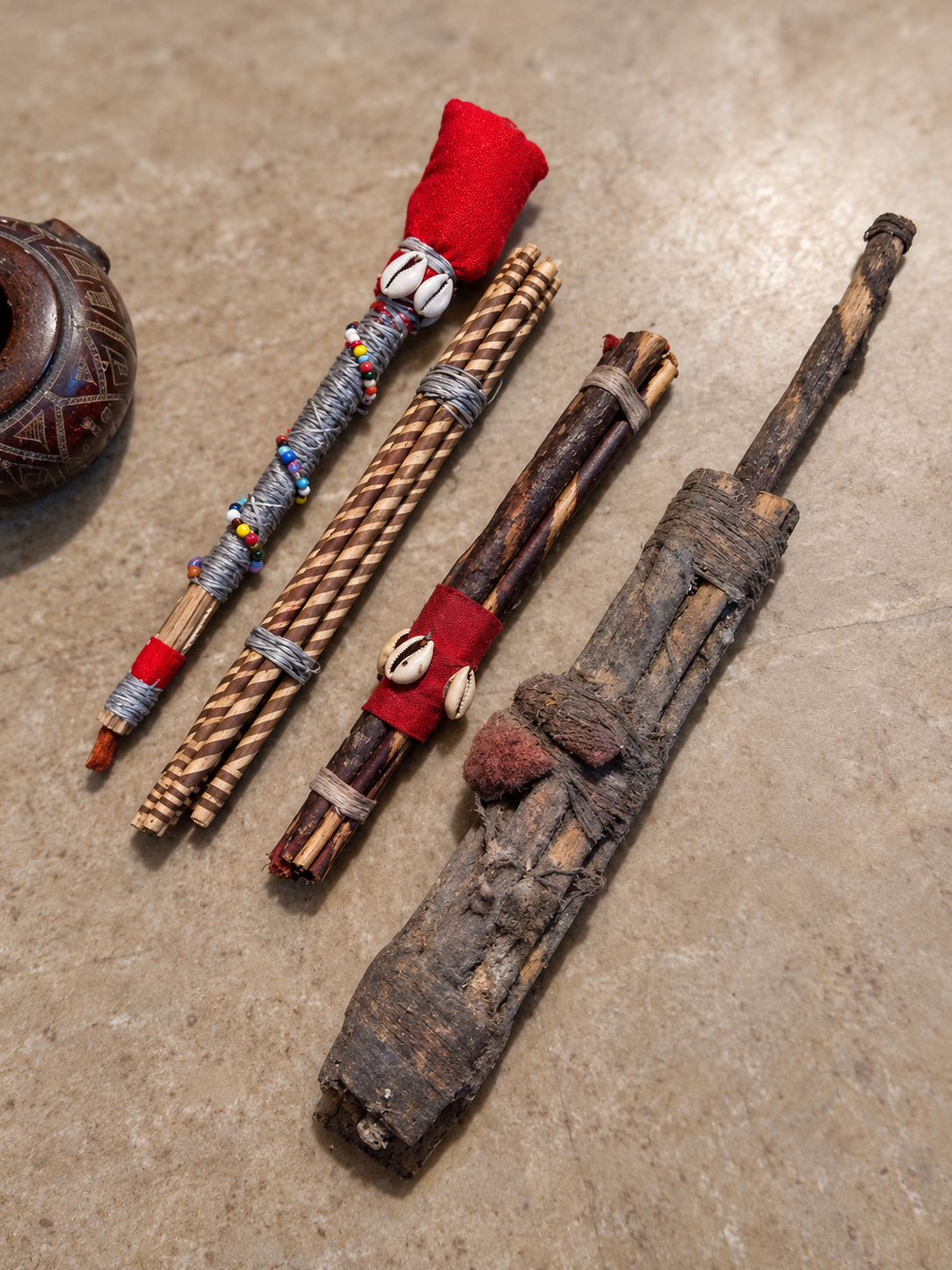
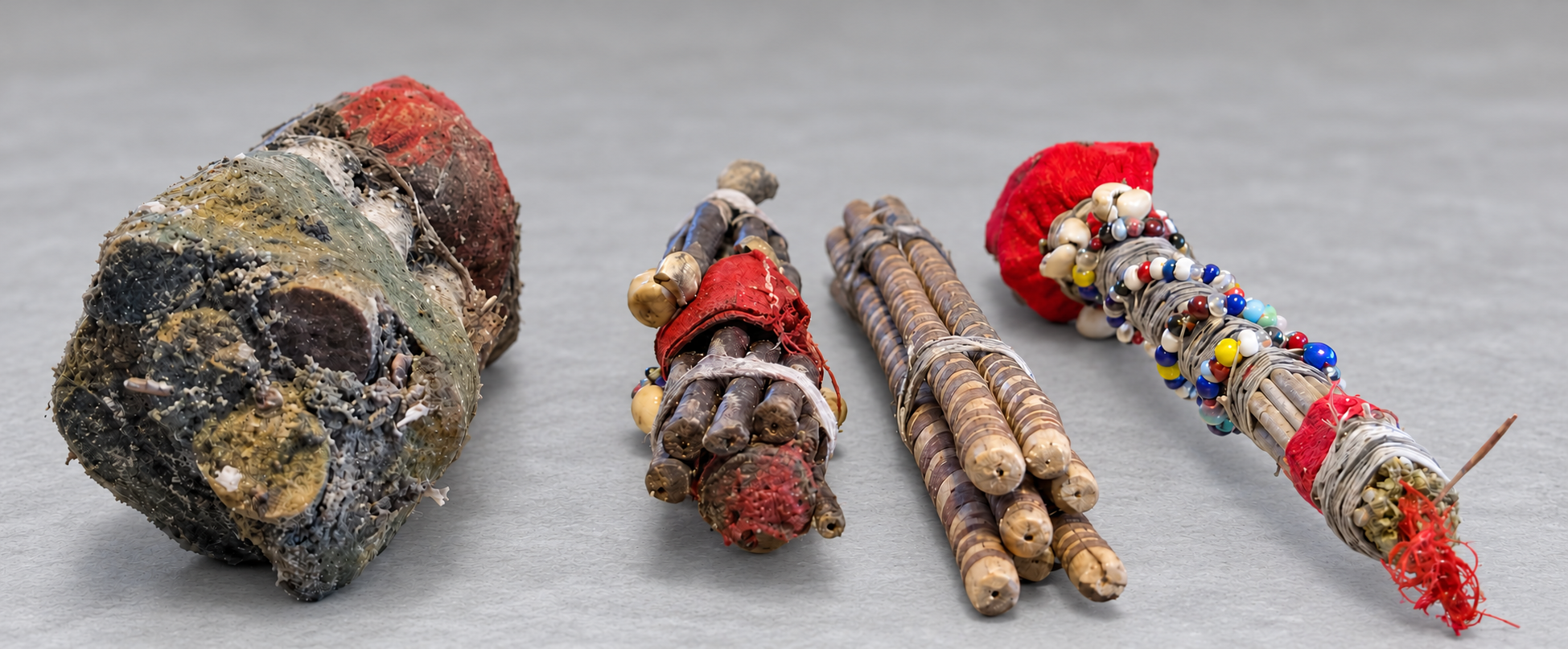
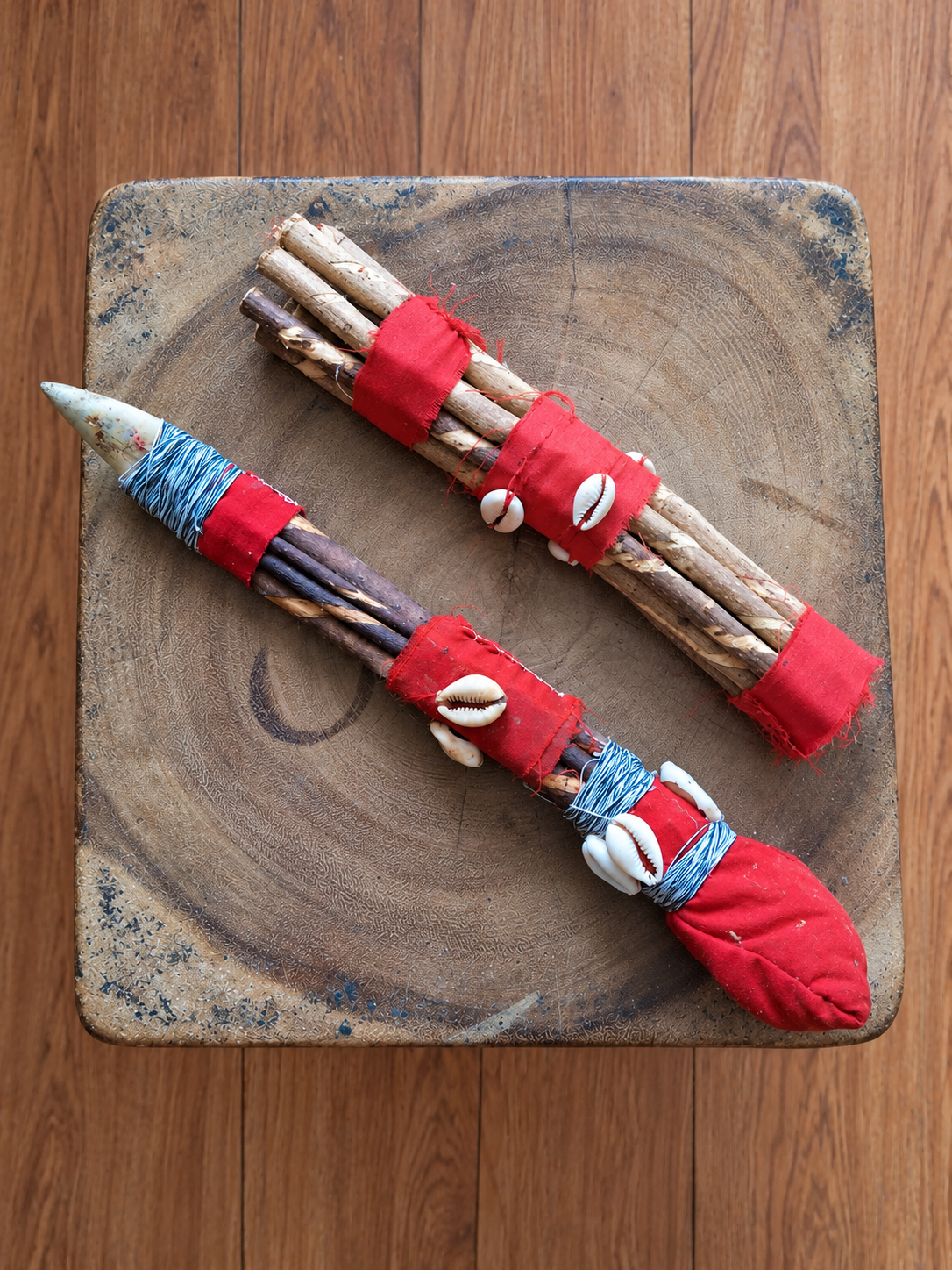
These AI-assisted educational illustrations are based on the owner's approved photographs of prepared, unconsecrated collection examples. Consecrated shrines are generally not displayed publicly. The original photographs remain unchanged; reconstructed details are not reliable evidence of exact stick counts, materials or components. Perspective also affects apparent size.
AI-assisted educational illustration — not a documentary photograph. The small African pot provides visual context, not a calibrated scale. From left to right: reinforced Diasporic Ancestral Emblem; an alternate traditional Nigerian Isan form without red cloth, retained in the collection but not offered by our house; traditional red-cloth and cowrie Isan; and the larger Atori with its attached handle, not a staff.Educational illustration, slightly adjusted by AI for clarity. From left to right: Atori, traditional red-cloth Isan, the alternate traditional form without red cloth, and the reinforced Diasporic Ancestral Emblem.
The owner identifies the beaded, red-pouch example as a reinforced Diasporic Ancestral Emblem. Its red fuzzy feather is a parrot feather; our house frequently uses diasporic emblems within Palo practice. The illustrations do not document the feather's precise appearance. Regional and house forms differ; comparable function does not make every bundle the same traditional construct.
After counting the actual collection examples, the owner identifies nine sticks in the traditional red-cloth bundle and seven in the traditional bundle without cloth. Overall thickness is not a dependable guide to stick count; these counts describe the actual objects, not the illustrated ends.
In the traditional teaching received by our house's founder, seven and nine may also distinguish what is given to a girl and a boy: seven associated with the girl, and nine with the boy and the ninth day after birth. He relates this to birth-rite numbering. This is a reported teaching, not a universal rule for every lineage or bundle; he has also encountered variations.
AI-assisted educational illustration. Prepared, unconsecrated examples, approved for public display. Above: a basic traditional Isan. Below: a reinforced warrior ancestral version, with a buffalo-bone arrow tip representing Oya, as identified by the owner. The original photograph is preserved; illustrated details are not an exact component record.
Àtòrì / Atori: the name and its spiritual interpretation
Àtòrì, written Atori without tone marks, names the tree Glyphaea brevis and sticks or switches made from its wood. Kew treats Glyphaea lateriflora as a synonym of Glyphaea brevis. The Ifá teaching glossary hosted by the Atlanta University Center library also identifies atori as an ancestral sacred stick under the older botanical name.
In the ancestral practice described here, sticks may be consecrated and bound as a ritual bundle expressing family unity and continuity across generations. The shrine takes its name from the wood used to make it. Ancestral consciousness is a spiritual interpretation of that function, not a literal translation of the tree's name. The word for the wood does not by itself establish that any bundle is the full priestly shrine or confers cross-lineage authority.
Orí means head and is associated in Yoruba spiritual thought with personal destiny and the inner spiritual head. Similarity of unmarked spelling does not establish a shared linguistic origin. In the spelling used here, Àtòrì ends in òrì, whose tones differ from orí. A derivation from orí remains unverified; the interpretive connection must not be presented as established etymology.
In the patakí posted by Omi Buyi under “The Shrine” in “Egun (Ancestors)” on February 1, 2004, a son avoids his deceased father’s funeral rites and leaves the body beneath a sacred ìrókò tree. After years of hardship, a diviner directs him to recover the remains and fulfill those obligations. He finds bones and remnants of clothing, gathers the bones, binds them with strips of his father’s red garments, and performs the required rites. The account explains the prepared sticks as representatives of ancestral remains, bound in red cloth.
The surrounding description specifies nine sticks. This particular account does not identify the stick-producing tree as àtòrì or name an Odù. Its ìrókò is the tree beneath which the father’s body was left; that is not evidence that the bundle must be made from ìrókò. Here the story illuminates the bones, red wrapping and ancestral obligation without establishing one universal shrine recipe.
Other Egúngún narratives emphasize different parts of the practice. A related account, published in 2021 and credited to Gbade TV, describes a widow and children returning for their father’s remains and bringing them in colorful cloth to a new settlement. Its focus on relocation, communal return and masquerade belongs to a separate discussion, rather than replacing the red-cloth bundle story here. Related masquerade/settlement story: Yoruba Traditional & Cultural Renaissance, November 6, 2021, credited to Gbade TV.
Àtòrì and Osir: Gathering the Ancestral Whole
Within our house, the àtòrì ancestral bundle represents the gathering, ordering, and restoration of ancestral relationship. We draw an interpretive association with the Yoruba verb tò, “to arrange” or “put in order.” This is our house’s symbolic reading rather than an established etymological breakdown of the tree’s name. The separate sticks, gathered and bound into one sacred form, express the restoration of connection among ancestors, descendants, and the living community.
We understand this principle alongside the Kemetic mysteries of Osir, widely known through the Greek-derived name Osiris. In the traditions of his dismemberment and restoration, the scattered divine body is sought, gathered, and restored through the work of Aset—known in Greek as Isis—and her divine companions. For our house, this becomes an image of ancestral healing: recovering what death, displacement, conflict, and forgetfulness have scattered, and restoring it to a coherent spiritual whole.
A related image appears in the late Greek-language account preserved by Plutarch in On Isis and Osiris, §§15–16. The chest containing Osir’s body reaches Byblos, where a tree grows around and encloses it. The king has the trunk cut into a palace pillar, unknowingly incorporating the concealed divine body into his dwelling. Aset discovers its location and retrieves the chest. Here, Osir is enclosed within a tree rather than simply transformed into one; the wood becomes both his covering and the support of a house.
Our interpretation brings these images together: the gathered sticks become a figure of the gathered lineage, while the tree enclosing Osir evokes ancestral presence held within wood. This also resonates with the djed, the Kemetic emblem of stability associated with Osir’s backbone. Through these correspondences, we understand the ancestral bundle as an image of restored continuity: many lives gathered into one lineage, and ancestral memory becoming a source of stability for the living.
We present this as our house’s comparative African spiritual interpretation. It expresses a meaningful relationship between Kemetic and Yoruba sacred imagery without claiming that the Yoruba word àtòrì derives from Osir’s mythology or that Egúngún has been historically proven to originate in his worship.
These are existing destinations for further information, not a recommended bundle or guaranteed outcome. Discuss which, if any, fits your situation.
Ancestral Manual — structured household ancestral learning beyond the public overview.
Egbe Manual — study and practical relationship with spiritual companions.
Isan Egun bundle — the basic $180 ancestral emblem/bundle, distinct from a pot.
Ancestral pots — a $300 starting module includes the clay pot and appropriate preparation. Optional additions support an affordable, modular approach; deluxe work is individually quoted.
Teja de Eggun — optional, independently receivable when indicated, and capable of later integration into a pot. The pot can also have the Isan bundle integrated into it; individual needs determine what is required.
Egbe shrine service — learn about an Egbe-specific point of relationship and continuing care.
Bring one question, your completed readings and any relevant prior training to your mentor or a guidance conversation. The next step may be study or a steadier home rhythm rather than a service or initiation. This overview creates no automatic assignment, enrollment or student credit.
Discuss shrine forms, initiation requirements and supervised practice with your teacher. Private procedures and individual student/member records are not part of this public overview.