How to use this lesson
Learning Map
Read this page in order the first time. It begins with the basic language of pattern, then shows how that language appears in Kemetic sign, architecture, African settlement design, Divine Mathematics, and inner cultivation.
- Recognize the pattern: learn the public vocabulary of center, line, circle, spiral, grid, proportion, and cycle.
- Read the context: see how image, sound, number, and sky-language work together without flattening African cultures into one system.
- Follow the scale: move from sign and body to household, settlement, temple, stars, and Divine Mathematics.
- Apply the principle: use pattern to improve attention, practice, relationship, and responsibility—not merely to collect symbols.
What Sacred Geometry Means Here
Sacred geometry is the study of meaningful pattern. A circle, line, crossroad, spiral, square, grid, center, or measured proportion can be used to organize space, memory, ritual action, art, architecture, and attention. Geometry becomes sacred when a community uses form to carry an understanding of relationship: above and below, center and edge, ancestor and descendant, earth and sky, part and whole.
The site approaches this as a connected grammar rather than a collection of isolated emblems. A point, line, circle, spiral, pyramid, crossroad, grid, or star may appear as image; as a proportion or number; as a sound-pattern; as an astronomical relation; and as an instruction for how a human being should organize attention and conduct. The useful question is always contextual: who uses the form, where, for what purpose, and inside what living system of knowledge?
One Pattern, Four Public Languages
For beginning study, it helps to separate four registers that continually meet inside Ancestral Egbé Divine Mathematics:
- Image and sign: the circle, central dot, pyramid, ankh, flower field, spiral, crown, and Medu Neter image can carry a teaching visually.
- Sound and speech: hesi, hekau, praise, chant, breath, and sacred name turn rhythm and voice into a lived pattern.
- Number and proportion: binary sequence, ratio, symmetry, direction, and recurrence describe how a form is counted, balanced, or unfolded.
- Sky and cycle: the Sun, stars, planetary sequences, seasonal return, and architectural orientation place earthly work inside a celestial order.
These are not four separate sciences competing for ownership. They are four ways of reading related structure. A small relationship can recur inside a larger one: body to household, household to city, seed to tree, atom to solar system, solar system to galaxy. “Fractal” is useful here as a teaching word for recurring relation across scale, not as a claim that every form has identical physical properties.
Medu Neter: Sacred Geometry of Image and Sound
Kemetic writing, properly named Medu Neter, is conventionally called “hieroglyphics,” a name inherited from Greek description. In the Ancestral Egbé reading, Medu Neter is not only writing to be decoded; it is a visual and sonic system in which living images, phonetic values, and ritual concepts can answer one another. The Amun, Amma, Olokun, and Aum study develops this image-and-sound relationship through water signs, sacred utterance, and breath.
The solar sign of Ra, commonly shown as a circle with a central point, introduces a compact lesson: center, radiance, circumference, and the force that gathers a field around itself. The pyramid makes the same lesson architectural: a stable base, a rising apex, direction, and a meeting of earth-bound work with celestial orientation. The ankh carries another relation—life held through a loop, upright axis, and crossbar. These forms are not decorative substitutes for theology. They are visual doors into it.
This is why Kemetic Fa and Divine Mathematics matters here. Its study of the crown signs, phonetic Fa reading, causal structure, and Ifá/Afa relationship shows how image, sound, and number operate together rather than as disconnected disciplines.
Geometry Is More Than Ornament
People often meet sacred geometry through modern diagrams, crystals, or social-media symbols. Those can be useful entry points, but they are not the whole subject. Geometry has always been practical: measuring fields, setting building lines, creating stable structures, dividing resources, weaving cloth, mapping direction, and making a shared visual language.
The Rhind Mathematical Papyrus shows that Kemetic scribes worked with area, ratio, measurement, and the slope of pyramid-shaped structures. The British Museum’s study of the papyrus describes the seked, a practical way of calculating a pyramid’s slope from height and base length. That is geometry serving construction, administration, and a measured civilization.
In the Ancestral Egbé frame, this practical level matters. Sacred geometry is not an excuse to abandon measurement for fantasy. A pattern must be able to stand in material reality before it can responsibly be used as a spiritual analogy.
Pyramids, the Stars, and Ordered Space
Pyramids make the architectural question visible at its largest scale. They are not simply large triangles. A pyramid complex requires surveying, level ground, stable proportion, orientation, labor coordination, transport, material knowledge, and a ritual understanding of what the structure joins together. The Smithsonian notes that astronomical knowledge was necessary to orient Egyptian pyramids to the cardinal directions; it also records the practical use of water-filled trenches to level a perimeter.
The sky was part of the builder’s field of reference. The Met describes standardized Old Kingdom pyramid complexes arranged on an east-west axis, with the pyramid in the western desert and the valley temple toward the eastern cultivation. Later Kemetic astronomical ceilings, calendars, and stellar imagery show that celestial observation was part of a larger religious, agricultural, and state system. A structure aligned to the directions or to a visible celestial cycle places human work inside a measured world.
Many ancient cultures aligned monuments, temples, tombs, and ritual spaces to cardinal directions, solar events, lunar events, horizons, or particular stars. The responsible interpretation is not that every old structure encodes the same astronomical program. It is that sky observation, seasonal timing, and the orientation of sacred space were serious forms of knowledge in many civilizations. In the Ancestral Egbé reading, this is a central example of Divine Mathematics: celestial pattern is studied, measured, and translated into earthly form.
The Seed of Life: Center, Relation, and Generative Pattern
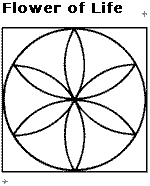
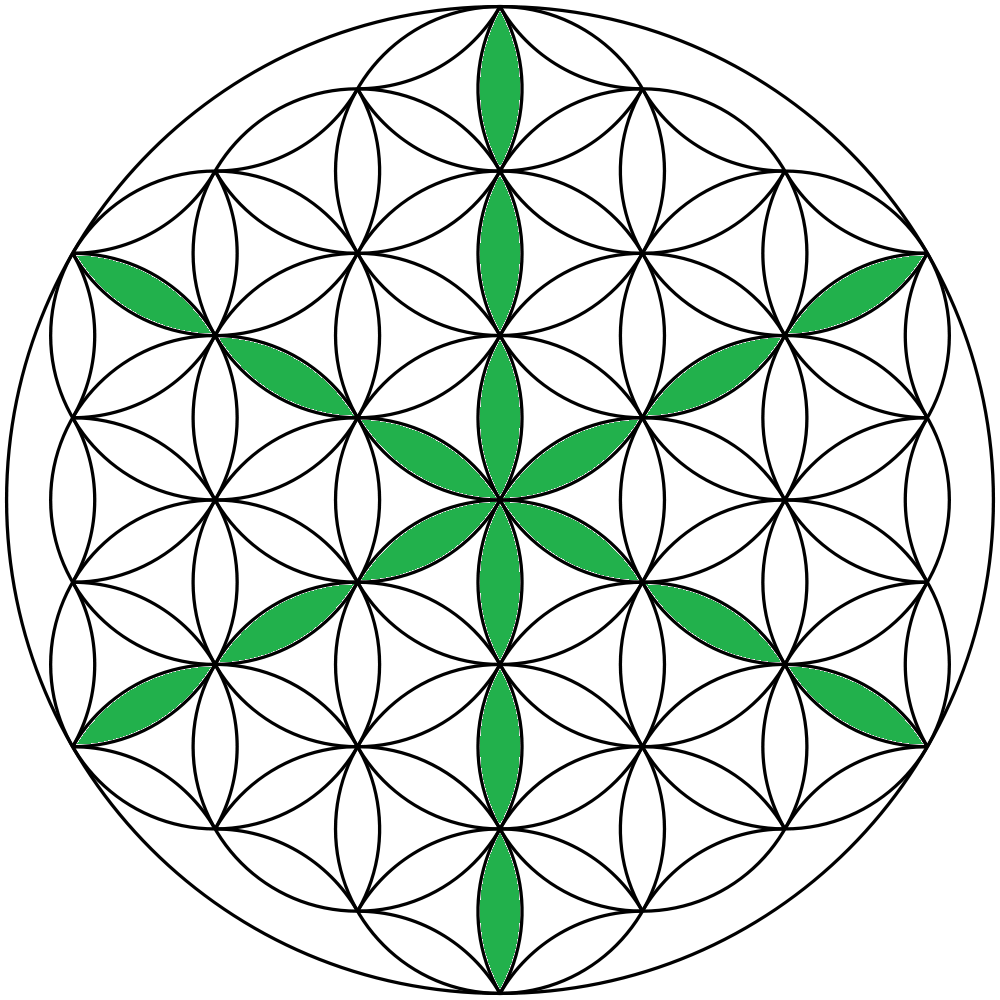
The Seed of Life is the modern sacred-geometry name often given to a pattern of seven equal, overlapping circles: one center and six surrounding circles. It produces a six-petaled field around a central point. The pattern is useful because it makes several geometric principles immediately visible: a center can generate a field; equal spacing can create balance; repetition can create a larger whole; and every outer circle remains related to the center.
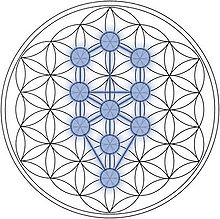
The seven-circle generative form, and more elaborate flower forms built from the same overlapping-circle logic, occur across many traditional visual cultures. Their historical names, material settings, and ritual uses differ. Read a pattern on a temple, textile, floor, vessel, wall, or diagram inside its own culture, then trace the relationships that its history and living practice disclose. Do not collapse distinct visual languages into an undifferentiated universal.
Within this website’s doctrine, the Seed of Life is a teaching diagram rather than an object of worship. It can help a student contemplate how one principle becomes many expressions without losing relationship to its center: Ori and its choices, a household and its roles, a lineage and its branches, a crown and its jurisdictions, or a celestial pattern translated into a built form. The diagram is not the teaching by itself; it is a way of seeing relationship.
African Geometric Knowledge Is Not an Afterthought
African societies have carried complex geometric languages through architecture, textile design, body art, tools, ritual spaces, cosmograms, and divinatory layouts. The Smithsonian records elaborate geometric relief decoration in traditional Asante architecture and preserves scholarship specifically on the geometry of Kuba art. These are not empty patterns added after the real work was complete. They are ways of making social memory, status, relationship, and cultural order visible.
Fractal geometry makes this structural intelligence especially visible. A fractal is a pattern in which a relation recurs at different scales: a small arrangement can echo a larger arrangement without being a mechanically identical copy. Ron Eglash’s work on African settlement architecture identifies deliberately recursive forms in buildings, streets, art, religion, engineering, games, and social design. The point is not that African communities accidentally happened to look geometric. The research describes intentional design processes that joined spatial form to social order.
At Logone-Birni in Cameroon, nested rectangular enclosures and a rectangular spiral route toward the chief’s palace show a geometry of approach, rank, and increasing formality. Ba-Ila settlements in southern Zambia repeat a ring structure from dwelling to family enclosure to village, carrying distinctions of entrance, household, livestock, ancestor, and chiefly center across scale. Nankani compounds offer another useful comparison: nested rounded forms and pot-like architectural relations place household, life-cycle, and ancestral continuity inside a visible spatial order. These examples make the central lesson concrete: a settlement can be a map of relationship, not merely a collection of buildings.
Pattern can also prepare a space for spiritual attention. The National Museum of African Art documents a Dogon diviner drawing parallel and intersecting lines in the earth to establish a divinatory space. The grid is not merely a picture. It organizes a place where observation, interpretation, and communication with the invisible may occur.
This is one reason the site studies Dikenga, crown systems, divination, architectural forms, and African design together. Each provides a way of thinking about center, threshold, cycle, direction, and relationship without pretending that Kongo, Dogon, Yoruba, Kemetic, Akan, or diasporic systems are identical.
Akan Adinkra: Symbols That Teach Relationship
Adinkra is a living Akan visual language from Ghana. Its symbols carry concepts, proverbs, social memory, and spiritual orientation through cloth, architecture, objects, and public design. They show why sacred geometry is not only about abstract diagrams: a compact form can hold a complete lesson for a household, a people, or a student.
Gye Nyame
“Except God.” A form for divine supremacy, omnipotence, and the source beyond human control.
Sankofa
Often pictured as a bird looking back or a stylized heart. It teaches that the past must be recovered in order to guide the future.
Nsoromma
“Child of the heavens,” or star. It connects guardianship, the celestial order, and relationship to the creator.
Nyame Dua
“Tree of God.” A sacred altar and protection image that makes divine presence, strength, and rootedness visible.
These forms should be learned as Akan teachings, not stripped of their people and turned into generic decoration. See the Adinkra reference guide and the University of Michigan’s Adinkra resource for further study.
Kemetic and Continental Teaching Forms
The ankh joins loop, upright axis, and crossbar in a Kemetic image of life, enduring existence, and divine breath. The Eye of Heru, conventionally called the Eye of Horus, carries healing, royal protection, and restored wholeness. Cowrie shells carry another material language across African regions: historical currency, value, fertility, sacredness, and, in particular traditions, divination and spiritual protection. For the wealth-and-exchange dimension of cowries, continue to Ajé, Olókun, and Ancestral Wealth.
From Geometry to Divine Mathematics
Divine Mathematics is the Ancestral Egbé framework for reading the relationship between physical number, pattern, and structure and divine archetype, law, and manifestation. Sacred geometry is one of its languages, but not the entire system.
- Geometry asks how a form is arranged, measured, or repeated.
- Architecture and craft ask whether that form can hold weight, organize a space, or carry a community’s work.
- Divination asks what a pattern reveals about condition, relationship, timing, obligation, and consequence.
- Divine Mathematics asks how these material patterns relate to archetype, cosmology, ethics, and the lawful process by which an intention becomes a lived reality.
That broader question is why this site joins sacred geometry to astronomy, astrology, number, divination, ritual design, and the Five Crown model. No single symbol is the doctrine. The structure of relationships is the subject.
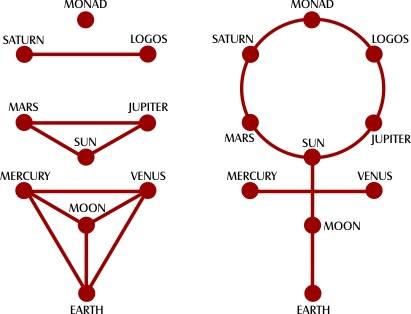
Spiral, Ram Horn, and the Ascending Current
The spiral is a practical image of return, expansion, and refinement. A ram horn, shell, vine, whirlpool, and many stellar forms make the curve visible in the natural world. Fibonacci sequence and related spiral diagrams give students one mathematical way to study how growth can repeat through changing scale. They are useful models for proportion and recurrence; they do not replace the specific cultural meanings carried by a sacred animal, a shrine image, or a Kemetic sign.
Within the Kemetic Ashram teaching, the spiral also helps explain Kundalini cultivation: a vital force is refined through stages rather than treated as one flat quantity. The Apedemak solar-lion current gives that upward movement an African-centered image of embodied solar realization. This is a path of disciplined breath, attention, service, and formation—not a claim that a diagram alone produces attainment.
At the introductory level, the student only needs the core relation: the raw, moving current is developed toward a more coherent and luminous expression. The body, the mind, the field of action, and the larger celestial order are read as connected scales of one training problem.
Three Public Ways to Study Sacred Geometry
First, observe. Learn to notice proportion, repetition, direction, center, symmetry, and asymmetry in a building, cloth, landscape, body posture, or diagram. Observation develops precision before interpretation.
Second, compare carefully. A cross-in-circle, a four-direction diagram, a spiral, or a grid may appear in more than one culture. Compare function, setting, relationship, and lineage before making claims. Similar visual form is an invitation to study connection; it is not permission to reduce distinct cultures to sameness.
Third, apply proportion to life. Sacred geometry is useful when it improves order: a meditation space that supports attention, a daily practice with a sustainable rhythm, a household that has clear roles, or a study sequence that moves from foundation to responsibility. The form must improve relationship, not merely look impressive.
Sacred Geometry and the Human Vessel
The body is not a rigid diagram. Yet posture, breath, balance, movement, and attention all have pattern. The site’s Subtle-Body Literacy material introduces the relationship among aura, meridians, chakras, and the body’s energetic maps. The Body, Breath and Energy practice shows how breath rhythm can organize attention and inner stillness.
Within the Nemes Crown path, Sacred Geo work is therefore not presented as a shortcut to status. It is a language of mental and energetic organization that can support a larger practice of self-governance. The right question is not, “Which symbol gives me power?” It is, “What pattern helps me become more coherent, responsible, and able to carry what I claim to seek?”
Deepen the Study in This Order
These links are not a requirement to master every subject at once. They are the site’s recommended sequence when you want to move from introductory geometry into the connected Ancestral Egbé system.
- Image and sacred sound: Amun, Amma, Olokun, and Aum explains how sign, name, water, breath, and sacred utterance meet.
- Pattern, causality, and divination: Kemetic Fa and Divine Mathematics develops the relationship among crown sign, number, lawful manifestation, Ifá, and Afa.
- Cycle and ancestral relation: Dikenga: the Kongo Cosmogram introduces a distinct Kongo map of direction, life, death, return, and relationship.
- Embodiment and perception: Subtle-Body Literacy and Body, Breath and Energy place pattern inside breath, posture, attention, and the human vessel.
- Disciplined formation: Kemetic Ashram shows how the Nemes Crown path turns study into a sequenced cultivation practice.
What This Article Does Not Claim
This public article does not claim that every geometric design is a secret code or that sacred geometry replaces mathematics, architecture, therapy, medical care, priesthood, or divination. It does not disclose private ritual procedure.
It offers a disciplined starting point: geometry becomes sacred through use, relationship, context, and responsibility. The next step is to study the specific system in which a form lives, then learn how that system connects pattern to practice.
Sources and Further Study
- British Museum: the Rhind Mathematical Papyrus and practical Egyptian geometry
- Smithsonian: astronomy, cardinal orientation, and Egyptian pyramids
- Metropolitan Museum of Art: the east-west alignment of Old Kingdom pyramid complexes
- Smithsonian: geometric decoration in Asante architecture
- Smithsonian Libraries: The Geometry of African Art I Bakuba Art
- National Museum of African Art: Dogon divinatory grid and ritual space
- Ron Eglash: African Fractals in Development
- Ron Eglash: Fractals in African Settlement Architecture
- Adinkra Symbols: Akan visual language, proverbs, and meanings
- University of Michigan DAAS: Adinkra symbols
These sources support the public historical examples of measurement, design, and divinatory space. The wider relationship among pattern, sacred order, and Divine Mathematics is stated here as Ancestral Egbé doctrine.