The Circle Is the Teaching
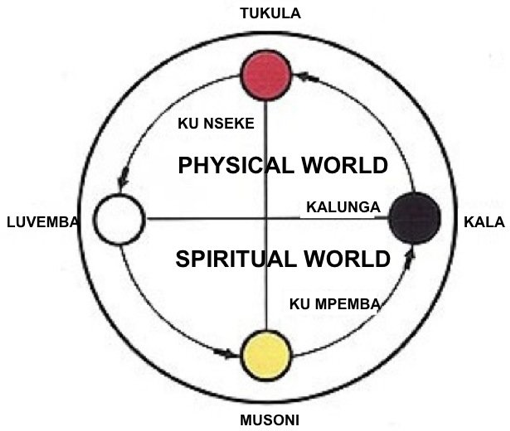
The Dikenga is often shown as a circle crossed by a horizontal line and a vertical axis. Its basic graphic structure is four cardinal points at the ends of two intersecting lines. The form can appear as a cross, a circle, or a diamond while preserving the same core principles. Its form matters because it refuses a flat, one-way story of human life. A person comes from an invisible depth, enters visible life, ripens through responsibility, crosses through death, and remains within a larger continuity that can nourish descendants and new beginnings.
Within the Bakongo presentation preserved in our source material, the cosmogram represents each human being as a living sun. It maps the community’s accumulation, interpretation, and transmission of knowledge as much as it maps biological life. It asks how a person develops conscience, carries responsibility, and becomes accountable to religious, political, cultural, familial, and national community.
For Ancestral Egbé, this is a Kongo cosmological teaching, not a claim that every African tradition uses the same diagram or the same names. Kongo is Kongo. Its precision is what makes it a strong bridge for understanding life, death, ancestor relationship, land, and spiritual transformation within the larger African field.
The Four Moments of the Dikenga
Musoni
Conception, fertility, and beginning Yellow sun of perfectionMusoni names conception: the beginning of a person within the community, the power of fertility, and the first exchange of force with ancestors in nature. It is not simply birth; it is the hidden beginning that makes visible life possible.
Kala
Vitality and social formation Black sun of vitalityKala names the living person’s formation into a fuller member of society through learning social rules and accepting responsibility within family and community.
Tukula
Maturity and intellectual power Red sun of warning and dangerTukula names the transformation of accumulated experience into intellectual power through interaction, responsibility, and participation in the community.
Luvemba
Death, change, and transmission Gray or white sun of death and changeLuvemba names the moment of departure, comprehension, and the transmission of society’s accumulated critical knowledge to younger generations. It includes death and change, but is not simply an ending.
When shown in a circle, the points are read counterclockwise from the southern point: Musoni, Kala, Tukula, and Luvemba. The movement rises toward the east and travels toward the west before returning again. In Kongo teaching, this is the path by which the living move toward their ancestors.
These moments can describe a human lifetime, but the cosmogram also applies to a relationship, a household, a community, a work of healing, a season, or a people. Every formation has a hidden beginning, a visible emergence, a period of ripening, and a time of completion and transformation.
Kalunga: The Boundary That Is Also a Crossing
Kalûnga is the horizontal east-west line. It marks the relationship between the visible world of embodied life and the invisible world of spirit and the dead. It is also understood as the energy that created life, a source of power, movement, and spiritual cleansing. It should not be treated as a wall that makes the two worlds unrelated. It is a threshold: a place of distinction, crossing, memory, communication, and transformation.
Kalûnga can carry different emphasis depending on context. In a family reading it may signify a husband-and-wife union; in divination it can signify the distinction between the living and the dead. The Kongo conception of apparent emptiness does not mean absence: where physical human life is absent, spiritual forces and waves may still be present.
This is why Kongo thought can speak of the dead without making death a blank end. The deceased is dead; death alone does not make a person wise, stable, elevated, or available as an ancestor. Yet death takes place within a cosmology of continuing relationship. The work of ancestral elevation concerns the condition and proper placement of the dead, while lineage elevation concerns the larger repair of the dead, living descendants, inherited patterns, and what will be carried forward.
The Dikenga therefore supports a disciplined relationship to the dead. It does not authorize treating every deceased person as an ancestor, every ancestor as elevated, or every spiritual contact as trustworthy. Relationship requires discernment, ethics, and proper formation.
Mukula and Muntu Ya Kuluzu
The vertical line is Mukula, meaning “to grow”: to gain a full understanding of the principles of life and to keep life’s potential power safe enough to pass on to one’s offspring. In the source teaching, ancestors transmit those principles along Mukula toward the land of the living. Palo Monte understands this vertical axis as the axis of time and a corridor of spirits.
The meeting of Kalûnga and Mukula is muntu ya kuluzu, “to grow up in the cross.” It names the individual person’s unique identity and life destiny. The cross is therefore not a borrowed Christian symbol here. It is a Kongo graphic philosophy of creation, growing, transmission, and personal responsibility. In some Kongo initiation contexts, the cross form is called yowa or kilisu; the form retains the Dikenga’s basic meaning even where later syncretic contexts shape how it is seen.
Visible and Invisible Worlds
In the familiar cosmogram image, the upper field is often associated with the visible world, while the lower field is associated with the invisible world. The distinction helps a student understand that bodily life, land, work, speech, and social responsibility are not detached from spiritual life. They are one side of a continuous cosmological field.
That is why the Dikenga belongs in the Red Crown jurisdiction. The Red Crown concerns earth, land, matter, elemental force, oath, boundary, danger, protection, and terrestrial responsibility. Kongo/Palo work is not merely an abstract belief about spirits. It is a path of relationship to embodied conditions, place, ancestors, material consequence, and the powers that move through the world.
The Dikenga Is Not a Ladder of Spirit Ranks
The four moments are movements of a cosmological cycle. They are not a universal ladder on which every dead person, ancestor, spirit guide, Akh, Egúngún, lwa, or deity can be placed as if the terms were interchangeable. Condition, tradition, and function remain separate questions.
This distinction matters in public Kongo/Palo study. Mfumbi in Palo names the deceased in a particular Kongo/Palo context. It does not automatically identify an elevated ancestor. The Dikenga gives the larger cosmological setting in which questions of death, transition, relationship, and return can be understood without collapsing those categories.
From Cosmogram to Practice
The Dikenga is not an invitation to copy restricted ritual forms. Its public value is orientation. It teaches the student to see the life cycle, the land, the dead, the unseen, and personal responsibility as related. A person who understands the cycle can ask better questions: What is beginning? What has reached maturity? What must be completed? What needs release? What memory needs honorable placement? What is ready to return in a more constructive form?
For this reason, the Dikenga belongs beside ancestor veneration and ethical lineage work, but it is not a substitute for them. Nor is it a substitute for Kongo/Palo house formation. Public study gives language and discernment; authorized lineage gives the responsibilities, permissions, and practices that public pages should not attempt to imitate.
The Dikenga Within the Ancestral Egbé System
In the wider Ancestral Egbé map, the Dikenga gives Kongo cosmological form to the Red Crown: the jurisdiction of earth, elemental force, material consequence, boundary, and transformation. It complements, but does not replace, the ancestral base of the Egun and Egúngún path, the inward discipline of Ori, the conceptual deity field of the White Crown, and the Ifá/Odù jurisdiction of sacred law and initiation.
Its teaching is direct: no spiritual development is complete if it ignores the cycle of embodiment, ripening, death, memory, release, and return. A path that wants power without responsibility, or ancestor relationship without discernment, has not yet understood the circle.
Dikenga in Cuba: Nkuyu and Lucero
In Kongo-descended Cuban practice, the cosmogram is also known as nkuyu and, in Palo Monte language, as lucero, “star” or “circle of new life.” The circle carries continuity across the Atlantic: protection, time, perfection, balance, the receipt of energy, and the crossing from one world to another.
This diaspora continuity does not erase the difference between Central African Kongo practice and Cuban Palo Monte. It shows how a Kongo cosmological graphic continued to speak through changed historical conditions. The public lesson remains the same: the circle is not decoration. It is a language of creation, ancestor relationship, transformation, and return.
Study Sources
This public article draws on the Kongo cosmological framework preserved in Ancestral Egbé study material and on the following studies:
- Bárbaro Martínez-Ruiz, Kongo Graphic Writing and Other Narratives of the Sign, in Afro-Atlantic Graphic Writing: Bidimbu, Bisinsu, and Firmas.
- K. K. Kia Bunseki Fu-Kiau, African Cosmology of the Bantu-Kongo: Tying the Spiritual Knot.
- Robert Farris Thompson, Flash of the Spirit: African and Afro-American Art and Philosophy.
Continue the Kongo study arc
Place the Cosmogram in Living Context
Read the terminology and elemental articles before moving toward a manual, registration, ceremony, or house-specific training.