
Why These Virtues Come Before Deeper Work
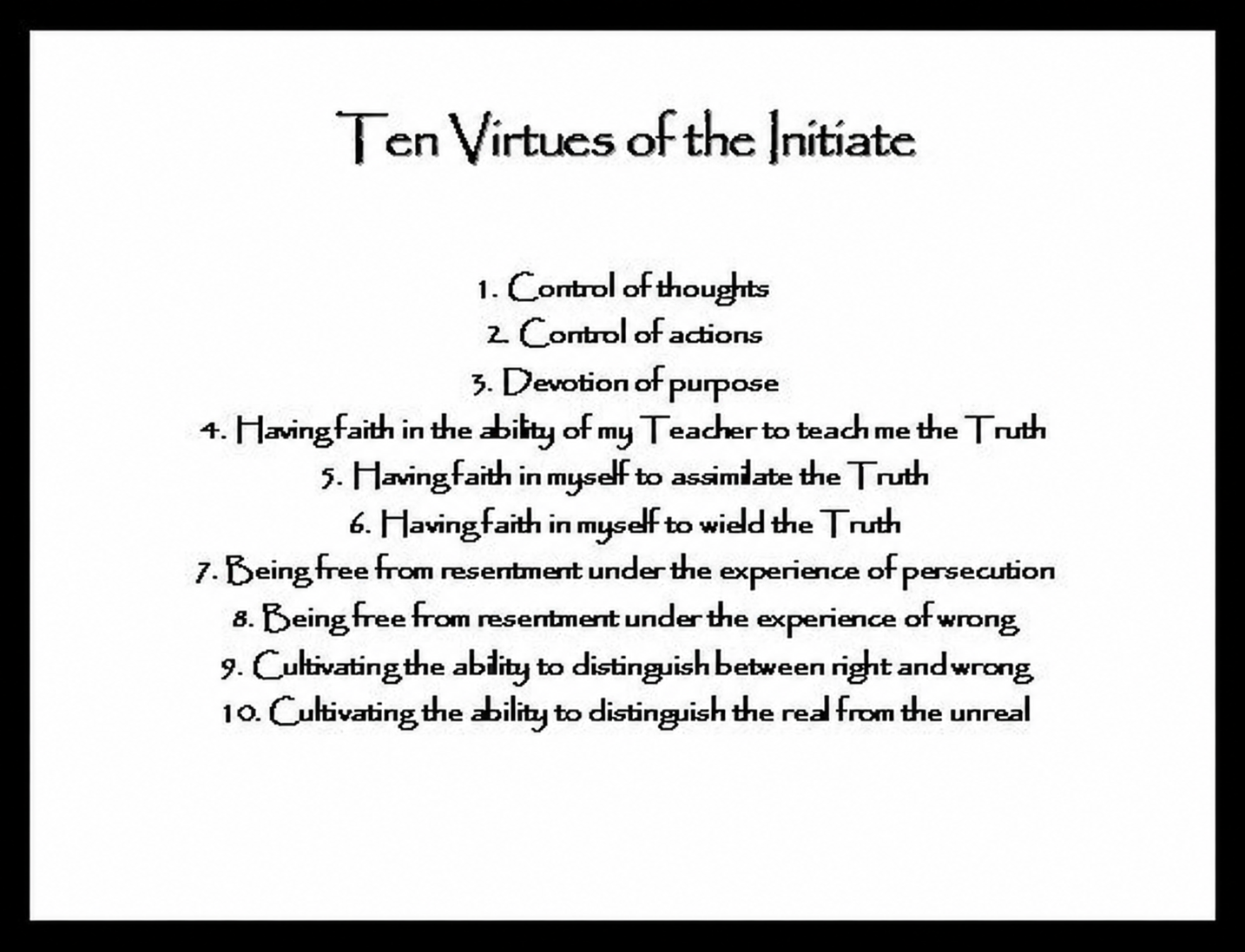
Every Crown has its own language, lineage, responsibilities, and initiatory thresholds. Yet advanced work in any of them requires more than curiosity. A person may attend a ceremony, receive instruction, or be given a task while still refusing reflection, correction, or transformation. The virtues name the inner habits that allow learning to take root.
This is why the lesson is public. It is expected study before a person seeks higher vertical levels of any Crown. Public access does not erase the role of teachers, godparents, elders, or house-specific guidance; it gives a prospective initiate a clear first standard to examine.
The Ten Virtues
- 1. Control of thoughtLearn to pause, examine what is happening, and choose a response rather than being driven by reaction.
- 2. Control of actionRight thought must become accountable conduct. A person's actions show whether study is becoming practice.
- 3. SteadfastnessFortitude means staying with meaningful work, holding to principle, and becoming dependable over time.
- 4. Identification with higher idealsFormation asks a person to move beyond a narrow self-interest toward responsibility to African people, community, lineage, and truth.
- 5. Evidence of a missionA mission gives direction to learning. It asks what a person is becoming responsible for, not merely what they wish to receive.
- 6. Evidence of a call to spiritual orderA spiritual calling requires ordered conduct, sustained study, and a willingness to align one's life with what one says one values.
- 7. Freedom from resentmentCourage permits change without becoming trapped by bitterness toward those who do not understand or share the path.
- 8. Confidence in the power of a teacherA teacher is not a substitute for discernment. A serious student must be able to learn from qualified guidance without surrendering ethical judgment.
- 9. Confidence in one's own learning abilitiesTransformation requires an active learner who is willing to reflect, practice, change, and receive correction.
- 10. Preparedness for initiationReadiness means more than desire. It includes the willingness to release harmful habits, meet obligations, and enter a disciplined process responsibly.
Maat, Mind, Speech, and Action
In the supplied Ancestral Egbe lesson, the virtues are related to a Kemetic understanding in which heart, tongue, perception, and embodied action work together. The lesson points students to the Memphite Theology and the account of Ptah: what the heart devises is given expression through the tongue, and action follows. The point for a student is practical. Inner thought, spoken intention, and visible conduct cannot be treated as unrelated.
That does not mean a person must become perfect before beginning study. It means that study must include truthful self-observation. Control of thought and action asks the learner to notice the habits that interrupt learning: impulsiveness, resentment, avoidance, self-deception, dependence on praise, or the urge to treat spiritual work as entertainment.
From Virtue to Growth
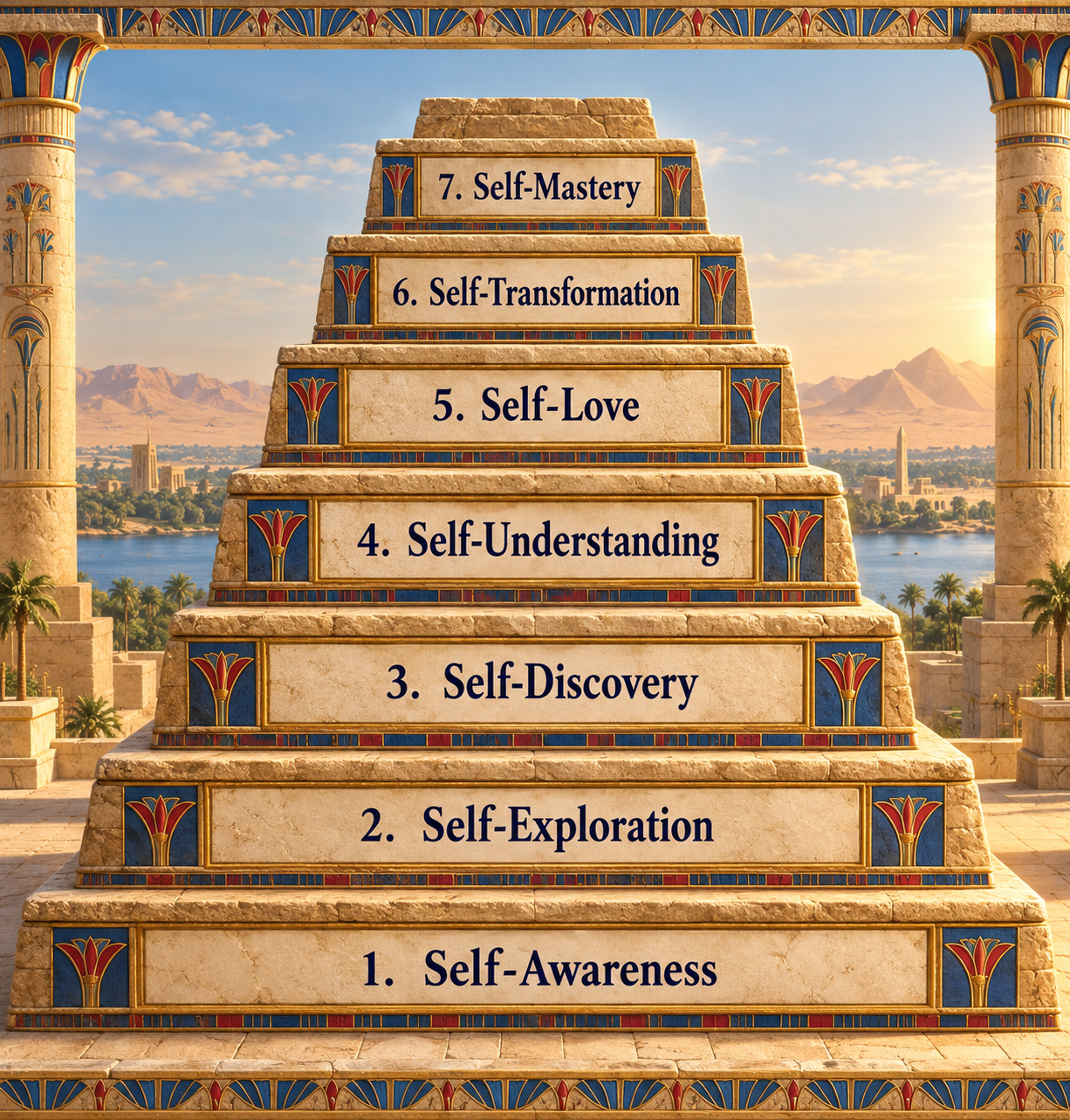
The Ten Virtues are not a separate ladder beside this hierarchy. They are the disciplines that make movement through it possible. Control of thought and action supports self-awareness. Steadfastness, higher ideals, and a sense of mission support exploration and discovery. Freedom from resentment and confidence in sound teaching make it easier to receive correction and understand oneself without collapsing into shame or defensiveness.
Resentment is one clear example. When it governs a person, it can narrow perception and turn every correction into an insult; self-discovery then becomes difficult because the person is defending against what they need to see. Emotional mastery does not mean denying emotion. It means being able to notice fear, anger, grief, envy, or insecurity, understand their influence, and choose a responsible response rather than giving them command.
In that sense, self-mastery is not domination over other people or a claim of perfection. It is the growing capacity to know oneself honestly, accept needed guidance, transform immature patterns, and use one’s strength in service. The initiatory framework supplies the ethical relationship, accountability, and tested practice through which those capacities can be developed over time.
Initiation Is Not Indoctrination

The elephant lesson: A young elephant may be restrained with a chain strong enough that it cannot break free. If it learns only that experience, it can later remain held by a much weaker rope—not because its adult strength is insufficient, but because it has accepted an old limit as permanent.
The lesson for a seeker is not to reject every boundary or to follow any teacher without question. It is to examine the beliefs that have already decided, “I cannot learn,” “I cannot change,” “my people cannot know,” or “no trustworthy guide exists.” Those beliefs can stop a person before honest study, disciplined practice, and accountable relationship have even begun.
Initiation requires an open mind: openness to evidence, correction, disciplined experience, and the possibility of transformation. It also requires self-efficacy and appropriate confidence in qualified guidance. A student who believes neither in their own capacity to learn nor in the possibility of competent teaching will remain motionless even when the path and the support are present.
Trust in a qualified teacher can steady the fear of failure: the learner does not have to invent every step alone or mistake every difficulty for a sign that they should quit. Trust in one’s own capacity to learn answers another obstacle, the fear sometimes called imposter syndrome—the belief that one is not truly allowed to grow, belong, or become competent. Neither kind of trust is blind. Both are built through ethical guidance, practice, evidence, and accountability.
Emotional mastery also asks for honest self-discovery. A person may not recognize their fear, immaturity, resentment, avoidance, or hunger for control until a real responsibility brings it to the surface. Seeing that darkness is not the same as becoming it. It is the beginning of removing what no longer serves, developing what is immature, and choosing a more disciplined response.
Teacher, Seeker, Godparent, and Godchild
These virtues belong in the relationship between guru and disciple, mystic teacher and seeker, and godparent and godchild. A teacher has a duty to guide ethically, explain boundaries, and refuse to promise what has not been earned or spiritually confirmed. A seeker has a duty to study, ask honest questions, follow sound instructions, and receive correction without confusing humility with passivity.
Confidence in a teacher does not require abandoning discernment. Likewise, confidence in one’s own learning ability does not mean treating private intuition as greater than every source, elder, or lineage rule. Mature formation requires both discernment and teachability.
Preparedness Is Not a Guarantee
Preparedness for initiation is the tenth virtue because readiness is the result of the other nine. It is not a service that can be purchased, an online badge, or an automatic consequence of reading this page. Readiness is determined through the appropriate lineage process, actual obligations, conduct over time, spiritual diagnosis where relevant, and the judgment of legitimate guides.
For the future student system, this article will be a public prerequisite. A person may be asked to acknowledge it, reflect on it, discuss it with an assigned teacher or godparent, or complete an assessment. Those private records support formation; they do not replace the human and spiritual judgment required for initiation.
A Study Practice
Choose one virtue at a time. Describe a recent situation in which it was difficult. What thought, action, fear, resentment, attachment, or assumption made it difficult? What would a more disciplined response have required? Then bring the question into accountable conversation with a qualified guide when you are in a teaching relationship.
The work is not to perform humility in public. It is to become more capable of truth, responsibility, learning, and transformation in the situations that actually test a person.
Study Sources
- Ancestral Egbe, The Ten Virtues of the Ancient Africans, curriculum lesson.
- Miriam Lichtheim, Ancient Egyptian Literature, Volume 1, pp. 51-55, for the cited Memphite Theology passage.
- George G. M. James, Stolen Legacy, for the source lesson's discussion of mystery-school learning and self-knowledge.
Where to go next
Study First. Seek the Right Path With Care.
Use the Five Crowns to locate the tradition and level that you are studying. Then read Kheper Mystic Maturity for the longer self-development framework: spiritual gifts, social recognition, or access to power are not the same as psychological, emotional, and ethical maturation. If you need orientation about a real-life concern or appropriate next step, make an inquiry rather than assuming initiation is the answer.