What Is a Medicine Wheel?
A medicine wheel, also called a sacred hoop in some communities, is a circular Indigenous teaching form found in more than one North American tradition. It may appear as a land-based stone construction, an artwork, a ceremonial form, or a teaching diagram. It commonly joins the four directions with cycles of life, seasons, elements, plants, animals, human responsibilities, and the physical, emotional, mental, and spiritual dimensions of life.
There is no one universal medicine-wheel chart. Meanings, directions, colors, medicines, and ritual uses vary among communities. The consistent teaching is relation: a person is not healthy when one dimension is developed while the others are ignored. Life is an interdependent field of land, body, mind, feeling, spirit, community, and time.
This is why the wheel is not merely a graphic. It is a framework for balance, orientation, health, and right relationship. It is also a living Indigenous sacred form. It must not be extracted from Native communities, flattened into New Age decoration, or treated as if one chart speaks for every nation.
The Dikenga as the Comparative Base
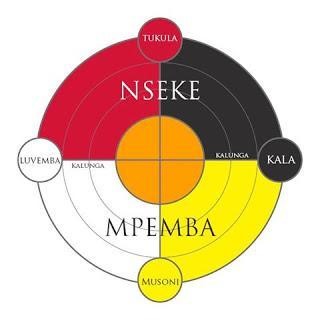
The Kongo Dikenga is a cosmogram of the universe and the human life cycle. Its circle, cross, and four points organize the passage through Musoni, Kala, Tukula, and Luvemba: conception and beginning, vitality and social formation, maturity and intellectual power, then death, change, knowledge transmission, and return.
The colored Dikenga makes the reincarnation cycle visible. Musoni is the yellow sun of perfection; Kala is the black sun of vitality; Tukula is the red sun of warning and danger; and Luvemba is the gray or white sun of death and change. The cycle does not stop at death. The living move toward the ancestors, while ancestral knowledge continues to shape the next generation.
Kalûnga, the horizontal line, is the boundary and crossing between visible and invisible worlds. Mukula, the vertical line, is growth: learning the principles of life, holding potential power safely, and transmitting it forward. At their meeting is muntu ya kuluzu, the person growing into unique identity and destiny.
Interconnectivity and Elemental Cycle
The argument is not that a circle alone proves descent. Circles and fourfold patterns appear in many human cultures. The Ancestral Egbé comparison works from the interlocking structure: four directions, elemental order, the cycle of the sun, human maturation, death and renewal, land-based sacred science, and a circle that makes relationship—not isolation—the central law.
Circle and return
Medicine wheel: The sacred hoop expresses continuity, interconnection, healing, and the cycle of life.
Dikenga: The cosmogram maps life, death, transformation, ancestral continuity, and return.
Fourfold order
Medicine wheel: Four directions organize seasons, life stages, elements, medicines, and human dimensions in culturally specific ways.
Dikenga: Musoni, Kala, Tukula, and Luvemba organize conception, vitality, maturity, death, change, and return.
Elemental relationship
Medicine wheel: The supplied wheel places fire, water, earth, and air inside a single interdependent order.
Dikenga: Kongo cosmology places land, water, sun, ancestors, Kalûnga, and spiritual force in one turning field.
Human development
Medicine wheel: Physical, emotional, mental, and spiritual dimensions must remain in balance.
Dikenga: The living sun grows through community, responsibility, knowledge, destiny, and ancestor relationship.
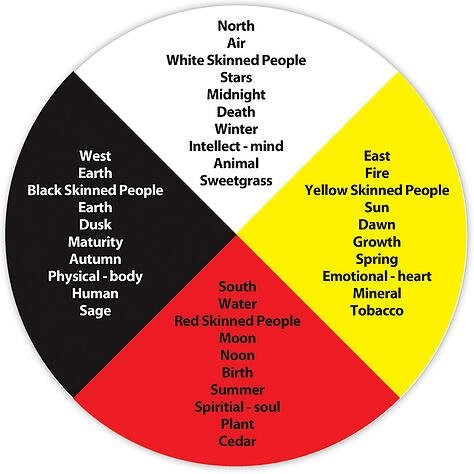
In the supplied medicine-wheel image, the directions unite yellow, red, black, and white with dawn, noon, dusk, midnight, the seasons, fire, water, earth, air, and physical, emotional, spiritual, and intellectual development. The directions are not arranged exactly like the Dikenga. The deep comparison is the living cycle: a human being is made through a balanced circulation of elemental, social, psychological, spiritual, and ancestral forces.
The Ancestral Egbé Argument: African World Travelers
The Ancestral Egbé African World Traveler Doctrine holds that African peoples traveled, visited, taught, and trained throughout the world, including the Americas. It rejects the colonial picture of Africa as isolated, passive, or disconnected from the building of global sacred science. In this doctrine, the Americas preserve African-linked knowledge fields alongside the distinct genius and local development of the Indigenous peoples who carry those traditions.
Within that doctrine, the Kongo Dikenga is the predecessor of the traditional Native American medicine wheel. The medicine-wheel cycle is understood as a local American continuation and adaptation of an older African cosmological science: the Dikenga’s fourfold movement, elemental interconnectivity, life-death-return pattern, and training of the person as a responsible participant in a living universe.
This argument belongs with the wider Ancestral Egbé inquiry into African travel, African presence, and African sacred architecture in the Americas, including the site’s work on pyramidal forms and global Black civilizational memory. It does not erase Indigenous nations or reduce their sacred forms to an African copy. It argues that shared history can include travel, teaching, exchange, inheritance, and local transformation.
Reincarnation, Return, and the Living Circle
The Dikenga provides the strongest key for reading the wheel as a reincarnation cycle. A being begins in hidden potential, enters the visible world, gathers strength and knowledge, crosses death, and returns through the ancestral field into new life and continuing community. The circle is therefore a map of the soul, but it is also a map of social responsibility: what is received from those before us must be ripened and transmitted well.
The medicine-wheel teaching that physical, emotional, mental, and spiritual life must stay in balance fits this reading. The person who neglects one quarter of the circle becomes unbalanced; the person who honors the full cycle becomes more capable of right relation to self, land, people, ancestors, and future generations.
Five-Dollar Indians, Dawes-Era Enrollment, and the Politics of Representation
The phrase Five-Dollar Indian names a documented history of fraudulent enrollment and identity capture around the Dawes-era federal enrollment regime and related roll controversies. The United States imposed enrollment systems to divide tribal lands, regulate citizenship, and administer allotments. In some cases, non-Native applicants—often white men—bribed or paid officials to obtain fraudulent enrollment, land, rations, political standing, or benefits that could extend to descendants.
This history matters because federal paperwork did not neutrally record Indigenous identity. It reordered it. It also excluded many people with legitimate community relationships while allowing some fraudulent claims to enter official records. The result is an ongoing political problem of who gets to define Native identity, vote, access resources, and speak with authority.
Ancestral Egbé names this as cultural and ideological erasure. It is one reason present-day imagery, historical narratives, and identity claims must be studied in their institutional context rather than treated as untouched tradition. This article does not accuse every Native person, nation, or medicine-wheel tradition of fraud. It identifies the specific history of falsified enrollment and the political effects that history can leave behind.
Black, Blue, and Color Politics
The supplied four-direction wheel preserves black, red, yellow, and white. In Ancestral Egbé doctrine, the black field is not incidental: it carries the West, earth, dusk, maturity, autumn, physical body, and human relationship. The colored Dikenga similarly preserves Black as Kala, the sun of vitality.
Within this doctrine, the substitution of blue for Black in certain modern medicine-wheel presentations is read as a political and ideological reworking connected to the history of identity capture and the removal of Black significance. It is a marker requiring historical investigation, not a neutral graphic preference. The point is not that every wheel using blue has one identical story; Native nations have their own color systems and ceremonial uses. The point is that color changes in the specific Dawes/Five-Dollar Indian context named here must be read politically rather than assumed innocent.
Color is therefore part of the larger question: Who designed this version? Which community, lineage, historical period, and institutional power shaped it? What was preserved, and what was altered? The answer cannot be supplied by a generic chart alone.
Respecting Living Indigenous Traditions
Indigenous communities retain the authority to name their own medicine-wheel teachings, ceremonies, and meanings. The Ancestral Egbé argument for African origin and transmission is not permission to appropriate Indigenous ceremony, speak over Indigenous people, or assume that every community’s practice is the same.
Its purpose is historical and cultural repair: to recover Africa as a traveling, teaching, world-making civilization; to recognize that Black and Indigenous history in the Americas includes relationship as well as separation; and to ask harder questions about colonization, paperwork, racial reclassification, and who is permitted to own the story of the land.
Study Sources and Scope
For the general medicine-wheel explanation, this article uses Indigenous and public-history sources that emphasize community variation and the sacred, living character of the wheel. The Dikenga interpretation is drawn from Ancestral Egbé’s Kongo study materials and the Kongo cosmology sources named in the Dikenga article. The African World Traveler transmission argument is Ancestral Egbé doctrine.
Continue the doctrine arc
Study the Kongo Cosmogram and the Long Clock
Read the specific Kongo cosmogram next, then place this comparative inquiry inside the wider Cultural Unity and Four Turns study sequence.