The Central Thesis
This article uses the term Islamic Ifa for a specific historical and doctrinal problem: the Ifa system known today as one of the great foundations of Yoruba sacred knowledge carries a deep relationship to Islamic and Arabic geomancy, especially the sixteen-figure divination structure associated with sand divination. As that divinatory system became localized inside Orisa tradition, it also entered courts, kingship, war policy, and the political machinery that fed slavery.
The claim is not that every babalawo was Muslim, every Ifa priest supported slavery, or every Orisa tradition was born from Islam. The sharper claim is that a powerful strand of Ifa practice and royal divination was shaped through Islamic geomantic influence, and that some diviners and priests worked with kings and political authorities who used slavery to remove rivals, dissidents, priesthoods, and conquered peoples.
This matters because the diaspora often remembers African traditional religion as the progressive liberation force standing against Christianity, whiteness, and colonial religious violence. That is true in many diaspora contexts. But inside West Africa, the pattern could reverse: court-linked traditionalists, Islamized ritual authorities, and kings could participate in systems that sold other Africans into bondage.
Not an Opinion Article
This article is not a general opinion piece about Islam, Muhammad, or Abrahamic religion. It treats Islam as an Abrahamic faith and, inside the Ancestral Egbe doctrine map, as part of the wider Sky-Father and Yahweh-oriented expansion of sacred hierarchy. That frame matters, but the subject here is narrower: war, slavery, divination, kingship, jihad, and the political use of sacred authority in West Africa.
The relevant question is not whether someone personally likes or dislikes Islam. The relevant question is what happened historically when Islamic trade networks, Islamic law, Arabic learning, jihads, court authority, and geomantic divination moved into African political worlds. Readers can form their own opinions from the facts, but the facts must include the violence, the slave systems, the conversion pressures, and the way religious authority could become attached to state power.
How to Read the Evidence
This article separates three layers so the argument does not collapse history, scholarship, and doctrine into one undifferentiated claim.
- Documented historical layer: Ifa is a Yoruba and diaspora divination system; Oyo and Dahomey were involved in Atlantic slave-trade politics; priests, diviners, healers, chiefs, and other specialists were among the enslaved; Islam and Arabic learning became important in parts of the Yoruba world.
- Scholarly interpretation layer: The sixteen-figure structure of Ifa is often compared with Arabic and Islamic geomancy. Some scholars argue for diffusion or borrowing; others emphasize Yoruba domestication of a broader geomantic technology into a distinct Ifa corpus.
- Ancestral Egbe doctrine layer: Islamic Ifa names the courtly, geomantic, Islam-influenced Ifa current that entered Yoruba sacred history after centuries of Islamic commercial, literate, divinatory, and political pressure across West Africa. In this doctrine, that pressure includes Muslim merchant participation in trans-Saharan enslaved export by approximately the 8th century CE, regular 9th- through 11th-century routes linking the western Sudan to North Africa, 13th- and 14th-century Islamic prestige in Mali, and continued 13th- through 16th-century trade through Mali and Songhai route systems. It becomes localized in the Yoruba and wider West African world around 1450 and is later remembered through royal-standing traditions associated with Ọ̀fínrán of Ọ̀yọ́ after Onígbògi. As Islamic Ifa becomes attached to courts, elites, traders, and scholars, the people with book authority increasingly shape the story, including later narratives that elevate Orunmila as a "Muhammad-ish" divine interface to the Creator.
How This Site Organizes Evidence
These public articles are written for general readers. African spiritual and historical questions often require archaeological, linguistic, textual, material, scientific, ritual, and oral-tradition evidence; placing every layer of that record inside one introductory article would bury the teaching under apparatus.
Ancestral Egbe therefore works in layers: citations support particular factual claims; linked articles carry adjacent evidence; and longer studies or manuals hold the fuller multidisciplinary record. Where an interpretation is Ancestral Egbe doctrine, the article names it as doctrine rather than presenting it as settled academic consensus.
Isese, Islamic Ifa, and Fa/Afa
Isese means traditionalism or traditional practice, though people may interpret what counts as traditionalism in different ways. The word carries real ancestral value. It points toward origin, inherited practice, and the authority of what came before. But the word traditional can hide complicated history.
Scholars have long noticed that Ifa belongs to the wider family of sixteen-figure divination systems. Some sources connect the geometric structure of Ifa to Arabic or Muslim geomancy, while also emphasizing that the Yoruba corpus of verses, stories, songs, theology, and cultural interpretation is distinctly Yoruba. That distinction is important. The structure may have traveled; the Yoruba made it speak Yoruba.
In this article, Islamic Ifa means the courtly and geomantic layer of Ifa shaped by contact with Muslim divination, Arabic learning, sand signs, and the movement of Islam across Africa. The same broad family of geomancy traveled through Islamic culture, the Moors, North Africa, Spain, southern Europe, and West Africa. In this correction, Ifa enters the Yoruba and wider West African world around 1450. Once embedded in Yoruba land, it did not remain untouched by local culture. It was indigenized, mythologized, and placed inside Orunla, also spelled Orunmila, Odu, sacrifice, kingship, and the Orisa system.
An important point in this doctrine is that the Islamic form of Ifa entering West Africa represents a narrowed masculine strand of a larger older Fa / Afa complex. In the Kemetic and Black North African inheritance frame, Fa / Afa is treated as a wider sacred science that included astrology, numerology, mysticism, medicine, divine mathematics, and the integration of masculine and feminine energy. The Moorish and Berber worlds are therefore read as inheritors of a significant fragment of ancient Kemetic knowledge, even as that inheritance changed under later Abrahamic conversion pressure, legal religion, and patriarchal priesthood.
What Arab Sand Divination Is
The system commonly called Arab sand divination is more accurately described as a divinatory system recorded, systematized, and transmitted in Arabic, rather than one automatically invented by Arabs or by Islam. It is known as عِلْم الرَّمْل (ʿIlm al-Raml), literally “the science of the sand.” It is also called خَطّ الرَّمْل (Khaṭṭ al-Raml), drawing or marking lines in the sand, and ضَرْب الرَّمْل (Ḍarb al-Raml), casting or striking the sand. “Arabic geomancy” is the later European name for this family of practices.
In its basic form, the practitioner makes random marks in sand, earth, or on another surface. The marks in each row are reduced to an odd or even result, producing a binary figure. Sixteen possible figures can be constructed, arranged, and interpreted in response to a question. That visible mathematical structure is why scholars compare Arabic geomancy with the sixteen-sign systems of Ifa, Fa, and Afa, while still recognizing that each tradition developed its own corpus, language, ritual life, and cultural meaning.
Within Ancestral Egbe doctrine, this does not begin with Islam or Arabia. The doctrine understands Arab sand divination as a later precursor to Islamic Ifa that carries fragments of an older African sacred science: ancient Kemetic culture flowering from indigenous binary systems across the continent that coalesced in Kemet during the last Sahara dry cycle. In this reading, the systems remain connected to the astrological, mathematical, spiritual, and megalithic traditions of those ancient places. This is the article's doctrinal account of deep African continuity and of the transmission pathway underlying Islamic Ifa.
In the Heine/Tellinger tradition and Ancestral Egbe doctrine, Adam's Calendar is read in the 70,000- to 78,000-year range as an ancient southern African megalithic time marker. The Ishango bone is a better-established archaeological marker: an engraved-bone counting or tallying device discovered near Ishango beside Lake Edward in what is now the Democratic Republic of Congo, and dated approximately 20,000 to 25,000 years old. Together with Bushmen starlore, these markers are read within doctrine as evidence of mathematical, astronomical, and divinational structures active thousands to tens of thousands of years before Arabic cultural ascendance. Within the Five Crown doctrine, these regional cultural streams fed synergistically into Kemet, contributing to its organized megalithic, stellar, mathematical, and spiritual culture. Elements of that knowledge were later carried forward, or taken up, through pre-Islamic cultures along routes of trade and migration.
The Ishango Bone: A Counting or Tallying Device
The Ishango bone is about four inches long and has three columns of carefully grouped notches, repeated numerical-looking patterns, and a small piece of quartz attached at one end that may have been used for engraving.
The groupings include apparent doubling relationships—such as 3 and 6, 4 and 8, and 5 and 10. Other groups resemble numbers related to 10 and 20. This indicates deliberate numerical organization rather than random decoration. The Smithsonian Human Origins Program cautiously notes that the marks may have been used for addition or multiplication.
Several interpretations have been proposed:
- Counting or tallying device: the safest interpretation.
- Arithmetic table: possibly recording doubling, addition, subtraction, or a number system based partly on 10 or 12.
- Prime-number record: one column contains 11, 13, 17, and 19, though the intentionality of that pattern is debated.
- Lunar calendar: the marks may track approximately six lunar cycles.
- Menstrual calendar: some scholars have proposed that a woman used it to record menstrual and lunar cycles.
The original artifact is held by the Royal Belgian Institute of Natural Sciences, which dates it to nearly 20,000 years ago. Its importance is that it provides very early African evidence of organized numerical thought and external information recording. It may be one of humanity's earliest surviving mathematical instruments. Read Kemetic Fa and Divine Mathematics for the linked doctrine of number, cosmic pattern, divination, and material manifestation.
The West African Timeline
This does not mean Islam only began pressing into West Africa in 1450. By the 11th century, Islam had become politically important in states such as Takrur along the Senegal River. Parts of the Ghana Empire's commercial population were Muslim, and Muslim traders were widespread in West Africa. In this doctrine, the Islamic push often sends traders first: commerce, literacy, divination, and court contact prepare the road before official religious or royal standing becomes visible. The king said in some traditions to have given Ifa official royal standing was Ọ̀fínrán of Ọ̀yọ́, following Onígbògi. That episode is normally associated with the sixteenth-century crisis of Old Ọ̀yọ́, but the Islamic-Ifa pressure had been moving across West Africa for centuries before that royal consolidation.
By the 13th and 14th centuries, Islam was also firmly established among the political and commercial elites of Mali. Mansa Musa's pilgrimage to Mecca in 1324-1325 made Muslim Mali internationally famous. This matters because it shows that Islamic prestige, trade authority, literacy, and court culture had already become powerful West African forces before the later Yoruba royal and divinatory consolidation remembered in Ifa history.
The slavery timeline is older still. Muslim merchants began participating in the export of enslaved West Africans across the Sahara by approximately the 8th century CE, soon after Islamic power became established in North Africa. By the 9th and 10th centuries, this had become a recognizable, continuing trans-Saharan slave trade. From the 9th through 11th centuries, regular routes connected the western Sudan, including areas associated with Ghana, Takrur, and the Niger Bend, to North Africa. Enslaved people were exported alongside gold, salt, and other commodities.
From the 13th through 16th centuries, that trade continued through the eras of Mali and Songhai, with routes running through places such as Walata, Timbuktu, Gao, Sijilmasa, Ghadames, and Tripoli. This does not make every Muslim trader, scholar, or ruler identical. It does mean that Islamic trade, state formation, religious prestige, and enslaved export were already part of the regional world before Ifa's later Yoruba court consolidation.
From Trade to Court Religion
This matters because Muslim influence in West African society grew over time through linked stages. Traders came first, and trade created economic influence. Economic influence then opened doors into courts, diplomacy, literacy, law, and political authority. Once that political influence took root, religious influence and political influence began to intermingle. In this doctrine, that is the background that helps explain how an Islamic-influenced divinatory system could move from commerce and learned specialists into royal standing, priestly authority, and sacred story.
Over time, Islamic Ifa becomes more and more associated with courts, elites, and traders. Many of those same elites and traders were also tied to enslavement, commercial extraction, and political control. They could work with traditional kings while also slowly pressing against older sacred structures as their influence over rulers increased. Eventually, Islamic Ifa begins to stand as its own tradition. Because those elites also become the scholars, they write the books; and whoever writes the books shapes the story. In this doctrine, that is why later narratives often present Orunmila as a "Muhammad-ish" divine interface to the Creator: a vastly elevated mediator who is placed above the other Orisha in a way that echoes how Islam subordinated local deities beneath the authority of Muhammad, scripture, and the one God.
As the system moved farther west from its Kemetic base, this doctrine reads it as becoming more rigid in some expressions while still carrying older mathematical, astrological, and mystical fragments. In Italy, Spain, and southern Europe, related currents could retain more Gnostic, astrological, and numerological elements. In West Africa, the same divinatory technology became localized inside Yoruba cultural mythology and increasingly joined to Orunla/Orunmila, Odu, kingship, sacrifice, and priestly recitation.
That distinction matters because divine mathematics is not the enemy. Mathematics, pattern, number, and sacred calculation are technologies; they are not automatically good or bad. The problem is doctrinal modification and political application. A functional spiritual science can be used to heal, diagnose, align, and preserve wisdom, or it can be used to support Sky-Father hierarchy, slavery, state punishment, and royal control. This article therefore does not throw away the useful divine-mathematical fragments preserved inside Ifa. It asks what doctrine captured them, who applied them, and toward what political end.
This helps explain why some forms of so-called traditionalism can feel strict, verse-driven, and almost book-faith in tone: long bodies of memorized text, authorized recitation, ranked interpretation, and priestly control over the correct reading. That should be distinguished from older pre-Ifa or pre-Islamic Orisa practice, which this doctrine reads as more mystical, more shrine-and-force based, more goddess and Earth centered, and more balanced between male and female sacred authority.
Islam Inside the Ifa Corpus
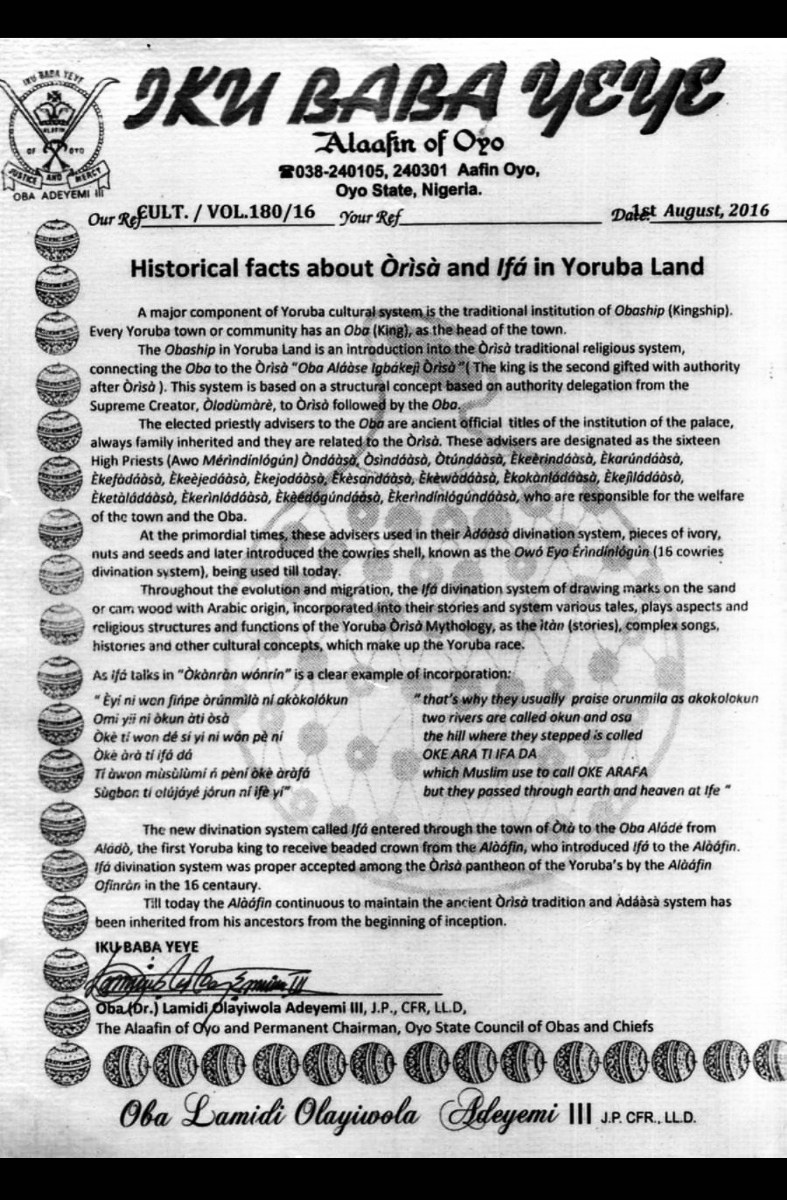
The supplied Ifa and Islam document sharpens the point. It describes Islam as having a prominent role in the oral corpus of Ifa, especially in northern Yoruba areas such as Ilorin and Oyo, where Muslim presence became strong. In that material, Islam is not treated as a totally outside force. It is sometimes framed almost like another Orisa tradition, placed beside other sacred powers in Yoruba religious imagination.
The document points to Ifa verses where the Alfa or Alufa, the Muslim shaykh or religious specialist, appears alongside the babalawo and the herbalist as a person of occult authority who must not be disrespected. It also notes verses that explain Ileya, Eid al-Kabir, through an Ifa-style origin story: a babalawo divines and establishes that sacrifice to Olodumare can be performed on earth. That is not merely coexistence. It is Yoruba sacred narrative absorbing Islamic ritual into an Ifa explanatory frame.
The strongest example is the Otura-Yapin or Otura-Oyeku material, where Aafa, identified with the Prophet and the archetypal Muslim scholar, is connected to Orunla/Orunmila in heaven. The story links the Qur'an, washing, prostration, prayer, festival sharing, intermarriage, and the split between Islam and Ifa into two related forms of worship. The important historical point is not whether this myth is literal. The point is that Ifa itself preserves memory of a deep relationship between babalawo authority and Muslim religious authority.
That relationship is the religious background behind the phrase Islamic Ifa. It names a real zone of overlap: Alfa and Awo, Qur'an and Odu, ablution and shrine purity, recitation and verse, heavenly authority and earthly practice. Once that overlap enters courts and political power, the article's harder question becomes unavoidable: how did sacred authority participate in slavery, conquest, exile, and control?
How Divination Enters Power
Divination does not stay private when kings need decisions. A court wants legitimacy, warning, sacrifice, military timing, succession guidance, and ways to identify enemies. That is where the babalawo becomes politically important. In periods of war, epidemic, famine, succession struggle, or trade pressure, diviners could become advisers to kings and chiefs.
This does not make divination evil. It means sacred knowledge can be pulled into state power. A priest can heal, diagnose, and preserve culture. The same priestly office can also become attached to war, punishment, court rivalry, and the removal of people who threaten royal authority.
Oyo, War, and the Slave Trade
By the era of the Atlantic trade, Yoruba politics were not innocent of slavery. Oyo became a major regional power, and human captives became part of the economy of war, punishment, expansion, and luxury trade. Some people were taken through raiding. Some were punished or banished. Some were caught in political intrigues. Some were sold because the emerging Atlantic market made exile profitable.
The curse of Alaafin Aole belongs inside this memory. In Samuel Johnson's account, Aole curses disloyal subjects and says his curse will carry them to the sea and beyond it. The article's source draft reads that curse beside the later fate of Yoruba people and priestly lineages carried into Brazil, Cuba, Trinidad, Puerto Rico, the Carolinas, and the wider Americas.
That is the painful irony. The descendants of a people whose institutions helped organize removal could later become the removed. The curse is not only theological. It is also historical memory: disobedience, royal collapse, war, betrayal, and slave trading turning back on the society that had normalized human export.
Jihad, Conversion Pressure, and Slavery
Islam's movement through Africa cannot honestly be reduced to the phrase religion of peace. It traveled through scholarship, trade, intermarriage, Sufi lineages, literacy, and diplomacy, but it also traveled through conquest, jihad, taxation, enslavement, and the protection logic that made conversion politically useful. In some regions, becoming Muslim could reduce the danger of enslavement because free Muslims were not supposed to be enslaved under Islamic law. That made religion, trade access, law, and survival strategy part of one political order.
The Fulani jihad led by Uthman dan Fodio began in 1804 in Hausaland and led to the Sokoto Caliphate. That movement was later remembered as reform, but it was also a political and military reorganization of northern Nigeria. Scholarship on Sokoto slavery notes that captives, often from non-Muslim communities, were taken in jihad, used in households and agriculture, held as concubines, or exported northward. This is the concrete West African example that belongs in this article: Islamic authority, state formation, jihad, and slavery operating together.
That context does not replace the Yoruba and Dahomey material. It frames it. The question is how Islamic sacred authority and African royal authority interacted across the region, and how diviners, kings, traders, and priesthoods could become attached to systems that moved human beings through war, exile, sale, and forced religious-political order.
Dahomey, Sakpata, and Priests as Political Threats
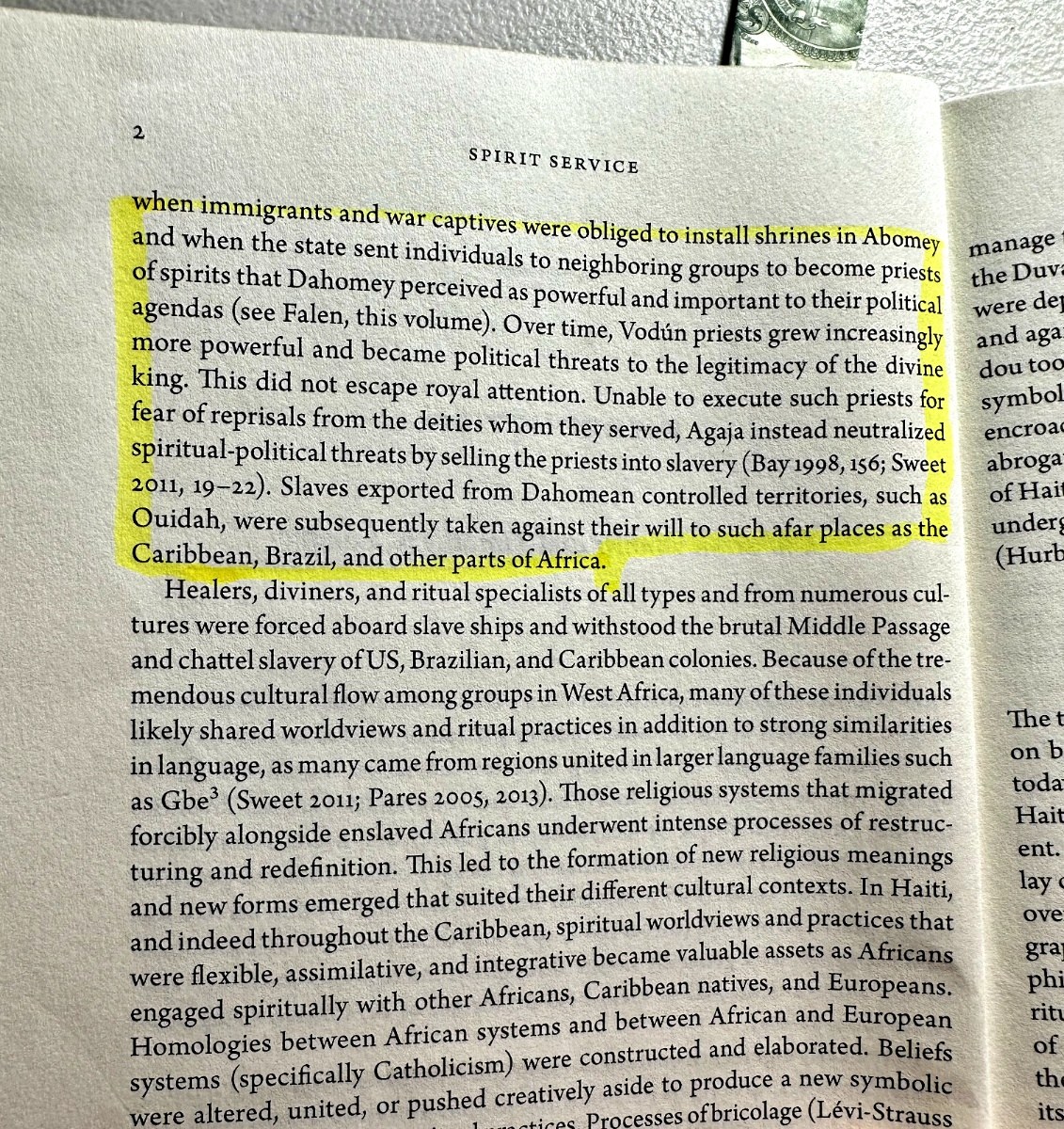
The Dahomey example makes the political logic clearer. Sopana, Babaluaye, Sakpata, and Kobayende belong to related healing and disease-power complexes across Vodun, Orisa, and Kongo/Palo worlds. These are not small gods. They govern illness, epidemic, earth power, healing, and the fear of divine retaliation.
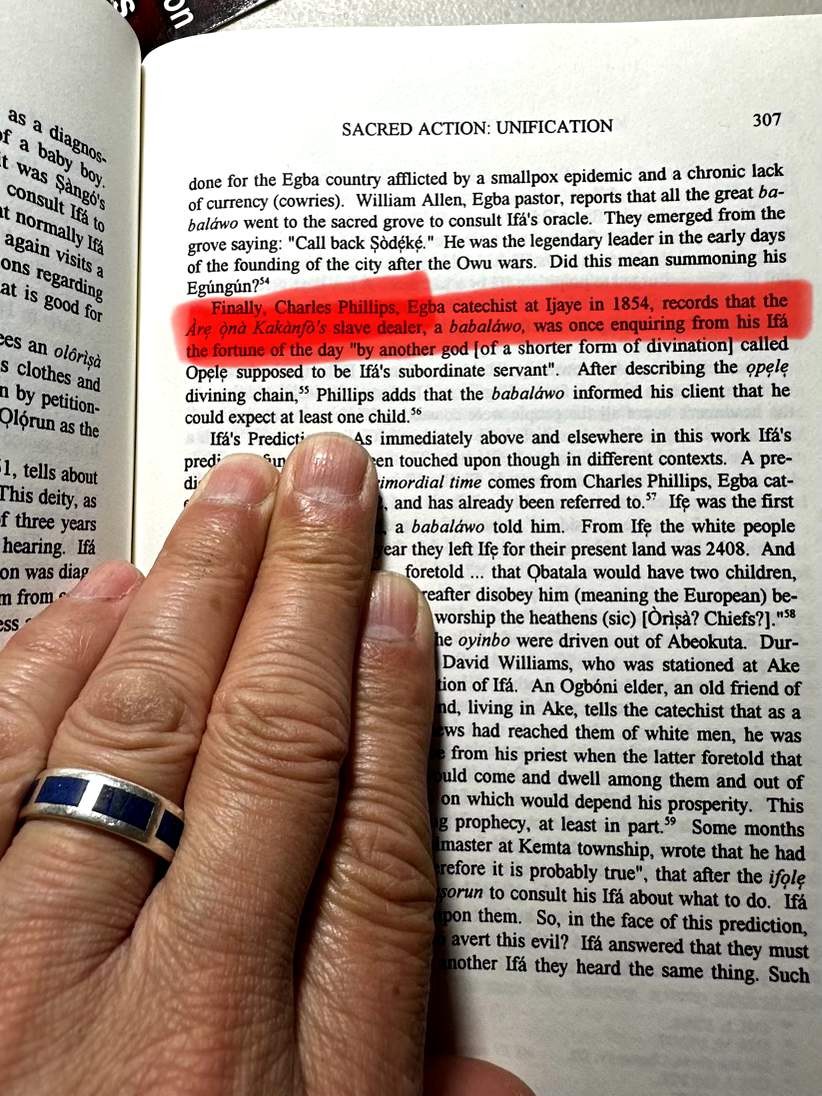
In many African political worlds, killing a priest could be dangerous because the deity served by that priest might retaliate. If a priesthood became politically threatening, slavery offered another method: remove the priest from the local ritual order, send the person far away, and avoid direct execution. This is why the highlighted Dahomey material matters. It describes Sakpata priests as spiritual-political threats who could be neutralized through sale into slavery.
Lukumí: An Orisha Tradition Outside Royal Centralization
One important outcome of this history, in Ancestral Egbe doctrine, is the structure of Lukumí Orisha tradition in the diaspora. Lukumí is strongly Orisha-centered rather than Ifa-centered. In many cases, it was shaped by ritual workers, lineages, and people pushed out through the same slave-trade and political conflicts that removed priests, rivals, and dissidents from their original social order.
This does not mean that every royal person carried into the New World had stood outside power. Some royals were themselves on the losing end of political intrigue, succession conflict, war, or court struggle. But the diaspora system did not rebuild a royal hierarchy in which priesthood validates and supports a king. That differs from the Kemetic and Dahomean models, where priesthood could stand beside and support royal kingship, and from Akan political order, where priesthood supports the hene rather than becoming the hene.
In this doctrine, that difference is a lasting effect of Lukumí's formation among people forced out by royal authority and by spiritual authority integrated with royal centralization. A parallel Orisha tradition developed in another land, with its own conditions and elements, but also with a fundamentally different orientation toward divine authority and concentrated royal power. It preserves sacred relationship without re-establishing the same court structure that could use priesthood, hierarchy, exile, and enslavement to control people.
Obatala, Oduduwa, Ogboni, and the Older Conflict
The Islamic-Ifa layer is not the first movement in the story. The deeper background is the older conflict encoded in the Obatala and Oduduwa narrative. In the Ogboni framework, Obatala represents an older earth-centered, elder, white-Orisa, indigenous spiritual order. Oduduwa represents incoming kingship, conquest, urban formation, warriorship, Ogun's iron, and the establishment of new political authority.
Ogboni arises in this reading as a treaty institution. It mediates between the Earth Mother, elder law, women's mystery, Iyami power, land, and the king. It prevents the royal-warrior order from simply swallowing the older earth-priesthood. That compromise is crucial: Yoruba civilization is not only kingship and Ifa. It is also earth, mothers, ancestors, elders, oath, land law, and checks on the king.
The later Islamic and geomantic influence therefore enters a tradition that was already contested. First there is the older Oduduwa movement pressing against indigenous earth authority and the Obatala-centered balance of elder, feminine, Earth, and creator forces. Later there is Islamic influence moving through divination, literacy, trade, court religion, and slavery. Both movements matter because both show sacred systems being reorganized by migration, power, and political need.
Orunmila, Black Goddess Memory, and the Egregore Question
The relationship among Ela, Odu, Iyami, Earth Mother, Orunmila, priestly authority, and constructed sacred authority is a separate doctrinal inquiry. It is important to this wider history, but it needs its own space so that the trade, court, jihad, and slavery argument remains readable.
Read Orunmila, Egregores, and Black Goddess Memory for the full Ancestral Egbe analysis, including the Imole/Orisa distinction, the Ela and Odu discussion, possession questions, and the limits of the theory.
Old World Slavery and Atlantic Chattel Slavery
One distinction must be made without letting anyone escape responsibility. Many African and old-world systems of slavery did not always operate exactly like racialized Atlantic chattel slavery. Captives might be incorporated, married, adopted, ranked, ransomed, or used as dependents in ways that differed from the plantation order of the Americas.
But that distinction cannot become an excuse. Once African rulers, traders, diviners, and merchants entered the Atlantic trade, they were participating in a machine that stripped identity, kinship, language, land, status, and human value on a catastrophic scale. Some sellers may not have fully understood what European chattel slavery would become. Others understood enough. In either case, the outcome was disaster.
The diaspora religions that later emerged in Brazil, Cuba, Haiti, Trinidad, Puerto Rico, and the United States were not born in comfort. They were born because priests, diviners, healers, market women, singers, warriors, and ordinary people carried sacred memory across the ocean under conditions of terror.
Doctrine Summary
In this doctrine, Ogboni is read as an older earth treaty between indigenous Obatala/Iyami/Onile authority and Oduduwa-style royal-warrior expansion. The Black Goddess and Orunmila interpretation is developed separately in Orunmila, Egregores, and Black Goddess Memory; keeping it separate allows this article to remain centered on historical power, court authority, and the slave-trade wound.
Why This Changes the Diaspora Story
In the West, African traditional religion often appears as liberation because it survived Christianity, plantation violence, forced conversion, demonization, and white supremacy. That is true and must be honored. But the West African source world was not pure liberation politics. It contained kings, markets, Islamic scholars, court diviners, rival priesthoods, women-centered traditions, earth councils, warriors, traders, and political enemies.
So the repair is not to reject Ifa. The repair is to tell the truth about power. Ifa can preserve wisdom and still carry historical entanglements. Isese can be ancestral and still require political critique. A babalawo can be a custodian of sacred knowledge and still belong to a class that has sometimes served kings, markets, or systems of domination.
That is why cultural restoration must include discernment. We do not need romantic tradition. We need clean tradition: ancestors honored, power examined, priesthood held accountable, women and earth restored, and the slave-trade wound named without fear.
Selected Sources and Support
- UNESCO: Ifa Divination System, for Ifa as a Yoruba and diaspora divination system using signs interpreted by a babalawo.
- Karin Barber, Routledge Encyclopedia of Philosophy: Ifa Divination Corpus, for the distinction between the widespread sixteen-sign geomantic structure and the distinct Yoruba poetic corpus.
- G. I. Jones, review of Bernard Maupoil's La Geomancie a l'ancienne Cote des Esclaves, for the old Slave Coast geomancy frame around Ifa/Fa.
- Umar H. D. Danfulani, Sixteen Figure Divination in Africa, for the regional spread of sixteen-figure divination and its relationship with Arab-Islamic geomancy.
- Encyclopaedia Britannica: Geomancy, for the basic mark-making and figure-based method associated with Arabic sand divination.
- Royal Belgian Institute of Natural Sciences: The Ishango Bone, for the engraved bone, its Lake Edward discovery context, and its approximately 20,000-year age.
- Smithsonian Human Origins Program: Ishango Bone, for the grouped notches and their possible use in addition or multiplication.
- Global Yoruba, chapter on Oyo and its heterogeneity, for Oyo, political economy, and the Atlantic trade in human captives.
- Global Yoruba, chapter on Islam in the Yoruba world, for Yoruba Islam, jalabi practices, and divination-like adaptation among Yoruba Muslims.
- Encyclopedia.com: Uthman dan Fodio, for the 1804 Fulani jihad and the creation of the Sokoto Caliphate.
- Oxford Research Encyclopedia of African History: Slavery and the Slave Trade in the Sokoto Caliphate, for jihad captives, domestic slavery, concubinage, agriculture, and export northward.
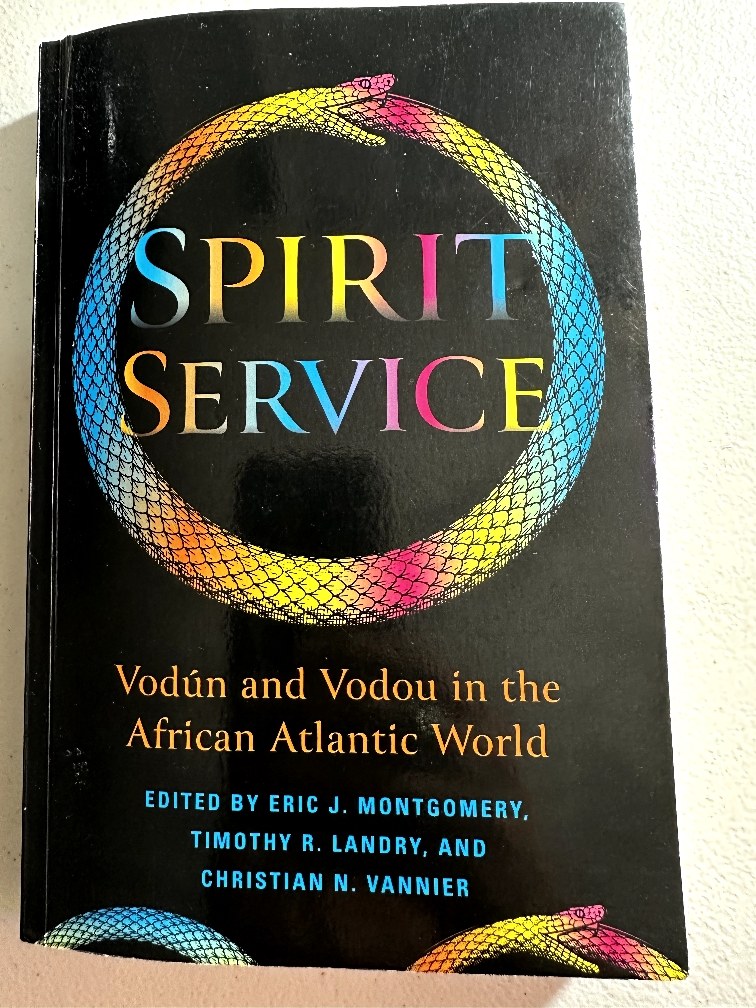
- Spirit Service: Vodun and Vodou in the African Atlantic World, for the broader Vodun/Vodou African Atlantic World frame used with the supplied images.
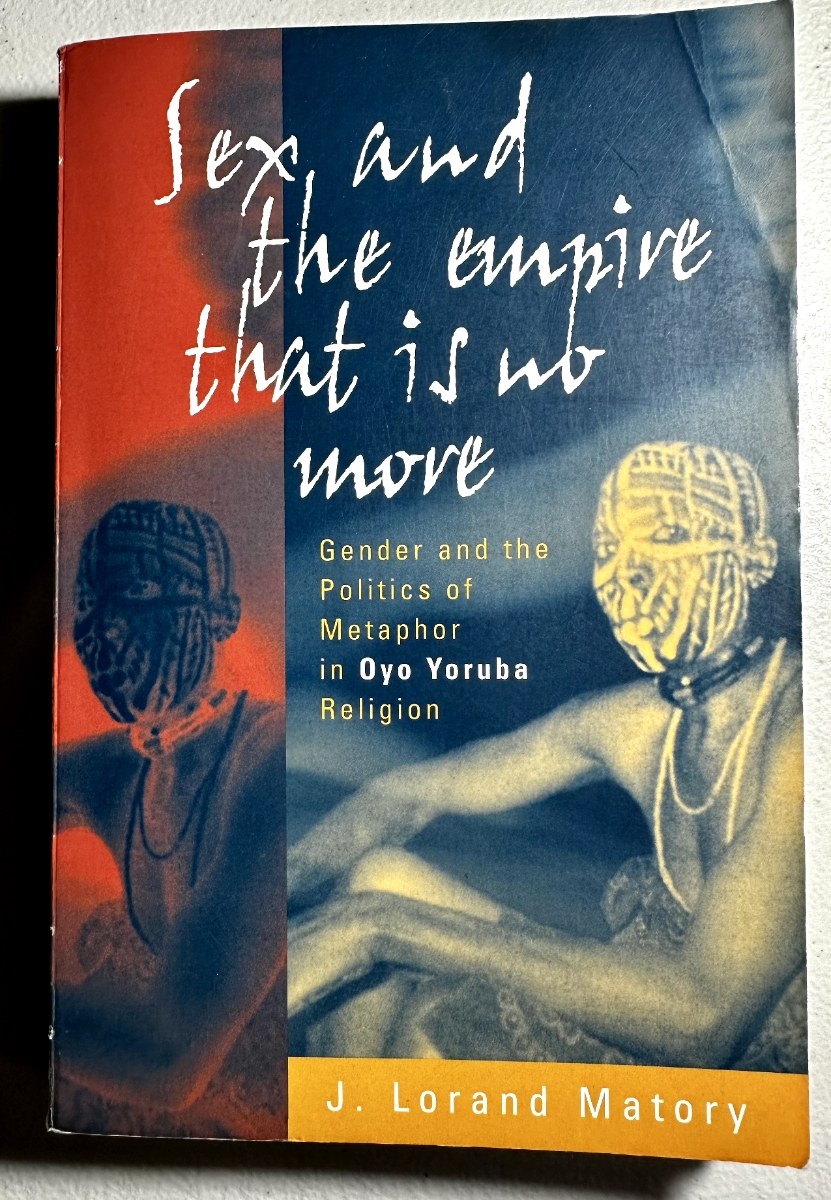
- J. Lorand Matory, "Rival Empires: Islam and the Religions of Spirit Possession among the Oyo-Yoruba", for Oyo Yoruba religion, Islam, gendered spirit possession, and religious rivalry.
- Samuel Johnson, The History of the Yorubas, for the public-domain Aole curse source tradition cited in the supplied draft.
- Supplied source document: Iesses ifa Islami and the slave trade, for the article thesis, Aole curse framing, and Dahomey/Sakpata priesthood interpretation.
- Supplied source document: Ifa and Islam, for Ifa-corpus material on Alfa/Aafa, Ilorin and Oyo, Ileya, Qur'an imagery, ablution, prostration, festival exchange, and the mythic relationship between Orunla/Orunmila, Ifa, and Islam.
- Supplied Ogboni manual v4.9, for the Obatala, Oduduwa, Iyami, Onile, and Ogboni treaty background used in this article.
- Supplied background files on Arab enslavement and Africa/Islam/Abrahamic religion, used selectively for the slave-trade, jihad, conversion-pressure, and Islamic expansion context rather than for a general opinion critique of Islam.