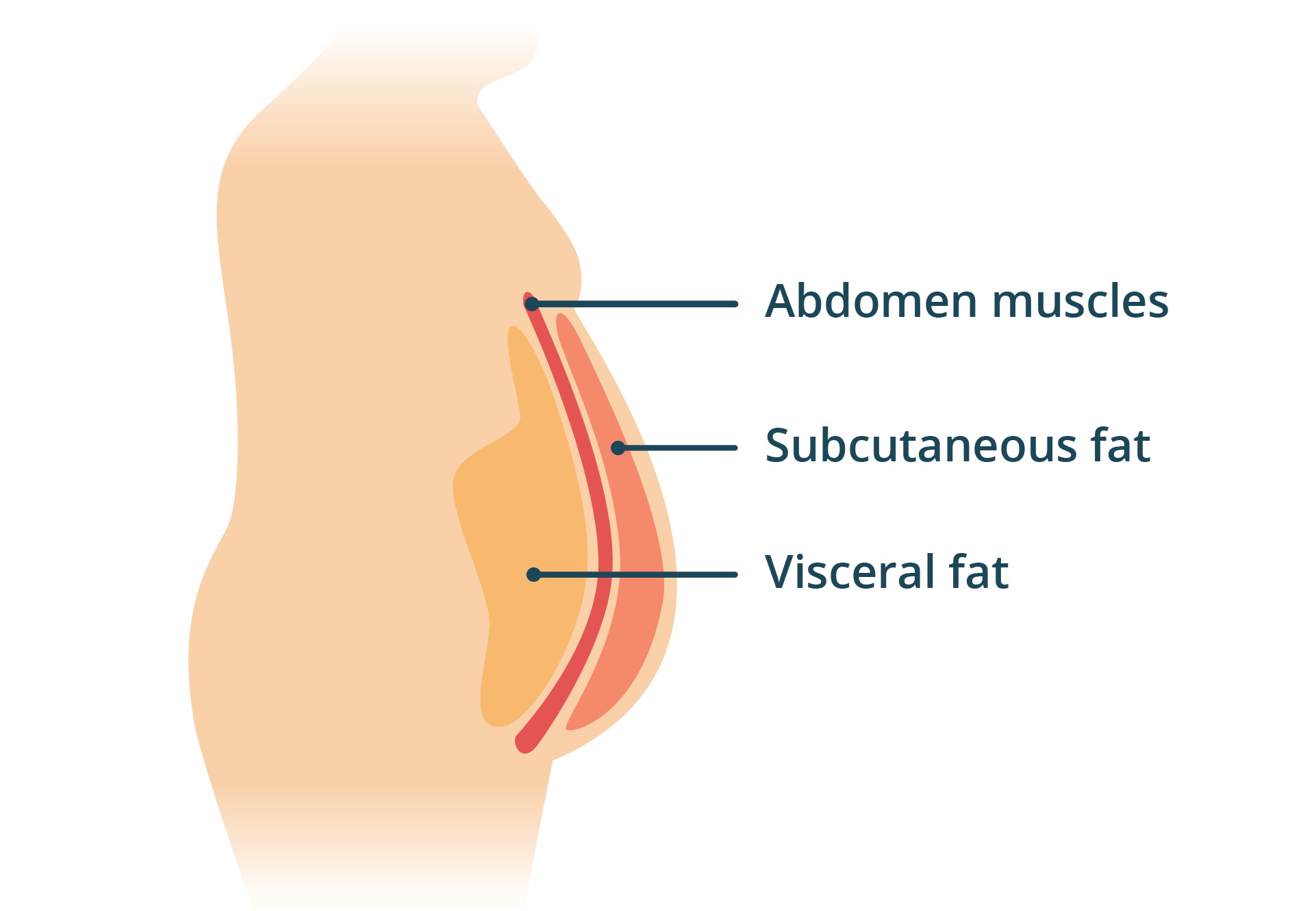
Duck Bod is a practical name for a common pattern: the body may look lean from the front, and the abdominal muscles may even show, but the stomach still appears pushed outward. The lower back may arch strongly, the pelvis may tilt forward, and the standing posture may resemble the forward-tilted stance of a toddler.
This is not always a classic "dad bod." It is not always solved by dieting harder. It may involve posture, breathing mechanics, pelvic position, and poor activation of the deeper core.
Many people with this pattern are told that their hip flexors are tight, their outer abs are weak, or they simply need more fat loss. They stretch, perform more crunches and leg raises, and push harder, but the shape remains. Sometimes those efforts make the imbalance more visible because the outer abdominal muscles and hip flexors keep doing most of the work while the deeper stabilizing system stays underactive.
The overlooked muscle is often the transverse abdominis, or TVA.
What Is the TVA? Your Natural Corset
The core is more than the rectus abdominis, the visible six-pack muscle. Beneath it lies the transverse abdominis, which runs horizontally around the torso like a corset or weightlifting belt.
The TVA helps stabilize the spine and pelvis and contributes to abdominal bracing. When deep-core control is poor, the outer abdominals and hip flexors may compensate. The pelvis may tilt forward, the lower back may arch excessively, and the abdomen may protrude even when the person is lean.
This does not mean the TVA is the only muscle that matters. It is one part of an integrated system that includes breathing, ribs, pelvis, glutes, hip flexors, spinal position, and daily posture. But when deep-core activation is missing, more crunches do not always fix the problem.
Why Conventional Ab Training Can Miss the Problem
Crunches, hanging leg raises, dragon-flag progressions, and other hard abdominal exercises can build visible strength. But they do not automatically teach the body to hold the ribs, pelvis, and lower abdomen in a controlled position.
If the pelvis stays tipped forward and the lower back keeps arching, the body may continue to present as lean but pushed outward. The goal is not to punish the stomach. The goal is to restore deep-core coordination.
Two Exercises for Deep-Core Control
Two exercises work especially well together: the stomach vacuum and the Pallof press. The stomach vacuum teaches you to locate and activate the deep abdominal wall. The Pallof press then trains that activation under resistance in a functional anti-rotation pattern.
Exercise 1: The Stomach Vacuum
The stomach vacuum is a drawing-in exercise that emphasizes the deep abdominal wall. It can be performed while standing, leaning over a counter, or on all fours. Many beginners find the all-fours position easiest because gravity makes the movement easier to feel.
Begin in your chosen position. If standing, place your feet about shoulder-width apart. If leaning over a counter, place both hands on the surface and incline your torso slightly forward. If working on all fours, keep your hands under your shoulders, your knees under your hips, and your back relatively flat.
Take a comfortable breath in, then exhale fully. As the air leaves your lungs, gently brace and draw your navel inward toward your spine, as though you were zipping up a tight pair of jeans. The contraction should feel deep in the lower abdomen rather than like a hard crunch of the upper abs.
Hold the contraction for 15 to 30 seconds while taking small, controlled breaths if necessary. Do not force yourself to hold your breath for the entire contraction. Release, breathe normally for several seconds, and repeat.
Complete three repetitions, or accumulate approximately 60 seconds of total contraction time. One practical progression is to perform up to three sets in the morning and again in the evening, provided the exercise remains comfortable and controlled.
Exercise 2: The Pallof Press
The Pallof press converts deep-core awareness into functional anti-rotation strength. It can be performed with a resistance band or cable machine.
Anchor the band securely at chest height. Stand sideways to the anchor with your feet about shoulder-width apart. Hold the band at the center of your chest with both hands, then step away until the band is under tension.
Brace your core and keep your ribs stacked over your pelvis. Press the band straight forward without allowing your torso, shoulders, or hips to rotate toward the anchor. Pause briefly with your arms extended, then return the band slowly to your chest. That is one repetition.
Begin with three sets of 10 repetitions on each side. Work toward three sets of 15 before increasing the resistance. Start with a light band, because excessive resistance often causes the lower back to arch or the hips to rotate, defeating the purpose of the exercise.
The movement should occur at the arms while the torso remains quiet. The Pallof press trains the body to resist rotational forces similar to those encountered while walking, carrying groceries, lifting, and standing under an uneven load.
Five Common Mistakes
1. Performing the vacuum on a full stomach. The drawing-in action is usually easier on an empty stomach or several hours after eating.
2. Holding the breath throughout the exercise. The contraction belongs in the abdominal wall, not the lungs.
3. Using too much resistance on the Pallof press. If the band pulls your torso out of position, reduce the resistance.
4. Allowing the lower back to arch. Keep the ribs down and the pelvis controlled.
5. Expecting overnight results. Motor control and strength develop gradually.
A Practical 10-Step Protocol
1. Choose the vacuum position that feels most natural: standing, leaning over a counter, or on all fours.
2. Practice a complete, controlled exhalation before drawing the abdomen inward.
3. Hold the contraction for 15 to 30 seconds while maintaining comfortable breathing.
4. Complete three repetitions per set.
5. After one or two weeks, gradually increase the hold time toward 30 to 45 seconds if form remains good.
6. Add the Pallof press using a light resistance band or cable.
7. Perform three sets of 10 repetitions on each side.
8. Progress toward 15 repetitions before increasing resistance.
9. Track posture and control over 30 days instead of judging the exercise after one session.
10. Stay consistent and reduce the workload whenever technique breaks down.
Frequently Asked Questions
How long does it take to notice results?
Some people notice better awareness and posture within a few weeks, while visible changes and meaningful strength gains may take four to eight weeks or longer. Results vary according to anatomy, consistency, breathing mechanics, body composition, and the presence of other postural or medical issues.
Can I do these exercises if I have lower-back pain?
Use caution. Begin with gentle, pain-free activation and stop if you feel sharp, radiating, or increasing pain. People with a history of back surgery, disc injury, hernia, pelvic-floor problems, or other medical concerns should obtain guidance from a qualified clinician.
Do I need both exercises?
The vacuum emphasizes awareness and activation. The Pallof press adds resisted anti-rotation strength. They complement one another, although either exercise can be adjusted or replaced when necessary.
How often should I train?
A practical schedule is to practice the vacuum once or twice daily and perform the Pallof press about three times per week. Consistency and technical quality matter more than intensity.
What if I cannot feel the TVA working?
That is common at first. Slow down, exhale fully, and focus on drawing the lower abdominal wall inward without forcefully crunching the upper abs. The all-fours position often makes the contraction easier to identify.
How This Fits Health Sovereignty
This protocol belongs beside the Health Sovereignty Protocols because posture, breathing, training quality, and trunk control affect the whole body system. It also connects to the Visceral Fat Intervention Map because not every protruding abdomen is the same problem.
Sometimes the issue is metabolic. Sometimes it is posture. Sometimes it is bloating, digestion, pelvic position, breathing, stress, or actual fat distribution. Health sovereignty means learning to distinguish the pattern before attacking the body with the wrong tool.
The Main Point
A protruding abdomen in a lean person is not always a simple body-fat issue, and it cannot always be corrected by stretching the hip flexors or performing more conventional abdominal exercises. Deep-core coordination, pelvic position, breathing mechanics, rib position, and overall posture may all contribute.
The transverse abdominis functions as part of the body's natural stabilization system. The stomach vacuum can help restore awareness of the deep abdominal wall, while the Pallof press develops the ability to maintain that control against rotational force.
These exercises are not a universal cure, and the TVA is not the sole cause of every protruding abdomen or case of back pain. However, when poor deep-core activation is part of the problem, consistent, technically sound training can improve posture, trunk control, and the appearance of the midsection over time.
Health Disclaimer
This page is educational coaching content only. It is not medical advice, diagnosis, treatment, physical therapy, rehabilitation, or a guaranteed body-transformation plan.
People with back surgery history, disc injury, hernia, pelvic-floor problems, pregnancy or postpartum concerns, radiating pain, numbness, weakness, unresolved abdominal pain, dizziness, breathing problems, or any medical condition should consult a qualified health professional before beginning deep-core, bracing, resistance, or posture exercises.