Book Plug
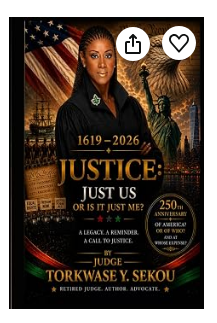
Previously published as 1619–2026: Justice—Just Us or Is It Just Me? by Torkwase Y. Sekou.
The first edition asked the question. The Second Edition makes the case. The verdict is still being written.
1619–2026: United States Justice—Just Us, or Is It Just Me? is companion reading for the site's work on U.S. historical erasure, Black land loss, public memory, policing, punishment, reparations, and the moral meaning of justice.
Book Synopsis
1619–2026: United States Justice—Just Us, or Is It Just Me?
Four hundred seven years after 1619—and 250 years after the birth of the United States—what does justice in America really mean, and who has been permitted to experience its full promise?
In this substantially revised and expanded Second Edition, retired judge, attorney, educator, and advocate Torkwase Y. Sekou examines the distance between America’s founding ideals and the lived reality of Black Americans across generations.
1619–2026: United States Justice—Just Us, or Is It Just Me? is neither a traditional history textbook nor an indictment of America. It is a conversation with America: historically grounded, legally informed, personally reflective, and unwilling to separate the nation’s extraordinary promise from the contradictions that have accompanied it.
Moving from slavery and emancipation through Reconstruction, Jim Crow, the Great Migration, voting rights, housing and wealth, education, policing, citizenship, the courts, civil rights, and the continuing struggle over equality, Sekou asks readers to examine not only what America has promised, but what those promises have meant in practice.
Drawing upon documented history, constitutional law, legal cases, economic realities, and HERSTORY—her own lived experience—Sekou brings the perspective of a former public defender, trial attorney, educator, and judge to a question that belongs to every generation.
Who received the promise? Who carried the burden? Who accumulated the wealth? Who was excluded? And what does justice require now?
This book does not ask readers to reject America. It asks them to know America well enough to demand that its practice rise to the level of its principles.
Justice—Just Us, or Is It Just Me?
The answer cannot belong to one race, one generation, one political party, or one courtroom.
The verdict is still being written.
Why It Belongs Near the U.S. Erasure Article
The Ancestral Egbe article U.S. Erasure of Black History as a Control System argues that erasure is not only about missing facts. It is about power: who gets remembered, who gets framed as dangerous, whose labor is extracted, whose land is taken, whose institutions are destroyed, and whose suffering is made invisible.
This book belongs beside that conversation because legal memory and historical memory cannot be separated. A justice system that forgets 1619, enslavement, Black Codes, convict leasing, racial terror, land theft, redlining, mass incarceration, and police violence cannot honestly explain the conditions it claims to judge.
Not Merely History
This is not merely a history book. It is likely a witness text: part legal critique, part racial truth-telling, and part moral challenge to the American conscience.
The value of a work like this is not only in the record it gathers. It is in the question it forces readers to carry: if justice has been promised for centuries, who has received it, who has been denied it, and what repair is required now?
Continue the Thread
External Book Link
Read the Book
Use this page as a bridge from the site's justice-memory work into Judge Sekou's legal and historical reflection.