A Height of Light, Not Unlimited Force
The Summer Solstice ritual works with the season's concentrated light, heat, activity, and visible growth. Its teaching is not simply to gather more power. It is to place power under direction.
Solar force without Ori can become scattered ambition, exhausted activity, domination, or spectacle. Solar force governed by Ori can become courage, clarity, relationship, disciplined manifestation, and useful service. The threshold asks: What deserves the strongest light I can give it?
What the Summer Solstice Is
In the Northern Hemisphere, the June solstice is the moment when that half of Earth reaches its greatest annual tilt toward the Sun. It usually occurs on June 20 or 21 and produces the year's longest period of daylight. The seasons come from Earth's axial tilt and orbit, not from a sudden increase in the Sun's power.
That measurable celestial event becomes a sacred clock when a community uses it to organize attention, gratitude, divination, offerings, movement, planning, and action. The astronomy establishes the threshold. Culture and lineage establish how people understand and work with it.
The Ancestral Egbe Summer Solstice Synthesis
This teaching is a house synthesis drawn from Ancestral Egbe and Kemetic Ashram ritual histories. It joins solar devotion, Pan-African seasonal remembrance, ancestral feeding, Ori-centered planning, Odunde and Yoruba New Year proximity, elemental practice, relationship work, and comparative inner-cultivation language.
It is not presented as one universal African ceremony. African peoples preserve many calendars shaped by latitude, rainfall, agriculture, local history, deity jurisdiction, and lineage law. The house doctrine is that the celestial threshold is real, while its responsible ritual form must remain culturally and spiritually situated.
The Powers Named in the Ritual Record
Ra
Solar illumination, visible authority, vitality, success, and the law of reciprocity. The house archive names Ra directly in the Summer Solstice offering record.
Ògìyán
Also known as Òṣògìyán or Osagiyan: the Orisha of fertility, agriculture, and newly harvested yam; the legendary founder-king of Èjìgbò; and a youthful, assertive, warrior-like manifestation of Ọbàtálá. This is distinct from the Obatala emphasis used in the Winter Solstice observance.
Ori
The inner authority that chooses the purpose, governs the force, and turns seasonal inspiration into accountable decisions.
Ancestors and Egungun
Lineage continuity, gratitude, food, memory, and responsibility for what the living generation will cultivate and transmit.
Egbe
Heavenly companions, destiny relationships, belonging, and the social-spiritual field in which individual purpose develops.
Oshun and Odunde
River, renewal, sweetness, prosperity, and communal New Year celebration in the nearby June cycle. Odunde and the astronomical solstice are related in the house calendar but are not the same observance.
Fire and the heart current
Love, joy, passion, expression, and relationship. This language comes partly through a comparative Qigong and Chinese-medicine lens used in the archive.
So: Recognized, but Not Part of Our Collective Observance
So is not Eshu. The cited Ganlodo Kingdom account identifies So with its thunder deities and recognizes So as a Summer power associated with high energy, focused force, and growth. Ancestral Egbe is aware of this cultural model, but So is not part of our house's collective Summer Solstice observance. Practitioners who follow the Ganlodo model are welcome to include So within their own properly grounded personal practice.
As Above, So Below
The Outer Sun and the Inner Sun
The archive compares the visible Sun with an inner solar center: the spiritual heart, the directing consciousness, and the radiant current within the Body of Light. The outer Sun does not replace the inner work. It gives the practitioner a visible cosmic pattern through which to examine that work.
The macrocosm-microcosm principle is African before it is later described in Hermetic vocabulary. Khametic sacred science understood the human being as participating in a greater living order. In practice, the outer height of light becomes a mirror: Where is the inner light strong? Where is it obstructed? Where is heat needed, and where must heat be cooled by character and right proportion?
Study the relationship between inner work, offerings, and external spiritual alignment.

The General Public Ritual Pattern
- Clean and prepare. Clean the body, room, altar, tools, and immediate environment. Preparation tells the mind and spirit that the threshold matters.
- Establish one governing intention. Name the work clearly. The Fa teaching preserved in the archive warns against scattering power by mixing every desire into one rite.
- Acknowledge solar authority. Greet the Sun or Ra through prayer, breath, stillness, praise, or respectful observation. Never stare directly at the Sun.
- Practice reciprocity. Offer gratitude before asking for increase. An offering expresses relationship; it is not a purchase or a way to command a deity.
- Consult spiritual weather when qualified. Divination may clarify which powers, cautions, or obligations are active. It should be performed within competence and lineage.
- Give the energy movement. Prayer, drumming, song, dance, visualization, safe ceremonial fire, exercise, or focused creative work can move intention into embodied action.
- Attend to relationship. Express gratitude, repair avoidable conflict, speak honestly, and create a nourishing experience with family, friends, or community.
- Commit the next action. End with a specific step and date. Carry the work through summer and review the harvest at the Autumn Equinox.
Offerings, Color, and Reciprocity
One archived Ancestral Egbe rite names golden or yellow fruits, sunflowers and seeds, frankincense, citrine, carnelian, pyrite, gold-colored metal, coins, and other solar correspondences as offerings to Ra. These materials communicate brightness, nourishment, vitality, success, and exchange.
The governing principle matters more than copying a list: offer cleanly, within your means, with respect for the power and the place. Do not leave food, flame, glass, metal, or ritual remains where they can injure people, animals, waterways, or land. Shrine-specific offerings should follow the requirements of that shrine rather than a public article.
Fire, Heart, Love, and Sacred Relationship
The Summer Solstice archive uses fire and heart language to connect seasonal heat with love, joy, passion, and relationship. In the comparative Qigong vocabulary used by the house, summer is a period of abundant Yang: outward movement, wakefulness, heat, and expression. This is a comparative lens, not an African origin claim for Chinese medicine.
The practical lesson is direct. Energy follows repeated attention. Concentrating only on disappointment feeds disappointment; studying what is worthy in oneself and others helps direct energy toward gratitude and repair. Honest speech, shared food, movement, affection, and meaningful time become relationship practices when they are carried with consciousness rather than habit.
The June Sacred Calendar
Odunde, Year Turning, and Ancestral Feeding
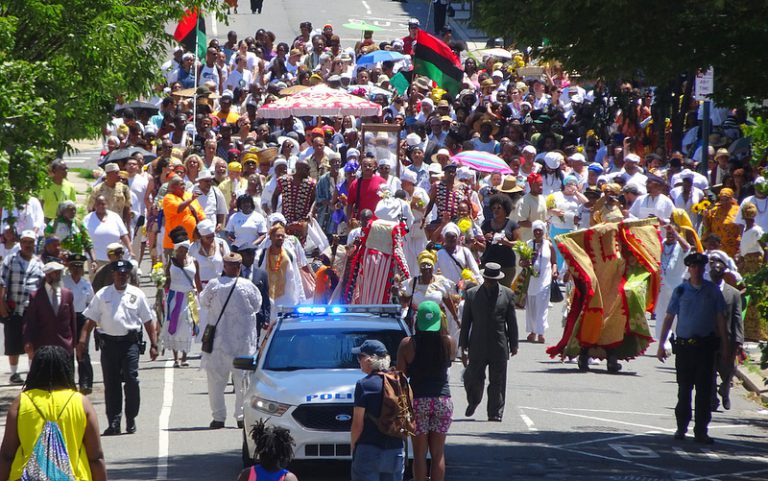
Ancestral Egbe places the solstice inside a larger June cycle that includes the closing of the old year, the Reading of the Year, Odunde, ancestral remembrance, and the opening of new work. The official Philadelphia ODUNDE Festival began in 1975 as a celebration of African heritage and the Yoruba New Year; its procession carries offerings of fruit and flowers to Oshun at the river.
Odunde and the Summer Solstice should not be treated as identical. Their proximity allows the house calendar to read them together: clear the old, consult the year, honor ancestors and river power, then direct the season's concentrated light into the new cycle.
Food, Yams, Ancestors, and the Living Cycle
House materials preserve a particular Summer yam practice through Ògìyán, also known as Òṣògìyán or Osagiyan. He is revered as the Orisha of fertility, agriculture, and newly harvested yam, and remembered as the legendary founder and king of Èjìgbò in Osun State. The name tradition connects Ògìyán with iyán, pounded yam, preserving the central place of yam in his identity and veneration.
Ògìyán is a youthful, fierce, warrior-like manifestation of Ọbàtálá. White carries Ọbàtálá's purity, cool character, and creative order, while Ògìyán's assertive and protective dimension may also be marked by red. This is not the same Obatala emphasis used in the Ancestral Egbe Winter Solstice observance. Ògìyán fits Summer because this road is active, energetic, externalized, and directed toward fertility, protection, and the visible renewal of life.
The yam does not have to wait for the later major harvest celebration. The Summer offering marks the transition from planting and dwindling stores of old yam toward renewed abundance. It gives thanks for survival through the leaner period, honors the ancestors, and asks blessing for the approaching agricultural year.
Nigerian harvest festivals do not all follow one fixed astronomical date. Their timing may move with rain, crop development, local conditions, divination, and the decision of a king, council, elders, or shrine authorities. Ancestral Egbe uses an astronomical seasonal model. Because an Ògìyán or yam observance may fall within roughly one or two weeks of the Summer Solstice, the house often folds a small courtesy to Ògìyán into the solstice rite. Depending on the practitioner and lineage calendar, a separate yam observance may still be held about two weeks later.
This courtesy is carried by a fresh white yam, Agunyẹ, as a foreshadowing of the fuller yam rite. It sits beside the abundant fruits of the June cycle: Oshun's sweet river and New Year current, and the bananas, citrus, and other sweet fruits associated with Egbe and communal renewal. Together they express movement from the rainy-season planting period and declining reserves toward fertility, fruitfulness, and a time of plenty.
This is best understood as an Ancestral Egbe seasonal application of harvest, renewal, and reciprocity, not as proof that every Yoruba community observes a universal June New Yam rite.
Ancestor food follows family or lineage tradition. Shrine food follows shrine law. Public guidance cannot responsibly replace dietary restrictions, ritual permissions, or the knowledge of how offerings are prepared and closed.
Divination and the Spiritual Weather
A seasonal reading asks more than, “What do I want?” It asks what forces are actually present, what opportunities should be strengthened, what dangers should be cooled, and what obligations have been neglected. A yearly reading may identify a particular emphasis beyond the standing Summer observance, but that result belongs to that reading and should not be turned into a permanent solstice assignment.
This is why the calendar does not mechanically assign every deity to every solstice. The season establishes a field; divination and lineage identify the particular work.
Public Teaching and Private Ritual Boundaries
The archives include advanced tantric, shrine, and initiatory forms. Those procedures are intentionally absent here. Public seasonal practice can safely teach preparation, prayer, intention, reciprocal offerings, movement, relationship repair, reflection, and follow-through. It should not publish sexual-energy sequences, initiatory identities, or house-specific ritual mechanics outside their proper container.
Carry the Solar Intention to Harvest
Write one intention in a sentence. Name the action that feeds it, the relationship that must support it, the habit that weakens it, and the evidence that will show progress. Revisit the commitment weekly. At the Autumn Equinox, evaluate what actually grew.
Astronomical context: NOAA, “What Is a Solstice?”; NASA, “June Solstice Brings Summer, Winter Seasons.”
Cultural context: ODUNDE Festival, “About ODUNDE”; Philadelphia City Council, 40th Anniversary of ODUNDE; Osun State Government, “Èjìgbò”, documenting the Ogiyan festival at the beginning of the new-yam harvest during the rainy season and the feeding of the Orisa with new yam. Ritual synthesis is drawn from the Ancestral Egbe and Kemetic Ashram Summer Solstice archive, including house records from 2011–2024 and Ganlodo Kingdom seasonal material.