Newsletter Archive
Pyramids in West Africa & the Sahelian Tradition
Reframing the Origin of the Pyramid
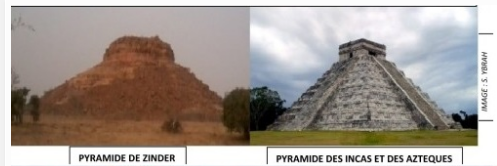
A pyramid in the village of Dan Baki, 20 km from the city of Zinder in Niger — similar to Aztec pyramids in South America.
When most people think of pyramids, they think of Egypt.
But across West Africa—particularly in the Inland Niger Delta, Senegambia, northern Ghana, and Nigeria—there exist monumental earthen structures known as tumuli: large, conical burial mounds built for royalty and ancestral veneration.
These are not random mounds.
They are architectural, spiritual, and cultural structures that mirror—and in many ways precede—the symbolic logic of the pyramid.
What Are These "Earthen Pyramids"?
Archaeological research has documented thousands of these structures across the Sahelian belt of Africa.
- Some rise over 70 feet in height
- Others span over 200 feet in diameter
- Many contain:
- Burial chambers
- Human remains
- Ritual objects
- Offerings and ceremonial items
These structures functioned as:
- Royal tombs
- Ancestral shrines
- Ritual centers of power
As noted in scholarly research, these tumuli were not merely graves—they were sites of ongoing spiritual interaction between the living and the ancestral world.
The Sahelian Continuum: West Africa to Nubia
What makes these structures even more significant is their connection to the Nile Valley.
Across Nubia (ancient Kush) and early Egypt, similar mound-based burial traditions existed:
- Royal tumuli in Nubia
- Early Egyptian burial mounds (pre-pyramid structures)
- Symbolic "primordial mound" concepts tied to resurrection
Scholars have long noted the structural and cultural parallels:
- Subterranean burial chambers
- Conical or mound-shaped superstructures
- Use of offerings, attendants, and ritual objects
- Strong emphasis on ancestral continuity and rebirth
In fact, some early researchers proposed that the pyramid tradition itself may have emerged from Central and Sudanic Africa, later developing into the stone pyramids of Egypt.
Congo as the cradle and Egypt (Kemet) as the mouthpiece through Greece into the western world.
From Mound to Pyramid
The pyramid did not emerge in isolation. It evolved.
The earthen tumulus represents:
- The original symbolic form
- The ancestral architecture of resurrection
- The earliest expression of sacred burial geometry
Later in the development process, stone Egyptian pyramids can be understood as:
- A refinement
- A monumentalization
- A geometric transformation
…of an already existing African tradition.
Why This Matters for the Yoruba Model
The Yoruba system is not an isolated cultural framework—it is part of a broader African civilizational continuum.
The same principles found in these tumuli appear in Yoruba spiritual logic:
- Ancestor veneration (Egún)
- Sacred relationship between life and death
- Sacredness of the relation to earth
- Ritual continuity across generations
- Structured spiritual cosmology tied to the land
These are not coincidences.
They are expressions of a shared philosophical and spiritual foundation that stretches:
From the Nile Valley → across the Sahel → into West Africa
Restoring the African Knowledge System
For generations, these West African structures were dismissed as "mounds," while pyramids were treated as a uniquely Egyptian phenomenon.
But when viewed in proper context, a different picture emerges:
- A trans-Sahelian cultural system
- A shared architectural language
- A continuous ancestral worldview
This is not about relocating Egypt.
It is about restoring Africa to itself.
Further Research
Reclaiming the Sahelian Origins of Sacred Architecture →
The deeper academic treatment: tumuli, Nubian parallels, Cheikh Anta Diop, and the full civilizational continuum.
Faraji — Earthen Pyramids of West Africa and Ancient Nubia (PDF) ↗