In 1921, William Leo Hansberry, the founder of African Studies in the United States, proposed that the origins of Egyptian pyramids lay not in Egypt itself, but in Central Africa. His argument was based on the massive earthen mounds (tumuli) of the Niger River basin in present-day Mali. A century of archaeological research has substantiated that argument. This page presents that case because it belongs in the foundation of any serious Yoruba civilizational framework.
For readers searching for West African pyramids, African pyramids outside Egypt, Nsude pyramids, or the Sahelian origins of pyramid architecture, this article connects those search questions to a wider African sacred architecture tradition.
Primary scholarly source: Salim Faraji, "Rediscovering the Links Between the Earthen Pyramids of West Africa and Ancient Nubia: Restoring William Leo Hansberry's Vision of Ancient Kush and Sudanic Africa," Journal of Ancient Egyptian Interconnections, vol. 35, September 2022, pp. 49–67.
The Three Pyramid Sites You Need to Know
The Nsude Pyramids, Igbo Nigeria
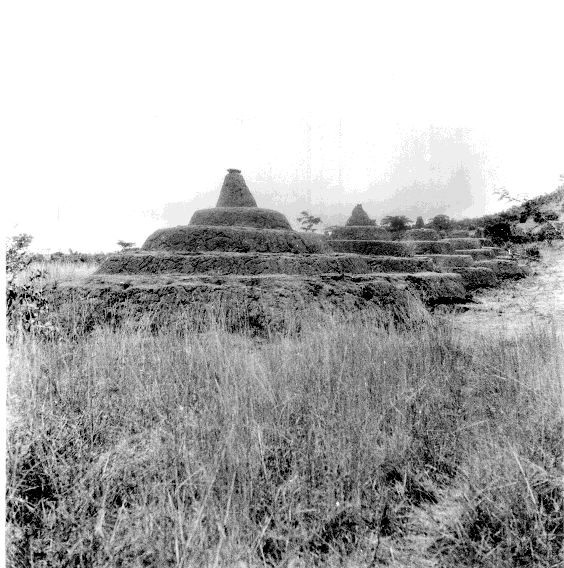
In 1935, G. I. Jones, an anthropologist and colonial administrator, photographed the Nsude pyramids — ancient Igbo earthen pyramids in Udi, Enugu State, Nigeria. The first base section was 60 ft. in circumference and 3 ft. in height. The next stack was 45 ft. in circumference. Circular stacks continued until the structure reached the top.
The structures were temples for the god Ala/Uto, who was believed to reside at the top. This places them not as burial monuments alone, but as sacred architectural shrines — living ritual spaces built upward toward the divine, on the same conceptual axis as Nile Valley pyramid theology.
The Nsude pyramids represent the Igbo architectural and spiritual tradition, a tradition culturally interconnected with the Yoruba through centuries of trade, marriage, and shared ancestral logic — particularly in the ancestral veneration practices that underlie both cultures.
The Pyramid of Dan Baki, Zinder, Niger
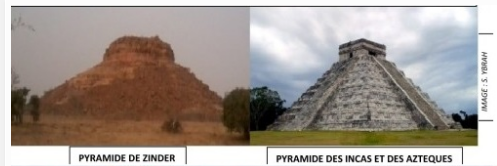
A pyramid in the village of Dan Baki, 20 km from the city of Zinder in Niger, demonstrates the Sahelian pyramid tradition in the central West African corridor. The structural similarity to Aztec pyramids in South America is not coincidental — it points to a common architectural logic rooted in the same trans-Sahelian cultural transmission that Hansberry and Faraji document.
The city of Katsina, approximately 200 miles southwest of Zinder, sat at the heart of medieval Hausaland — the same zone from which the Durbi Takusheyi tumuli were excavated. Zinder's Dan Baki pyramid is part of that same unbroken tradition of monumental mound-building that stretches from ancient Kerma in Sudan to the Niger Valley and into the forest zones of modern Nigeria.
This is the zone that produced the Yoruba-adjacent Nok civilization — itself the cultural ancestor of many spiritual practices that later crystallized into what we now call Yoruba religion.
The Oba's Pyramid, Benin City, Nigeria
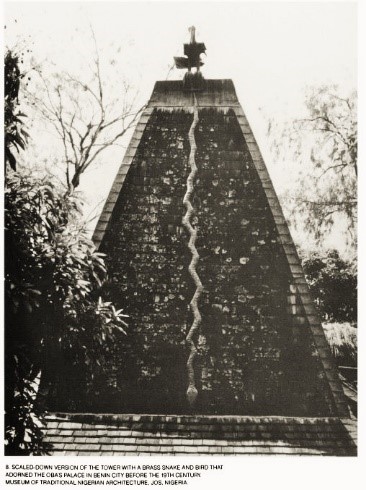
A photo of the Oba's Pyramid before the 19th century in Benin, Nigeria — specifically, a scaled-down version of the tower with a brass snake and bird that adorned the Oba's Palace in Benin City. This structure is now held at the Museum of Traditional Nigerian Architecture in Jos, Nigeria.
Benin City's palace complex was one of the great architectural achievements of pre-colonial Africa, described by European visitors in the 16th and 17th centuries as comparable to Amsterdam. The pyramid-tower form at its apex is not decorative — it encodes the same cosmological logic found in Nile Valley monuments: the king's palace as axis mundi, the vertical structure as the king's conduit to ancestral power.
The Benin Kingdom sat at the western edge of the Yoruba world. Oduduwa — the founding ancestor of the Yoruba — is claimed in oral tradition by both the Yoruba and the Edo (Benin) people as their common progenitor. That shared claim is reinforced by this shared architectural vocabulary of sovereignty and ancestral power expressed through pyramidal form.
The Scholarly Argument: A Trans-Sahelian Civilizational Continuum
Faraji's 2022 paper establishes a framework that changes how we read all of these structures. He argues — following Hansberry, Cheikh Anta Diop, and archaeological findings across five countries — that the West African earthen pyramid (tumulus) tradition forms a single cultural continuum with the Nile Valley pyramid tradition.
Key Archaeological Evidence
- Senegambia: 10,000 documented tumuli in Senegal alone; 3,000 megalith-encircled mounds dating from 200 BCE to the 14th century CE. Structurally identical to Kerma (Kush) stone-circle tumuli from 2500 BCE.
- Mali (Inland Niger Delta): The tumulus of El Oualedji — 17 meters high, 100 square meters in area, dated 11th century CE. Contains burial goods, animal remains, weapons, and copper ornaments. Louis Desplagnes described it as a "truncated pyramid." Leo Frobenius called these "the monumental pyramids of Songai."
- Northern Ghana (Komaland): 600 stone-circle mounds dated 6th–14th century CE. Structural design mirrors Kerma Kush burial mounds from 2500 BCE. The orientation, burial goods, animal sacrifice, and terracotta figurines match Nile Valley traditions in detail.
- Northern Nigeria (Durbi Takusheyi): Eight royal tumuli in Hausaland, dated 13th–16th century CE. Sir Herbert Richmond Palmer, who first excavated them in 1907, literally called them "pyramids of earth." The largest measured 90 ft. wide and 25–30 ft. high.
Why This Belongs in the Yoruba Framework
The Yoruba-adjacent civilizations — Igbo, Benin/Edo, Nok, Hausa — all produced or were surrounded by these pyramid traditions. This is not a coincidence. It is evidence of what Faraji and Hansberry call a "Classical Sudanese" cultural heritage: a shared trans-Sahelian tradition of mound-building, ancestral veneration, and royal sacred architecture that connects West Africa to the Nile Valley across 5,000 years.
In the Ancestral Egbe framework, we teach that the Yoruba cultural model connects to Kemet (ancient Egypt) through a Sudanic-Sahelian corridor that runs through the same zones where these pyramids were built. The architecture proves the connection. The burial practices — ancestral shrines, ritual feeding of the dead, offerings, the belief in postmortem life — are identical to what underlies Egungun practice today.
These pyramids are not Egypt's distant cousins. They are the ancestral archives of the same civilizational impulse — to mark the ancestors, honor their power, and build upward toward the divine. That is the axis around which Yoruba cosmology still turns.