The False Split Between Kemet and Kongo
One of the deepest injuries in African history is not only that history was stolen. It is that African people were trained to read their own civilizations through a colonial map of value. In that map, Kemet is often isolated, lightened, or treated as almost non-African, while Kongo, Central Africa, and forest civilizations are pushed into the category of primitive, dark, backward, or merely tribal.
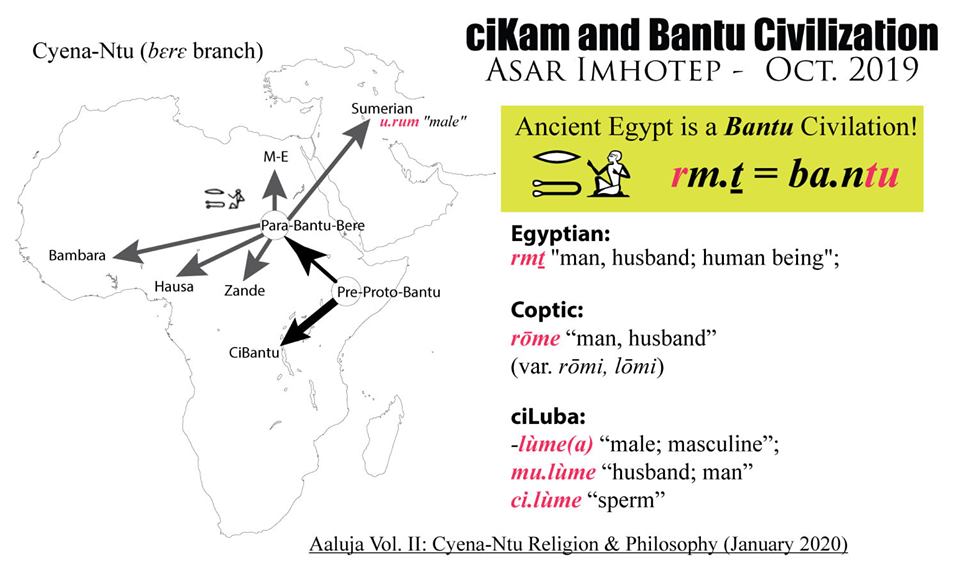
This article rejects that split. Kemet was not an island floating outside Africa. It was a Nile Valley civilization inside a wider African world. The Nile Valley received people, symbols, technologies, spiritual ideas, and ritual forms from multiple African regions as the Sahara dried and populations moved toward river corridors, forests, savannas, and trade zones. Kemet became one of the great centers of African civilization, but it did not create Africa by itself.
The better frame is cultural unity with local distinction. Kongo is not Kemet. Yoruba is not Kongo. Nubia is not Yoruba. But these systems can still preserve related African logics: ancestor veneration, sacred kingship, ritual specialists, bush colleges and initiation systems, cosmograms, sacred sound, elemental force, and the spiritual authority of the land, water, forest, dead, and divine.
Doctrine Note
The cultural unity of Black Africa does not mean every African culture is identical. It means that Africa should be studied as an internally connected civilizational world, not as isolated fragments interpreted through colonial hierarchy. The question is not whether Kongo "copied" Kemet or Kemet "copied" Kongo. The better question is how ancient African systems shared, inherited, transformed, and preserved related sacred technologies across time.
Kemet as a Gathering Place of African Memory
Ancient Kemet developed along the Nile, one of the great corridors of the African continent. The drying of the Sahara pushed older populations toward water systems, trade pathways, and fertile lands. That movement matters because it makes Kemet part of a continental story: desert, savanna, forest, river, lake, mountain, and ocean systems all feeding human movement and sacred exchange.
From this perspective, Kemet can be understood as a fountainhead and a receiver. It preserved and refined many forms of African knowledge, but it also received ancestral currents from older and parallel African worlds. The article's Kongo thesis belongs here: Central African, Bantu, Twa, and forest-linked traditions should not be treated as late, marginal, or unrelated to the spiritual foundations of ancient Africa.
The Kongo world is especially important because it preserves a sophisticated ritual universe: cosmology, ancestor work, initiatory societies, healing systems, sacred medicines, nkisi technologies, elemental relationships, and spiritual authority rooted in land, water, forest, and the dead. These are not primitive remnants. They are high cultural technologies.
The Priest, the Staff, and Sacred Authority
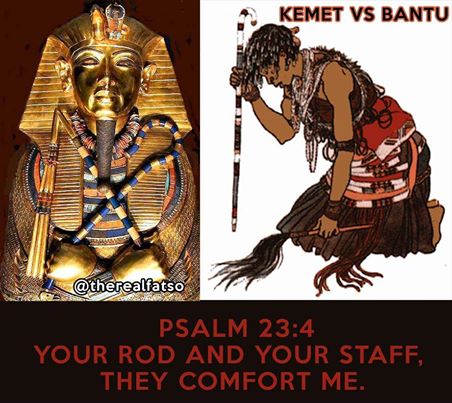
The staff, rod, wand, walking stick, broom, flywhisk, and ritual implement appear across African systems as signs of authority, protection, cleansing, office, and spiritual command. When images place a Kemetic ruler beside a Bantu or Central African ritual specialist, the point is not that the two figures are the same person. The point is that African sacred authority often carries recognizable patterns: posture, regalia, staff, animal power, ancestral mediation, and the embodied dignity of office.
This is why visual literacy matters. A person trained to see Kemet as separate from Black Africa may miss continuity that is obvious to a ritual reader. A person trained only by European categories may see costume, superstition, or folklore where an African priest sees office, lineage, medicine, and jurisdiction.
Twa, Dwarfs, and the Old Ancestors
The draft article places special attention on dwarfs, pygmies, and Twa-related memory in ancient Egyptian symbolism. This is a sensitive area because modern language around dwarfism, pygmy peoples, and ancient representation can easily become disrespectful. The point here is not mockery or exoticism. The point is status, sacred memory, and ancestral priority.
Scholarly studies of dwarfs in ancient Egypt show that they could hold respected social, ritual, and court positions. William R. Dawson's 1938 article "Pygmies and Dwarfs in Ancient Egypt," Veronique Dasen's Dwarfs in Ancient Egypt and Greece, and Karl-Joachim Seyfried's work in the Lexikon der Aegyptologie all point toward the importance of these figures in ancient Egyptian society and imagery.
The Ancestral Egbe interpretation adds a cultural reading: the repeated dignity given to short-statured figures may preserve memory of ancient African forest peoples, ritual specialists, or old ancestral masters associated with deep antiquity. In the draft argument, the short figures on the Narmer Palette are read as possible markers of old priestly authority, potentially connected to Twa or Central African ancestral memory. This should be handled as an interpretive thesis, not a settled academic consensus.
Ptah, Bes, and the Southern Interior
Kemetic religion contains figures that point toward craft, protection, speech, embodiment, and deep ancestral force. Ptah is associated with creation through heart, tongue, craft, and sacred making. Bes appears as a protective figure connected with household power, birth, sexuality, music, dance, and guarding vulnerable thresholds. Thoth carries wisdom, writing, speech, measure, and divine intelligence.
The Kongo/Kemet thesis asks readers to look at these beings with African eyes. Protective dwarf imagery, animal power, sacred craft, forest force, baboon forms, and ritual specialists should not be divorced from the wider African world. They may preserve memory of older relationships between Nile Valley civilization and interior African sacred systems.
This does not require reducing Kemetic religion to Kongo religion. It requires refusing the colonial habit of isolating Kemet from the rest of Africa whenever continuity becomes inconvenient.
Kongo Civilization Was Not a Footnote
The later Kingdom of Kongo, emerging in western Central Africa and centered around Mbanza Kongo, shows how sophisticated Kongo political and spiritual civilization remained into the medieval and early modern period. Kongo had monarchy, provinces, trade networks, currency systems, ritual structures, diplomatic relations, craft production, and complex engagement with the Portuguese after the fifteenth century.
That later history does not prove every ancient claim by itself, but it does correct the cultural insult. Kongo civilization was capable of high organization, philosophical depth, spiritual technology, political adaptation, and international diplomacy. When colonial writers called Central Africa primitive, they were describing their ideology more than African reality.
The tragedy is that European contact also intensified the slave trade, political destabilization, religious interference, and extraction. Kongo's later decline under pressure from Portugal, slavery, internal factional conflict, and colonial expansion should be studied as historical disruption, not as evidence of cultural inferiority.
Why This Matters for Cultural Repair
If Kemet is separated from Black Africa, Black people inherit a broken map. They may admire Egypt while despising the forest, the village, the drum, the ancestor, the priest, the shrine, the nkisi, the Egungun, the mask, the cosmogram, and the living African systems that survived.
That broken map creates spiritual and psychological confusion. It trains people to want an ancient Africa that has been cleaned, whitened, museumized, and removed from living African ritual culture.
The cultural unity of Black Africa restores the map. Kemet, Nubia, Kongo, Yoruba, Igbo, Mande, Akan, Dogon, Sahelian, East African, Central African, and diaspora systems do not have to collapse into one identity in order to belong to one African civilizational conversation.
Read This as a Thread
This article is the bridge into a dedicated Reader's Journey on the cultural unity of Black Africa. Use the sequence to move from the Kongo/Kemet foundation into Sahelian sacred architecture and then back into the broader Pan-African divine-name thesis.
Sources and Further Reading
- William R. Dawson, "Pygmies and Dwarfs in Ancient Egypt," Journal of Egyptian Archaeology, vol. 24, 1938.
- Veronique Dasen, Dwarfs in Ancient Egypt and Greece, Oxford University Press, 2013.
- Karl-Joachim Seyfried, "Zwerg," Lexikon der Aegyptologie, vol. VI.
- Chuka Nduneseokwu, "A History of The Ancient African Kingdom of Kongo," Liberty Writers Global, 2021.
- Internal study notes: "Congo influences in Kemetic foundation" and "A History of The Ancient African Kingdom of Kongo."
Continue the Cultural Unity Study Path
Use this article as the opening doctrine bridge for the Cultural Unity of Black Africa thread. The next step is not to memorize isolated facts, but to learn how African language, architecture, ritual office, ancestor memory, and sacred form speak to each other across regions. For readers moving from Kongo/Kemetic history into living Kongo orientation, continue with the Palo Mayombe Orientation Manual.