
Receiving Eshu / Elegba - Opening the Road Correctly
Eshu, also called Elegba or Elegua in related diaspora lines, is the messenger, opener of roads, keeper of crossroads, and divine force that governs movement between worlds.
In practical terms, Eshu stands at the gate. Before a person rushes toward Orisha, Ifa, initiation, or higher-status priesthood work, the road itself must be opened, respected, and understood.
Receiving Eshu / Elegba gives the practitioner a consecrated point of relationship with the force that carries messages, opens pathways, blocks what should not pass, and reveals where the person is not moving cleanly.
Why Eshu Matters
Eshu is not a cartoon trickster. Eshu is intelligence at the crossroads. He tests character, exposes contradiction, opens the way when the way is clean, and closes the way when the person is moving without order.
For many students, this is the missing layer. They want access to power, but they have not built relationship with the one who governs access. They want answers, but they have not honored the messenger. They want movement, but they have not dealt with the gate.
Messenger, Threshold, and Translation
Eshu translates between human language and spirit language. In that sense, he is tied to communication, signs, timing, and the ability to understand what is being said from the invisible side.
This is why Eshu appears around thresholds, crossroads, entrances, roads, and moments of change. He is present where one condition becomes another.
In some Ifa explanations, the concept of iwaju, the forehead or inner portal of perception, is associated with Esu because Esu translates between the language of spirit and the language of human beings. This is part of why Eshu is not simply a road opener in the outer world. He is also connected to perception, interpretation, and the ability to read what the road is saying.
What Receiving Eshu Does
Receiving Eshu establishes a formal point of contact for road opening, communication, protection, and spiritual accountability. It can support clearer movement in prayer, divination, offerings, shrine work, and daily life decisions.
This does not mean life becomes effortless. It means the person has entered a more conscious relationship with the force that governs openings, choices, signs, warnings, and consequences.
Where It Fits in the Journey
Receiving Eshu belongs before deeper Ifa responsibility and beside serious Orisha preparation. Egun and Ori remain foundational. Eshu opens and guards the road so that the person does not enter deeper work by guesswork, ego, or spiritual appetite.
Different traditions sequence this receiving differently. In Lucumi, Eshu is often received earlier with Ogun, Ochosi, and Osun as part of what is commonly called the Warriors. That makes sense inside the Lucumi diaspora setting, where the spiritual system developed under extreme pressure in a hostile Western colonial world. In that context, basic functionality, protection, road opening, and survival required an earlier warrior structure.
In many Isese-style approaches, born in the more culturally intact homelands of Africa, Eshu is not always received as early as a general system practice. It may be tied to priestly initiation, Orisha preparation, Ifa work, or received earlier only when a reading shows that the person specifically needs Eshu for a particular life condition.
In our diaspora practice, we respect the doctrine of the Primacy of Ìṣẹ̀ṣe, which is attested in the sacred Ifa Odu of Ògúndá-Owónrín. This doctrine is one of the key structuring points in the student's spiritual journey. It explains why meditation, Ori discipline, and ancestral work are treated as foundation; why Palo, Kongo, and elemental work belong in the middle layer; and why Eshu, Orisha, and Ifa elements sit at the upper tier.
Egbe work is also foundational for some people, but its urgency varies. If a person has already found their right pairing or is in a strong, harmonious union, much of that Egbe-related work may already be resolved, stabilized, or in process. If the Egbe current is disturbed, neglected, or showing through dreams, relationships, isolation, or repeated interruption, then Egbe becomes more central to the foundation.
The physical level is also key. Martial arts, dance, yoga, breath, posture, and embodied discipline all help stabilize the vessel. They are simply harder to execute and communicate through a digital service page, so they are not always as visible in the website structure as the written, ritual, and shrine-based supports.
The upper tier is powerful, but it does not work well when the bottom and middle are out of order. That means the foundation must be solidified first: ancestors, Ori, and the ground of practice. A person may be advised to receive an ancestral shrine, and often Ori support depending on the circumstances, before receiving Eshu or other Orisha shrines. Ancestral shrines can operate without Eshu because they are rooted in lineage and family relationship. Eshu can still assist that work, but later Orisha and Ifa shrine systems generally require Eshu for proper communication, road opening, and ritual operation.
This is why the work must be approached with respect. Eshu is not received as an ornament. Eshu is received as a living spiritual responsibility.
Receiving Eshu is often bundled with Hand of Ifa because the road, message, and gate must be addressed as part of entering deeper Ifa relationship. It may also be received with other priestly initiations, because different varieties or paths of Eshu support different functions: communication, road opening, defense, boundary work, spiritual translation, and movement through specific ritual gates.
Offerings and Respect
Eshu offerings vary by house, path, and reading. General offerings may include simple items such as coconut, coffee, candy, palm oil, honey, peppers, smoked fish, tobacco, or other materials depending on the tradition and the instruction received.
The important principle is not excess. The important principle is correct relationship. Offerings should match the path, the reading, and the elder guidance.
Eshu, Elegba, Legba, and Exu
Names and functions differ across Yoruba, Lucumi, Vodou, Quimbanda, Umbanda, and related diaspora traditions. Eshu / Elegba should not be carelessly collapsed into every road-opening spirit in every tradition.
The similarities matter, but so do the differences. This page is focused on Eshu / Elegba within the Yoruba and Yoruba-derived road-opening frame.
Many Paths, Different Functions
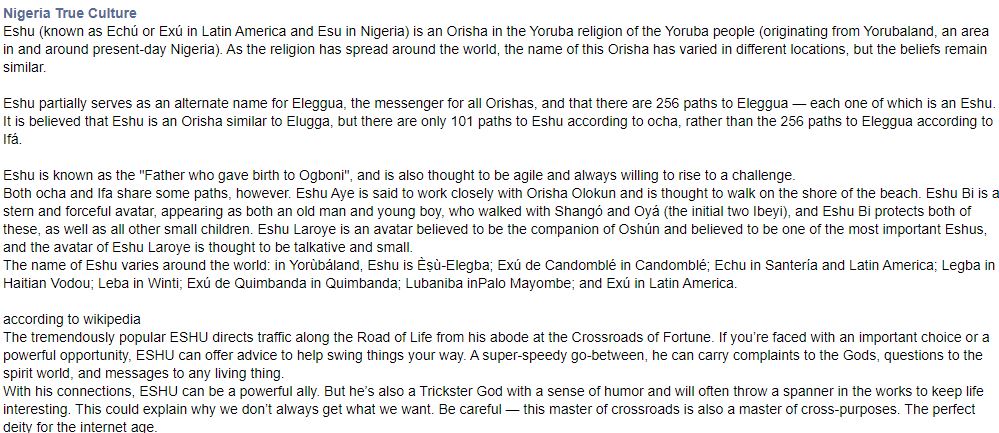
Some houses speak of many paths or caminos of Eshu and Elegba, including traditions that discuss 101, 256, or other counted forms depending on the lineage and system being referenced. The exact number is less important here than the principle: Eshu is not one flat function.
Different paths of Eshu may support different kinds of work: road opening, communication, defense, reversal, boundary protection, spiritual translation, opportunity, discipline, or the management of specific ritual gates. This is why Receiving Eshu should be matched to the person, the reading, the house, and the priestly function being developed.
Some better-known cultural names point to these functions. Esu Odara speaks to the beautiful, benevolent, well-ordered manifestation of Esu. Esu Laroye or Alaroye is often discussed as a messenger and speaker form, connected with communication and the movement of messages. Other names may point toward mountain, water, market, defense, or specific Orisha-related functions. The point is not to memorize names casually. The point is to understand that Eshu is received according to function, path, and need.
Who This Is For
This is for students preparing for Hand of Ifa, people whose readings identify Eshu / Elegba as a necessary point of support, practitioners experiencing road blockage, and those who need a cleaner relationship with communication, crossroads, choice, and spiritual consequence.
It is also for people who understand that road opening without character becomes chaos. Eshu opens the road, but the person must walk it correctly.
For a beginner-friendly companion post, read FAQ: Approaching Eshu for New Devotees. For a broader shrine-focused discussion, read Benefits of Receiving an Eshu Shrine.
Preparation and Cost
Receiving Eshu starts at $390. Final cost can vary depending on the path of Eshu, materials, ritual requirements, lineage instructions, and whether the receiving is bundled with Hand of Ifa or another priestly initiation.
Do not treat this as a casual purchase. Contact Ancestral Egbe to confirm whether Receiving Eshu is the correct next step, whether diagnosis is needed first, and what preparation applies.